
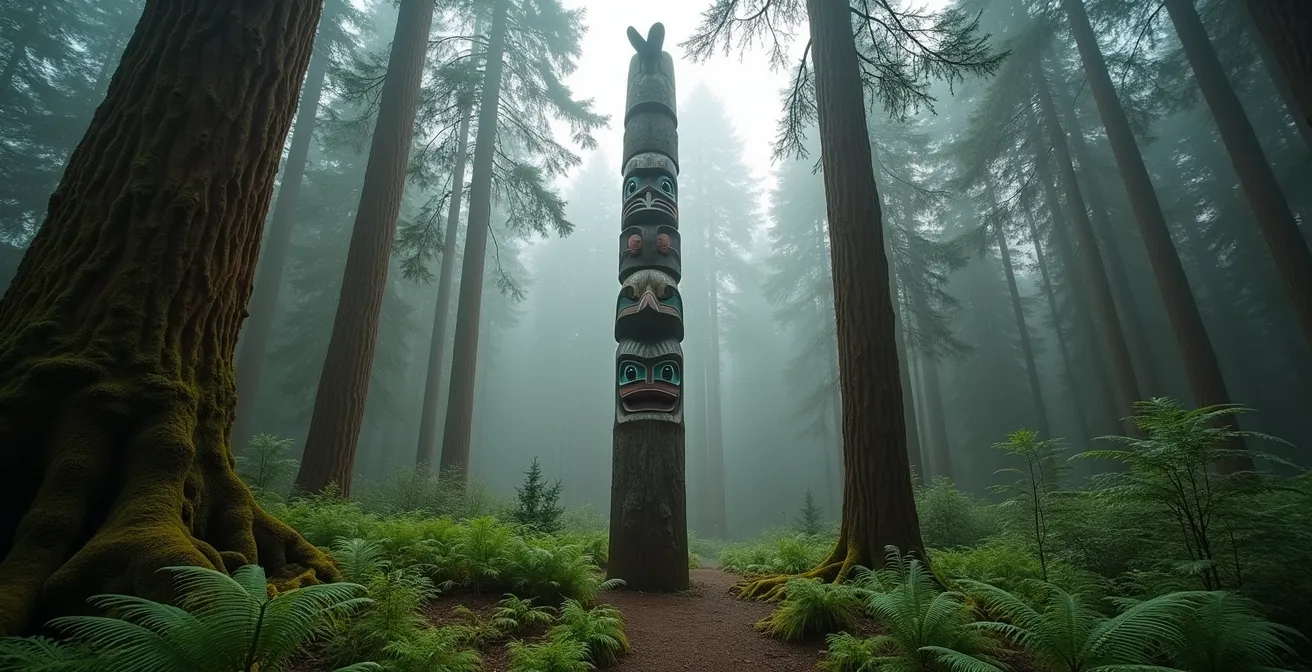
The most common mistake tourists make is believing the “low man on the totem pole” is the least important; in reality, the bottom figure is the foundation of the story and the most significant.
- Totem poles are not just art; they are complex visual documents asserting legal rights, lineage, and history.
- The meaning of a pole is inseparable from its context, whether it’s preserved in a museum or returning to the earth at a sacred site like SGang Gwaay.
Recommendation: To truly understand these monumental carvings, shift your perspective from passive observation to active interpretation by visiting Indigenous-led heritage sites and learning their visual language.
You stand before a towering cedar monument in British Columbia, a column of interlocking figures staring out with silent, painted eyes. You see a bear, a raven, a whale. You know it tells a story, but the narrative remains locked away. For many cultural tourists visiting Vancouver, Victoria, or the misty shores of Haida Gwaii, this is a familiar feeling: a mix of awe and incomprehension. The common advice is to “read the pole from the bottom up,” but this simple instruction barely scratches the surface. It’s like learning the alphabet without understanding how to form words or sentences. The truth is, these poles are not simple storybooks; they are a sophisticated form of visual grammar, communicating complex ideas about law, lineage, and spiritual inheritance.
Many guides focus on identifying the animal crests, but this is only the first step. To truly read a pole, one must look beyond the individual figures and understand their relationships, their position, and the very purpose for which the pole was raised. This involves decoding a language where a mortuary pole functions as a legal testament and a heraldic pole as a political declaration. It requires appreciating the monumental “social engineering” needed to raise a multi-tonne cedar log without modern machinery, an act that is as much a part of the story as the carvings themselves. The colours—traditionally black from charcoal, red from ochre, and turquoise from copper minerals—add emphasis, but the core narrative is in the formline design and structure.
But what if the key to unlocking these stories wasn’t in memorizing what each animal means, but in learning to see the pole as a complete, contextual statement? This guide will move beyond simple identification. We will explore the functional differences between pole types, the community power behind their creation, and the profound impact of their location—whether in a museum or in the wild. By understanding the visual language of West Coast First Nations art, you will learn to see not just a stack of figures, but a dynamic story of cultural jurisprudence carved in cedar.
This article provides a framework for interpreting these monumental works. By exploring the distinctions between pole types, the engineering of their raising, and the critical misconceptions about their hierarchy, you will gain the tools to engage with them on a much deeper level.
Summary: Decoding the Stories Carved in Cedar
- Why is a mortuary pole distinct from a heraldic pole?
- How does a community lift a tonne of cedar without cranes?
- UBC Museum of Anthropology or SGang Gwaay: which viewing context is more powerful?
- The linguistic error that reverses the actual meaning of the bottom figure
- When to photograph the poles at Stanley Park for the best relief shadows?
- Why does the Raven hold a different meaning than the Eagle in West Coast art?
- How to visually tell the difference between a managed forest and an ancient one?
- How to visit ‘Ksan or Wanuskewin to understand pre-contact Indigenous life?
Why is a mortuary pole distinct from a heraldic pole?
Not all totem poles serve the same purpose. Understanding the fundamental difference between a mortuary pole and a heraldic pole is the first step in correctly interpreting its story and significance. A heraldic pole, often facing the water, acts as a public declaration. It is a form of cultural jurisprudence, displaying a family’s crests to assert territorial rights, historical precedence, and social standing to all who arrive by canoe. It is a political statement, a billboard of lineage and legitimacy.
In stark contrast, a mortuary pole is an intensely personal monument. It serves as a memorial and often functions as a “last will and testament” for a high-ranking individual. These poles frequently feature a distinctive rectangular board or cavity at the top, which once held the remains of the deceased. Their purpose is to commemorate the life of the person and to formally transfer their spiritual names, rights, and privileges to their successor. Their placement reflects this private function; they are typically located at the edge of a village or near gravesites, not on the main shoreline.
Case Study: The Skedans Mortuary Pole
A powerful example of this distinction is the Skedans Mortuary Pole, whose replica now stands in Stanley Park. The original pole, carved around 1870 in the Haida village of Skedans, held the remains of the village’s chief in its top cavity. Its carved figures represented the chief’s lineage, serving to solidify the inheritance of his spiritual wealth by his successor. According to information from the Vancouver Park Board on its First Nations art, the original pole was eventually returned to Haida Gwaii, an act that respects its intimate memorial function, distinguishing it from the public-facing, political role of heraldic poles.
To differentiate them, look for visual and contextual clues. Check for a burial cavity at the top, note its orientation relative to the village and water, and consider the story it tells. Is it a broad claim of family history, or a focused commemoration of one individual’s legacy? Answering this question is key to reading the pole’s true intent.
How does a community lift a tonne of cedar without cranes?
The creation of a totem pole is a monumental undertaking that extends far beyond the master carver’s workshop. The final act, the pole raising, is a breathtaking display of what can be described as social engineering. It is a testament to a community’s strength, organization, and shared commitment, transforming the physical act of lifting into a powerful cultural ceremony. Without cranes or modern machinery, hundreds of people work in unison, guided by tradition, to hoist a log weighing many tonnes into the sky.
The technique relies on a combination of simple physics and immense, coordinated human power. A deep trench is dug to anchor the base of the pole. A-frame levers, known as sheer legs, are erected to provide mechanical advantage. Thick ropes, traditionally made from cedar bark, are attached to the pole. Then, at the direction of a leader who uses chants to synchronize the effort, hundreds of community members begin to pull. It is a moment of immense collective energy, where the pole’s story becomes interwoven with the living community that raises it.
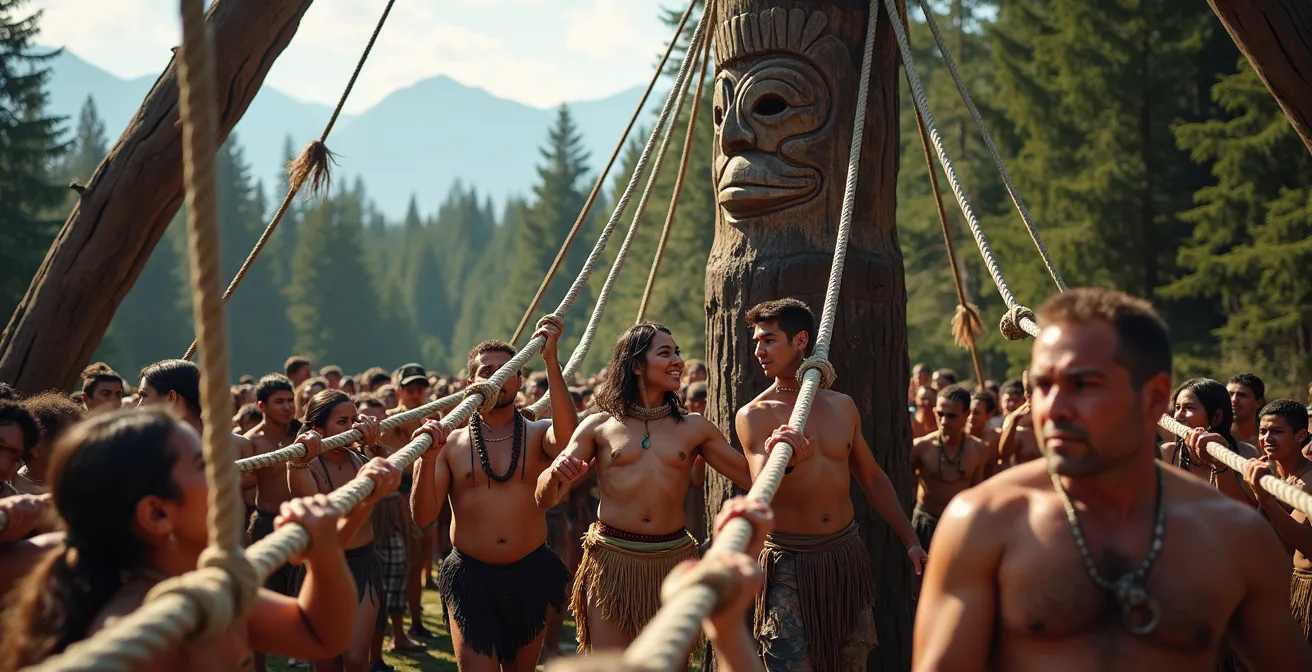
The 2017 raising of the Reconciliation Pole at the University of British Columbia serves as a spectacular modern example. As detailed in the project’s history, the 55-foot pole, carved by Haida master carver Chief James Hart, was raised using these traditional methods. It took the combined strength of hundreds of pullers generating an estimated 32,000 pounds of force to lift the pole in under 10 minutes. This event, described by UBC’s Indigenous Engagement office, wasn’t just about erecting a sculpture; it was a demonstration of the chief’s capacity to organize his community and a powerful symbol of unified purpose.
When you look at a pole, you are seeing not only the carver’s art but also the echo of this collective effort. The raising ceremony validates the pole’s message and the chief’s authority, proving that the strength of a community remains a more significant force than any machine.
UBC Museum of Anthropology or SGang Gwaay: which viewing context is more powerful?
A totem pole is not a static object; its meaning is profoundly shaped by its environment. A cultural tourist in British Columbia faces a choice: view these monuments in a climate-controlled museum or witness them in their original, natural setting. Each context offers a powerful but fundamentally different experience, highlighting the contrast between preservation and the concept of contextual integrity.
The UBC Museum of Anthropology (MOA) in Vancouver offers an unparalleled opportunity to see a vast collection of poles, protected from the elements. Here, in a curated space, you can appreciate the fine details of the carving, compare styles from different Nations, and learn from detailed interpretive panels. The museum’s role is one of eternal preservation, saving these masterpieces from decay. However, the experience is academic. The poles are artifacts, removed from the sounds of the ocean and the scent of the rainforest that shaped their stories. The visitor is a guest in a gallery, learning *about* a culture.
In contrast, visiting a site like SGang Gwaay on Haida Gwaii, a UNESCO World Heritage site, is an entirely different pilgrimage. Here, the poles stand silently in a moss-covered village, slowly being reclaimed by the forest. They are not preserved; they are living out their intended life cycle. This perspective is beautifully captured by the site’s guardians. As the Haida Gwaii Watchmen state, at SGang Gwaay, the poles are “returning to the earth, fulfilling their life cycle amidst the ecosystem they represent,” a powerful idea also noted by The Canadian Encyclopedia in its discussion on totem poles. Here, the visitor is an observer of a sacred process, welcomed *into* a conversation between the art and the land.
The choice between these two contexts depends on the visitor’s goal. For comparative study and detailed viewing, the museum is invaluable. For a spiritual and philosophical understanding of the Haida worldview, SGang Gwaay is irreplaceable.
| Aspect | UBC Museum of Anthropology | SGang Gwaay (Haida Gwaii) |
|---|---|---|
| Preservation State | Protected against decay, climate-controlled | Natural weathering, returning to earth |
| Sensory Experience | Curated space, interpretive panels, visitor buzz | Silent moss-covered village, ocean sounds, rainforest smell |
| Interpretation | Academic/museological approach | Direct connection through Haida Watchmen descendants |
| Cultural Philosophy | Eternal preservation focus | Natural life cycle and transformation (Haida beliefs) |
| Visitor Role | Museum guest, ‘learning about’ culture | Uninvited guest, ‘welcomed into’ conversation |
| Access | Year-round, urban location | Remote, weather-dependent, UNESCO site |
The linguistic error that reverses the actual meaning of the bottom figure
Perhaps the most pervasive and damaging misconception a visitor brings to a totem pole is the English idiom “low man on the totem pole.” This phrase, implying the least important person in a hierarchy, is a 20th-century American slang invention that has absolutely no connection to Indigenous culture. In fact, it represents a complete reversal of the truth. Within the visual grammar of a totem pole, the figure at the bottom is often the most important.
There are several critical reasons for this. First, the bottom figure is the foundation of the entire structure, both literally and narratively. It often represents the owner of the pole, the central character of the story being told, or the primary crest of the family. Second, from a carver’s perspective, the base of the pole is the most accessible. It is at eye level for the viewer and receives the most intricate, detailed, and expressive carving. Placing the key figure here ensures it is seen and appreciated up close.
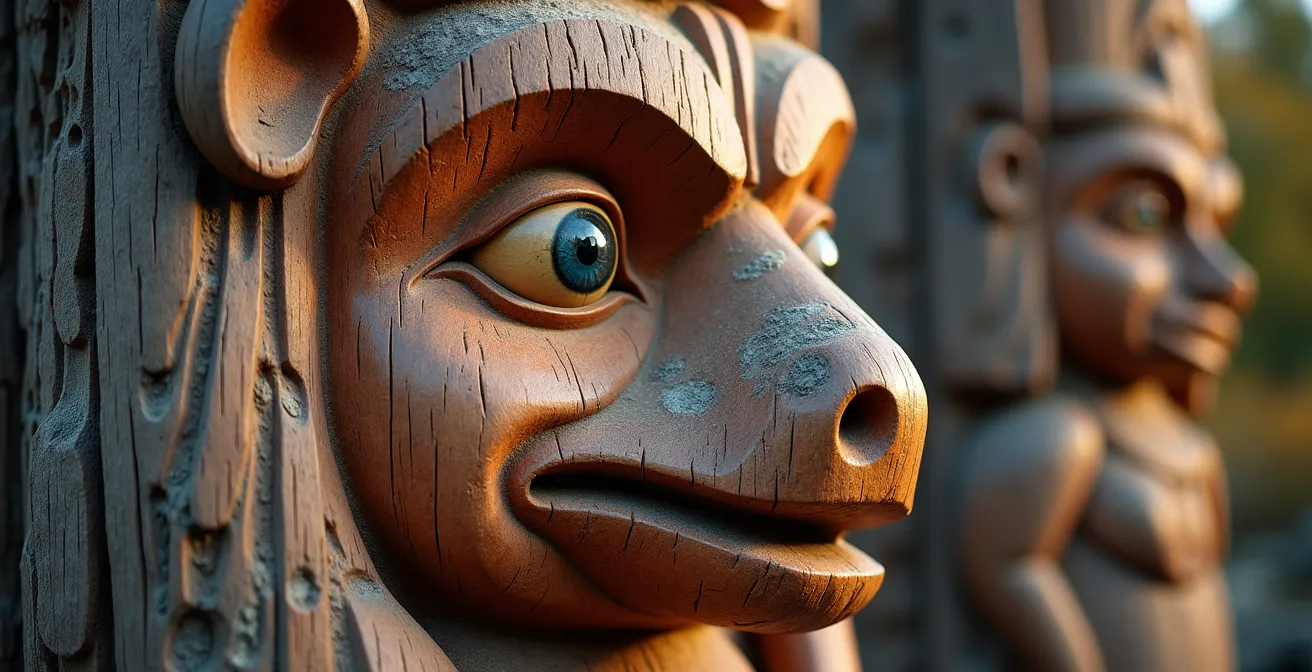
As analysis from sources like PBS’s Antiques Roadshow explains, Indigenous languages like Kwak’wala and Sm’algyax describe spatial relationships without imposing the vertical power hierarchies common in Western thought. The sequence of figures on a pole typically follows a narrative flow or establishes spiritual connections, not a power ranking from top to bottom. A visit to the Royal BC Museum in Victoria provides concrete proof: you can see numerous poles where the Bear Mother or another principal being is carved at the base, with the subsequent figures above her telling the chapters of her story. The bottom is the beginning, the anchor of the entire tale.
To correctly read a pole, one must mentally erase the English idiom and replace it with the proper cultural understanding: the base is the place of honour. It is the visual and symbolic foundation upon which the entire history, lineage, and story rests.
When to photograph the poles at Stanley Park for the best relief shadows?
The collection of nine totem poles at Brockton Point in Stanley Park is not only a stunning display of First Nations art but also British Columbia’s most-visited tourist attraction. For a photographer, capturing their grandeur requires more than just pointing and shooting. The key to a powerful image lies in understanding how light interacts with the carved cedar, and this is entirely dependent on the time of day and the season. The goal is to use light to create relief shadows that define the three-dimensional forms and bring the figures to life.
The best light for revealing the texture and depth of the carvings is directional, raking across the surface of the wood. Harsh, direct overhead light, such as that found at midday, will flatten the figures and wash out the details. Similarly, while late afternoon can create dramatic silhouettes against the sky, it will plunge the intricate fronts of the poles into shadow. The “golden hours” of early morning and, to a lesser extent, late afternoon are your greatest allies.
A wet, overcast day during Vancouver’s rainy season can also be a photographer’s secret weapon. Damp cedar becomes deeply saturated, making the colours of the paint pop with dramatic contrast. The soft, diffused light prevents harsh shadows and allows the subtle contours of the carving to emerge. Considering that Brockton Point’s 9 totem poles are BC’s most visited tourist attraction, timing your visit for early morning not only provides better light but also helps you avoid the largest crowds, allowing for cleaner, more contemplative shots.
Photographer’s Schedule for Stanley Park Brockton Point Poles
- Golden Hour Morning (7-9 AM summer, 8-10 AM winter): The eastern light illuminates the fronts of the poles with soft, defining shadows that are perfect for revealing shallow carving details.
- Mid-Morning (10 AM-12 PM): Provides even, bright lighting ideal for documenting the pole’s colours and overall composition without harsh shadows.
- Early Afternoon (1-3 PM): The sun is high and overhead, creating minimal shadows. This is the least ideal time for relief photography.
- Late Afternoon (4-6 PM): The sun is behind the poles, which is excellent for dramatic silhouettes but poor for capturing carving details.
- Winter Wet Season: Overcast days are a hidden gem. The damp wood shows deeper colour saturation and contrast, ideal for moody, artistic shots.
- Summer Dry Season: The wood appears lighter, which can make fine details more visible, lending itself well to documentary-style photography.
Why does the Raven hold a different meaning than the Eagle in West Coast art?
On the surface, Raven and Eagle appear as two of the most prominent birds in the pantheon of West Coast art. However, their significance goes far beyond that of mere symbols or “spirit animals.” In many First Nations, particularly the Haida and Tlingit, Raven and Eagle represent the two primary moieties: the fundamental kinship divisions that organize society. A person is born into either the Raven or the Eagle moiety through their mother’s line. This is not a choice; it is a core part of one’s identity that dictates social obligations, who one can marry (it must be someone from the opposite moiety), and rights to clan crests and resources. This is a foundational element of cultural jurisprudence.
Within this social structure, their narrative roles create a dynamic balance. The Raven is a complex figure, a cultural hero and a trickster. In many stories, it is Raven’s cunning and cleverness that brings light to the world, steals the sun, moon, and stars, and discovers the first humans in a clamshell. He is an agent of transformation, often bending the rules to bring about necessary change. The Eagle, by contrast, represents power, vision, and prestige. Flying closest to the Creator, it embodies chiefly authority and celestial power. It sees the world from a great height, symbolizing knowledge and foresight.
The “narrative tension” between them is a recurring theme. The stories are not about good versus evil, but about the essential balance between cunning and power, between the transformer and the authority. Visually distinguishing them is key to reading these stories in the art. According to resources from UBC’s Indigenous Foundations, the visual cues are clear once you know what to look for:
- Beak Shape: Raven is defined by a long, straight, and formidable beak. The Eagle has a shorter, sharply curved beak.
- Cultural Role: Raven is the trickster and transformer, while Eagle embodies celestial power and chiefly vision.
- Eye Design: Ravens are often depicted with round, intelligent eyes, whereas Eagles have fierce, angular eyes that convey authority.
- Wing Treatment: Raven’s wings might be shown folded or in a state of transformation, while an Eagle’s wings are often spread to show dominance.
When you see Raven and Eagle together on a pole, you are not just seeing two birds. You are witnessing a visual representation of the fundamental social structure and the philosophical balance between two essential forces that shape the world.
How to visually tell the difference between a managed forest and an ancient one?
A totem pole does not begin its life in the carver’s shed; it begins as a monumental Red Cedar in an ancient, old-growth forest. The very material of these poles is imbued with a spirit and history that is inseparable from their final form. For a cultural tourist traveling through British Columbia, learning to distinguish a truly ancient forest from a managed, second-growth forest deepens the appreciation for the origin of this art form. The visual clues are distinct and tell a story of either millennia of natural cycles or decades of human intervention.
A managed or second-growth forest is often characterized by uniformity. The trees are of a similar age and height, creating a single, dense canopy layer that blocks out light. The forest floor is often clear, sometimes with visible planting rows or leftover debris from logging. The biodiversity is limited, frequently dominated by a single species like Douglas Fir planted as a monoculture. It lacks the complex, layered structure of a forest that has evolved over centuries.
An ancient forest, by contrast, is a testament to complexity and diversity. It is a multi-generational community of trees. The canopy is uneven, with multiple layers created by trees of vastly different ages and heights, allowing complex patterns of light to dapple the forest floor. This floor is not flat but has a “pit-and-mound” topography created by fallen giants. It is covered in a deep, spongy layer of decomposing material and features “nurse logs”—fallen trees that become nurseries for new life. The presence of giant Western Red Cedars, some exceeding three meters in diameter, is a primary indicator. These ancient ecosystems also host unique indicator species, such as specific lichens and mosses that only grow on old bark.
This comparative table breaks down the key visual markers that can help you identify the type of forest you are in.
| Feature | Ancient Forest (Pacific Rim, Haida Gwaii) | Managed/Second-Growth Forest |
|---|---|---|
| Forest Floor | Deep spongy layer, nurse logs with new growth, pit-and-mound topography | Uniform floor, visible planting rows, logging debris |
| Canopy Structure | Multiple uneven layers, vastly different tree ages/heights, complex light patterns | Single uniform canopy layer, similar-aged trees, darker understory |
| Tree Diameter | Red Cedars >3 meters diameter common | Uniform smaller diameters, typically <1 meter |
| Indicator Species | Lobaria oregana lichen, old-bark specific mosses, rare fungi | Common pioneer species, limited moss/lichen diversity |
| Species Diversity | Mixed species, natural distribution patterns | Often monoculture (e.g., Douglas Fir), planted in rows |
| Dead Wood | Abundant standing snags and fallen logs at various decay stages | Minimal dead wood, cleared for management |
Key Takeaways
- The most important figure on a totem pole is at the bottom, serving as the narrative and structural foundation.
- Totem poles function as complex legal and social documents (heraldic) or as deeply personal memorials (mortuary), not just decorations.
- The context in which a pole is viewed—preserved in a museum versus decaying naturally in its original location—fundamentally changes its meaning.
How to visit ‘Ksan or Wanuskewin to understand pre-contact Indigenous life?
After learning to decode the visual language of totem poles, the next logical step is to immerse yourself in the living cultures that create them. Visiting Indigenous-led heritage sites is the most respectful and powerful way to deepen your understanding. In Canada, sites like ‘Ksan Historical Village in British Columbia and Wanuskewin Heritage Park in Saskatchewan offer two distinct but equally profound windows into Indigenous life, both past and present. They transform the tourist from a passive observer into an active participant in cultural continuity and reconciliation.
‘Ksan, located near Hazelton, BC, is a replicated Gitxsan village from the period around European contact. It features stunning traditional longhouses, totem poles, and active carving demonstrations. It offers an immersive experience of West Coast life, bringing the social structures and artistic traditions to life. In contrast, Wanuskewin, near Saskatoon, is not a replica but an actual archaeological site with a history spanning over 6,000 years. It represents the continuous presence of Northern Plains Indigenous peoples. Here, you walk on the same land where bison hunts and ceremonies took place for millennia. The key distinction is reconstruction versus authentic ancient grounds.
Both sites move beyond a static “pre-contact” narrative to connect history with contemporary reality. ‘Ksan is deeply connected to the landmark Delgamuukw land rights case of the Gitxsan people, while Wanuskewin’s recent reintroduction of bison links ancient ecological practices with modern conservation. The significance of these places extends beyond education; as a 2023 report highlighted by publications like National Geographic confirms, Indigenous tourism is a vital economic force. In fact, a recent analysis showed Indigenous tourism contributed over $1.2 billion in revenue and supported tens of thousands of jobs in Canada.
Your Action Plan: Respectful Visitor Guidelines for Indigenous Heritage Sites
- Book a guided tour: Always opt for tours led by Indigenous interpreters to hear the stories from the people themselves and directly support Indigenous employment.
- Visit the gift shop as a gallery: Treat these spaces as opportunities to support local Indigenous artists by purchasing authentic work, not as simple souvenir stands.
- Do your homework: Before visiting, research the specific Nation’s history and current issues to understand the contemporary context of the stories you will hear.
- Ask for permission: Always ask before photographing individuals, ceremonies, or sacred spaces. Respect that some areas and objects may be off-limits to photography.
- Engage with purpose: View your visit as an act of reconciliation and active participation, not just passive historical tourism. Your presence and support matter.
Your journey from a curious tourist to an informed interpreter begins now. By engaging with these sites respectfully, you not only enrich your own understanding but also contribute to the vitality and continuity of these foundational cultures.