
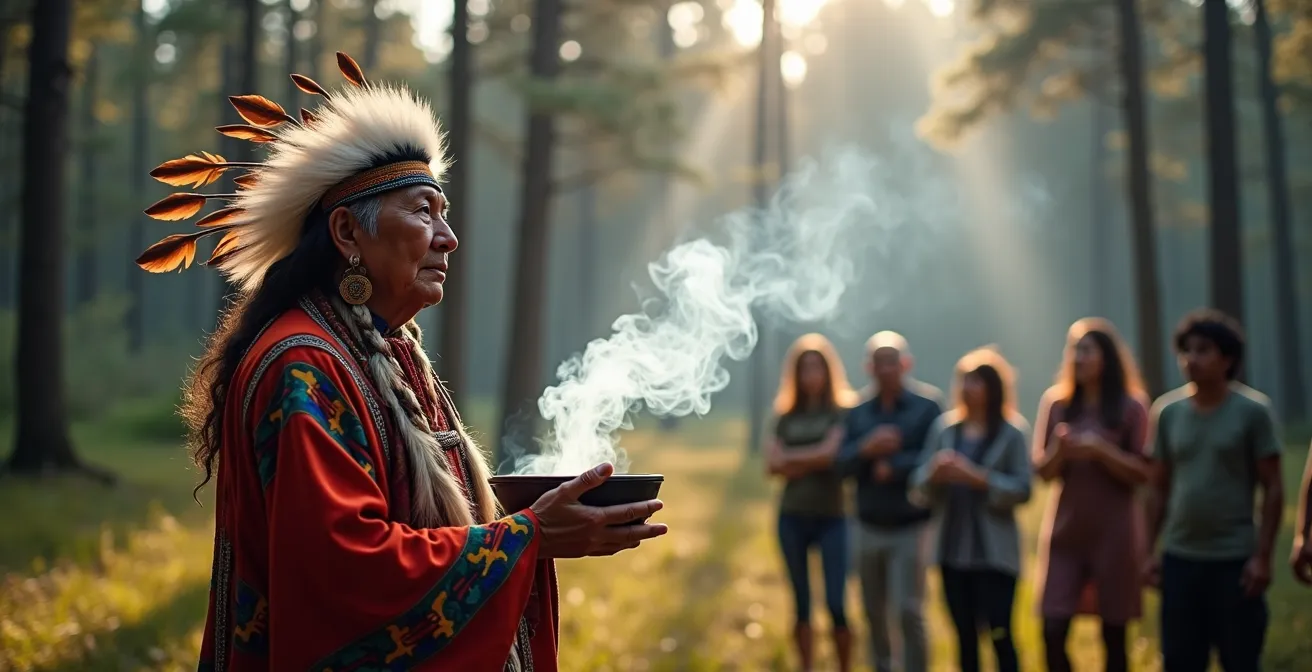
True engagement with Indigenous tourism isn’t a checklist of ‘dos and don’ts’; it’s about understanding the deep-rooted ‘why’ behind each protocol.
- Respectful interaction is based on reciprocity and recognizing living, sovereign cultures, not just historical artifacts.
- Economic support through certified businesses is a direct act of reconciliation, countering appropriation and stereotypes.
Recommendation: Shift from a consumer mindset to that of a guest. Your goal is not just to see, but to learn and build a relationship.
Welcome. If you are reading this, you are likely seeking more than just a vacation. You are looking for a connection, for understanding, and to participate in the vital journey of reconciliation here in Canada. This desire is the first and most important step. Many guides will offer simple lists of things to do, but genuine respect is not born from a checklist. It is born from understanding the ‘why’—the history, the worldview, and the living sovereignty of the First Nations, Métis, and Inuit peoples whose lands you wish to visit. It is about understanding the concept of relationality, where we are all connected and have responsibilities to each other and the land.
The path of reconciliation is complex. As Rebecca Godfrey of CBRE Tourism Consulting notes, “The unmarked graves found across the country have made it clear that there is an urgent need for all of us to partake in reconciliation.” Tourism, when approached with intention, can be a powerful bridge. It can move us beyond the headlines and into a space of shared humanity. However, it can also, if done poorly, reinforce colonial attitudes and cause harm.
This guide is built on a different premise. Instead of just telling you *what* to do, we will explore *why* these protocols exist. We will move beyond the surface-level performance of respect to cultivate a deeper understanding. We will explore the difference between viewing culture as a static artifact and engaging with it as a living, breathing entity. Our goal is to shift your perspective from that of a tourist who consumes, to that of a guest who learns, respects, and participates in an act of reciprocity. This journey is about building relationships, not just taking pictures. Let’s walk this path together.
This article will guide you through the essential principles and practical steps for engaging respectfully with Indigenous communities across Canada. From understanding foundational concepts to participating in cultural events, you will gain the insight needed to be a true ally.
Summary: A Guide to Respectful Indigenous Tourism in Canada
- Why do events in Canada start with acknowledging traditional territory?
- How to greet an Elder respectfully when visiting a community?
- Artifacts or interaction: which offers a deeper understanding of current realities?
- The “costume” mistake that offends community members
- How to find and support businesses certified by the Indigenous Tourism Association of Canada?
- Haida Gwaii or Torngat Mountains: which remote cultural site changes your worldview?
- The ignorance error of assuming all Indigenous people live in rural poverty
- How to attend a Powwow as a non-Indigenous guest without breaking protocol?
Why do events in Canada start with acknowledging traditional territory?
A Land Acknowledgment is an act of reconciliation that recognizes the traditional territory of the Indigenous people who have stewarded the land since time immemorial. It is a formal statement that serves as a starting point, a conscious and deliberate effort to counter the colonial doctrine of “terra nullius” (nobody’s land) and to recognize the enduring relationship that exists between Indigenous Peoples and their territories. It is more than just a formality; it’s a step toward honouring the truth.
However, an acknowledgment without action is just performative. The Truth and Reconciliation Commission’s Call to Action #92 urges the corporate sector to build respectful relationships, yet progress is slow. Research from Indigenous Works shows that 85% of Canadian businesses are not engaged with Indigenous communities. This highlights a significant gap between words and deeds. For a traveler, this means your acknowledgment should be linked to a personal commitment to learn more and act in solidarity.
A meaningful acknowledgment is specific. It names the treaty and the specific Nations whose land you are on (e.g., “I am speaking to you from the traditional, ancestral, and unceded territory of the Musqueam, Squamish, and Tsleil-Waututh Nations”). It reflects personal research and an understanding that you are a guest on these lands. This act of naming is an act of restoring presence to peoples who have been systematically erased from the narrative of this country.
The goal is to internalize this practice. It’s not just for events but can be part of your email signature or the beginning of a conversation. It’s a constant reminder of the history beneath your feet and the responsibility that comes with being on this land. It is the first step in building a relationship based on respect and truth.
How to greet an Elder respectfully when visiting a community?
Approaching an Elder is a moment that calls for humility, patience, and an understanding of protocol. Elders are revered as knowledge keepers, librarians of oral history, and spiritual guides for their communities. They are not simply “older people”; they hold a specific and earned role of immense importance. Greeting them is not a casual act but an entry into a system of knowledge transfer that has existed for millennia.
The most important principle is to approach with humility. You are a guest entering a different cultural space. It’s perfectly acceptable to state your position clearly and respectfully, for example, “Hello, my name is [Your Name]. I am new to your community’s protocols and I wish to be respectful. I am honoured to meet you.” This shows you are not making assumptions and are open to guidance. Patience is equally critical; never interrupt an Elder when they are speaking. The pauses and silence are as much a part of the communication as the words themselves.
In many First Nations cultures, it is customary to offer a gift when seeking knowledge or teachings from an Elder. This is a fundamental act of reciprocity. The most traditional gift is tobacco (semaa in Anishinaabemowin), which is considered a sacred medicine used for prayer and connection to the spirit world. It is offered as a sign of respect and an exchange for the wisdom you hope to receive. The gift is not a payment but a physical manifestation of your gratitude and respect for the Elder’s time and energy. If you are attending a formal teaching session, an honorarium (a monetary gift) is also appropriate and should be arranged beforehand.
Differentiate between a casual social greeting and a formal request for knowledge. A simple, warm hello is fine in passing. But if you wish to ask significant questions or learn a story, you must follow the protocol of offering a gift. By doing so, you are not just being polite; you are honouring a sacred tradition and validating the immense value of the knowledge the Elder carries.
Artifacts or interaction: which offers a deeper understanding of current realities?
Museums have historically played a complicated role in representing Indigenous cultures, often presenting them as a static, vanished people through collections of artifacts. While these objects are beautiful and hold immense historical value, they can reinforce the idea of a culture frozen in time. A deeper understanding of current realities comes from engaging with living history—the people, stories, and contemporary expressions of culture that are thriving today.
The contrast is stark. An artifact behind glass is an object of observation, often disconnected from its original purpose and community. An interaction with a knowledge keeper, an artist, or a guide, however, is a multi-sensory experience. It connects you to the stories, songs, and ceremonies that give the “artifact” its life and meaning. It is the difference between seeing a bentwood box in a display case and hearing about how it is used today in a community feast, feeling its spiritual significance.
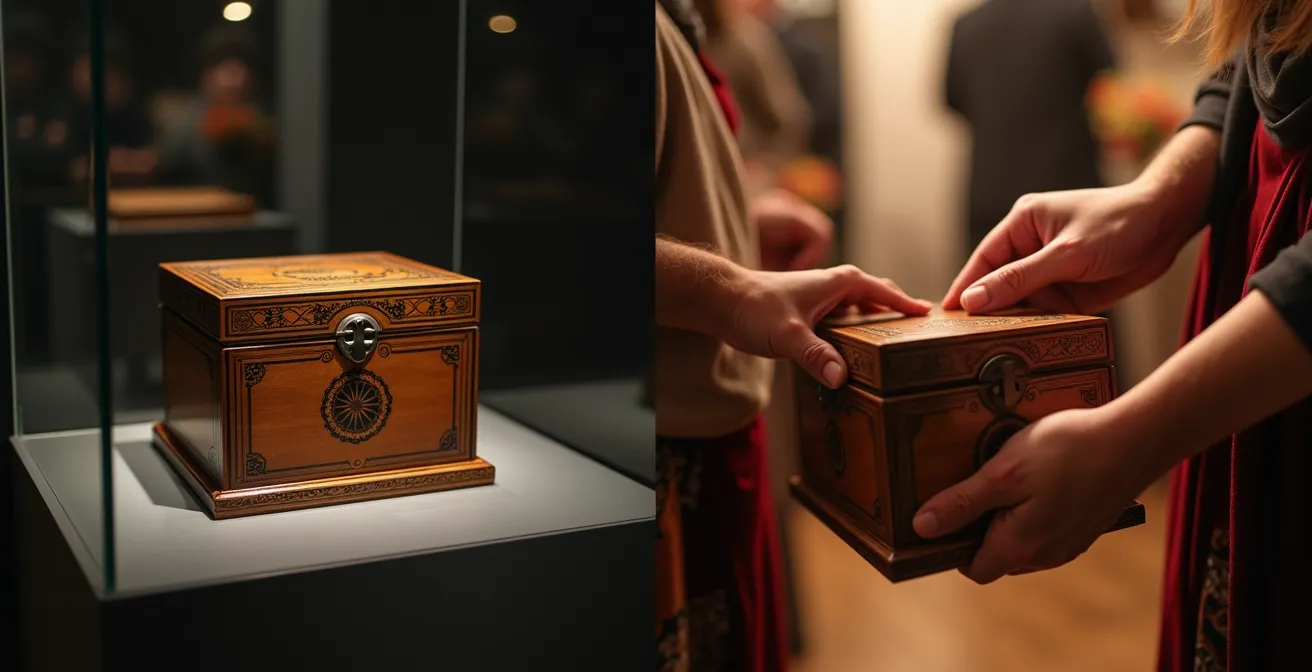
This image perfectly illustrates the difference between passive observation and active engagement. Living culture is not confined to the past; it is a dynamic force that addresses contemporary issues, from language revitalization and land rights to entrepreneurial success. Engaging with living culture allows you to understand the challenges and triumphs of Indigenous peoples today, recognizing their resilience and cultural sovereignty.
The following table, based on insights from Destination Indigenous, clarifies this crucial distinction and why prioritizing interaction is key to meaningful reconciliation.
| Museum Artifacts | Living Interactions |
|---|---|
| Static representation of history | Dynamic contemporary culture |
| Often represents colonial extraction | Active cultural sovereignty and reclamation |
| Limited to visual observation | Multi-sensory engagement with stories, songs, ceremonies |
| Historical context only | Current issues: language revitalization, water rights, business success |
| Public domain assumption | Understanding of intellectual/cultural property ownership |
Case Study: The Woodland Cultural Centre
A powerful example of bridging this gap is the Woodland Cultural Centre in Brantford, Ontario. Located on the site of the former Mohawk Institute Residential School, it not only houses over 50,000 artifacts but also brings history to life. The Centre offers a virtual tour of the former school featuring the direct testimonies of five survivors, transforming a historical site into a powerful, living lesson on resilience and the ongoing impacts of colonialism.
The “costume” mistake that offends community members
One of the most significant and hurtful mistakes a non-Indigenous person can make is treating culturally sacred items as a “costume.” Wearing a headdress (war bonnet) or other items of regalia is a profound act of disrespect. These are not accessories; they are deeply spiritual items that are earned through specific actions, deeds, or a recognized position within a Nation. A headdress, for example, is a high honour, akin to a decorated military uniform, and each feather may represent a specific act of courage or service to the community.
To wear it as a costume is to trivialize its meaning, erase its history, and perpetuate a harmful caricature of Indigenous identity. This act is a form of cultural appropriation—taking from a marginalized culture without permission or understanding, and in a way that reinforces stereotypes. It reduces a complex and diverse group of peoples to a single, monolithic image, often rooted in Hollywood’s misrepresentations.
So, how does a respectful guest show appreciation for the beauty of Indigenous artistry without crossing this line? The answer lies in shifting from appropriation to support. Your role as an ally is to become a conscious consumer and supporter of authentic Indigenous art and design. This is a direct and powerful act of economic reconciliation. By purchasing authentic items, you are helping to preserve cultural traditions and supporting the livelihoods of artists and their families.
Instead of buying a mass-produced knock-off headdress at a festival, you can invest in a piece of authentic beadwork, a contemporary fashion item from an Indigenous designer, or a print from a First Nations artist. This supports cultural sovereignty by ensuring that Indigenous peoples are the ones controlling and benefiting from their own cultural expressions.
Your Action Plan: Supporting Indigenous Artists Authentically
- Purchase authentic items directly from Indigenous artists or shops certified by the Indigenous Tourism Association of Canada (ITAC).
- Support businesses and galleries that champion Indigenous art, such as the Bill Reid Gallery in Vancouver or the online ITAC Marketplace.
- Internalize the understanding that regalia are earned spiritual items, not costumes to be worn by outsiders.
- Actively avoid mass-produced knock-offs, which often steal designs and always undercut the livelihoods of Indigenous artisans.
- Invest in contemporary Indigenous fashion designers as an act of allyship, celebrating modern cultural expression, not appropriating it.
How to find and support businesses certified by the Indigenous Tourism Association of Canada?
Supporting Indigenous-owned businesses is one of the most direct and impactful ways to contribute to reconciliation. It shifts the dynamic from passive observation to active economic partnership, empowering communities to share their culture on their own terms. The Indigenous tourism sector is a vital part of Canada’s economy, and your choices as a traveler matter. As Keith Henry, President and CEO of the Indigenous Tourism Association of Canada (ITAC), states, ” Indigenous tourism has really helped to differentiate Canada as a cultural destination for visitors.”
The best way to ensure your money is supporting authentic experiences is to seek out businesses certified by ITAC. ITAC has established a national standard for quality and authenticity through its “Original Original” brand. This accreditation guarantees that the business is at least 51% Indigenous-owned and delivers an experience that is both market-ready and culturally appropriate. This takes the guesswork out of your planning and ensures you are connecting with genuine cultural ambassadors.
The economic impact of this sector is significant. In 2023, the Conference Board of Canada reported that the Indigenous tourism sector was projected to contribute $3.7 billion in revenue and support 34,700 jobs. By consciously choosing ITAC-certified businesses, you are directly contributing to Indigenous self-determination, job creation, and the revitalization of culture and language.
Finding these businesses is straightforward. The primary tool for travelers is the Destination Indigenous website, ITAC’s consumer-facing platform. It functions as a trip planner, allowing you to discover a wide range of experiences across the country. Your support doesn’t have to end when your trip does; many of these businesses also offer online shops where you can continue to purchase authentic art and products.
Your Action Plan: Using the Destination Indigenous Planner Effectively
- Visit DestinationIndigenous.ca to find businesses and experiences that carry the “Original Original” seal of certification.
- Use the filters to search for experiences by province/territory and by type (e.g., Culture, Nature, Reconciliation).
- Understand the difference between ITAC’s accreditation levels: “Market-Ready” businesses meet tourism standards, while “Experience-Ready” businesses offer a higher level of visitor services.
- When planning, remember the diversity of nations. An itinerary can respectfully include distinct cultures like Wendat, Mi’kmaq, or Squamish, each with its own protocols and stories.
- Continue your support after your visit through online purchases from their marketplaces, following them on social media, and leaving detailed, thoughtful reviews.
Haida Gwaii or Torngat Mountains: which remote cultural site changes your worldview?
To truly move beyond stereotypes, one must appreciate the immense diversity of Indigenous Nations across Canada. There is no single “Indigenous experience.” A visit to Haida Gwaii, off the coast of British Columbia, and a journey to the Torngat Mountains National Park in Nunatsiavut and Nunavik offer profoundly different, yet equally transformative, lessons in worldview, governance, and humanity’s relationship with the land.
Haida Gwaii is an archipelago that pulses with the energy of cultural and political resurgence. The Haida Nation’s co-management of the Gwaii Haanas National Park Reserve is a powerful model of self-determination. Here, the story is one of resilience and revival. You will see new totem poles being raised, hear the Haida language being spoken, and feel the strength of a Nation that is actively reclaiming its sovereignty. The journey to get there reinforces its identity as a world apart, and the worldview lesson is one of political strength and the power of a people to reclaim their future.
The Torngat Mountains, by contrast, offer a lesson in timeless spirituality and humility. This is one of the most remote places on Earth, a landscape of stark, powerful beauty where the Inuit have lived for millennia. Tourism here is a fragile presence, managed cooperatively with the Inuit of Nunatsiavut and Nunavik. Accessibility is extremely limited, and every visitor must be accompanied by an armed Inuit bear guard, a constant reminder of the raw power of nature. The worldview lesson here is about humanity’s small place within a vast and powerful natural order, and the deep spiritual connection required to survive and thrive in such an environment.

Both experiences are profound acts of decolonization for the visitor. They dismantle the notion of a monolithic Indigenous identity and replace it with a rich tapestry of distinct governance models, cultural priorities, and spiritual philosophies, as detailed in the following comparison.
| Aspect | Haida Gwaii | Torngat Mountains |
|---|---|---|
| Governance Model | Co-management with Council of Haida Nation | Co-operative management with Inuit of Nunatsiavut/Nunavik |
| Cultural Focus | Resilience and revival (new totem poles, language revival) | Timeless spirituality and land connection |
| Tourism Impact | Key part of modern economy supporting cultural programs | Fragile presence in pristine UNESCO environment |
| Accessibility | Journey reinforces ‘world apart’ identity | Extreme remoteness requiring Inuit guide survival skills |
| Worldview Lesson | Political resurgence and self-determination | Humanity’s place within powerful nature |
The ignorance error of assuming all Indigenous people live in rural poverty
One of the most persistent and damaging stereotypes is the image of Indigenous peoples living exclusively in remote, rural poverty. This narrative is not only false but it also erases the vibrant, diverse, and successful reality of Indigenous life in Canada today. It is an error rooted in ignorance, one that is easily corrected by looking at the facts and celebrating Indigenous success stories.
The first fact to dismantle this myth is demographic. The reality is that Indigenous peoples are increasingly urban. Statistics show that over 50% of Indigenous Peoples in Canada live in cities, creating dynamic urban communities with rich cultural centers, businesses, and social enterprises. Indigenous identity is not tied to a rural geography; it is a living culture that adapts and thrives in all environments. Assuming otherwise is to deny the modern reality of millions of people.
The second fact is economic. The narrative of universal poverty ignores the tremendous economic growth and contribution of Indigenous peoples to the Canadian economy. Far from being a drain on the economy, Indigenous businesses and communities are powerful drivers of prosperity. According to the National Indigenous Economic Development Board, the Indigenous GDP, or ‘Indigenous economy,’ saw remarkable growth, reaching $97.0 billion by 2020. This represents a significant and growing contribution to Canada’s overall economic fabric.
Indigenous entrepreneurship is flourishing, particularly in the tourism sector. From high-end thermal spas like the Dakota Dunes in Saskatchewan to luxury hotels like the Hôtel-Musée Premières Nations in Quebec, Indigenous business leaders are creating world-class experiences that celebrate culture while creating jobs and opportunities. Recognizing and supporting this economic sovereignty is a crucial part of reconciliation. It means seeing Indigenous peoples not as subjects of pity, but as innovative and successful partners in building a more prosperous and equitable Canada.
Key Takeaways
- A Land Acknowledgment is the start of a conversation, not the end. It requires action.
- Shift focus from static artifacts to living interactions, recognizing Indigenous peoples as contemporary, sovereign nations.
- Financial support for authentic, Indigenous-owned businesses is one of the most powerful forms of allyship.
How to attend a Powwow as a non-Indigenous guest without breaking protocol?
A Powwow is a beautiful, powerful, and joyous celebration of Indigenous culture, resilience, and community. It is a time for people to come together to sing, dance, and honour their traditions. As a non-Indigenous guest, you are often welcome, but it is crucial to attend with an attitude of respect and a willingness to follow protocol. You are entering a sacred space, and your conduct should reflect that understanding.
The most important person to pay attention to is the Master of Ceremonies (MC). The MC is your guide for the entire event. They will announce what is happening, explain the significance of different dances and songs, and will let you know when it is appropriate to stand, when to remove your hat, and when photography is not permitted. Listen to the MC above all else. They will guide you through the protocols of the day.
Case Study: Manito Ahbee Festival
The Manito Ahbee Festival in Winnipeg is a prime example of an inclusive cultural celebration. Held annually on a sacred gathering site, it unites residents and visitors through a large pow wow, an Indigenous marketplace, and other events. Its creators explicitly recognize the site as ‘a sacred place for all people,’ modelling how these events can be powerful bridges between cultures when approached with respect.
The central element of the Powwow is the drum. The drum is considered the heartbeat of the Nation, a sacred living entity. Never touch a drum unless you are explicitly invited to do so by the drum keeper. Similarly, the dancers’ regalia are sacred items, imbued with spirit and story. Never touch a dancer’s regalia without permission. By observing these protocols, you are showing the highest respect for the spiritual foundations of the celebration.
Your Action Plan: Essential Powwow Protocols for Guests
- Recognize the Grand Entry as a sacred prayer, not a parade. Stand, remove your hat (if you are a man), and do not take photos during this time.
- Understand the drum as the “heartbeat of the Nation.” Never touch a drum or the drum arbor without explicit permission from the drum group.
- Listen carefully to the MC (Master of Ceremonies). They are your guide for all protocols, announcements of sacred moments, and when to participate.
- Support the Powwow economy. Purchase food from the food trucks and buy arts and crafts directly from the Indigenous vendors at the marketplace.
- Bring your own chair for seating. Be prepared to offer your seat to an Elder if they need one, as this is a significant sign of respect.
- For photography, general shots of the arena are usually acceptable. Never take close-up photos of individuals, especially children, without asking for their explicit permission first.
The next step is yours. Use the Destination Indigenous planner to find an experience near you, and begin your journey not as a tourist, but as a respectful guest ready to learn. Your journey of reconciliation starts now.