
In summary:
- Respect goes beyond a checklist; it’s about understanding the “why” behind the protocols you observe.
- Always ask for permission before photographing a dancer or their regalia, and know when it’s inappropriate to even ask.
- Identify the type of event you’re attending—a large competition or a smaller traditional gathering—to align your expectations.
- The Grand Entry is the most sacred part of the day; plan to arrive early and follow the community’s lead for when to stand.
- The best preparation is learning about the local Indigenous history and culture in the territory you are visiting *before* you arrive.
Receiving an invitation to a Powwow, or seeing a public notice for one, is an honour and a wonderful opportunity to witness a vibrant, living culture. You feel the excitement, the pull of the drum, and the beauty of the regalia. But alongside that excitement often comes a quiet anxiety: “What are the rules? What if I do something wrong? How can I be a good guest?” Many online guides offer simple lists of dos and don’ts, but these can feel like trying to memorize a test. They tell you *what* to do, but rarely *why*.
The truth is, being a respectful guest isn’t about perfectly following a rigid set of rules. It’s about arriving with a foundation of understanding. It’s about shifting your perspective from that of a spectator at a performance to a guest in a community’s home. When you understand the spirit behind the protocols—the deep respect for the drum, the personal significance of regalia, the sacred nature of the dance arbor—acting correctly becomes intuitive. This is not a performance for an audience; it is a celebration of life, spirit, and resilience you are being welcomed into.
This guide is designed to give you that foundational knowledge. We, as organizers, want you to feel welcome and confident. By exploring the meaning behind the traditions, you’ll be able to participate with an open heart and genuine respect, which is the most important protocol of all. We’ll explore the spiritual core of the event, the etiquette around photography and different types of gatherings, and finally, how understanding the deep history of the land is the first step to being the best possible guest.
To help you navigate your visit, this article will walk you through the key aspects of a Powwow, from the central role of the drum to the protocols of the Grand Entry and beyond. Let’s begin this journey of respectful understanding.
Summary: Your Guide to Attending a Powwow with Understanding
- Why is the drum considered the heartbeat of the nation?
- How to ask for permission before photographing dancers or regalia?
- Prize money or spiritual gathering: which event offers the vibe you seek?
- The boundary mistake that is considered highly disrespectful
- When to arrive to witness the most important part of the ceremony?
- When to visit city squares to see modern musical performances on June 21st?
- Street party or sunset beach vibe: which celebration fits your style?
- How to visit ‘Ksan or Wanuskewin to understand pre-contact Indigenous life?
Why is the drum considered the heartbeat of the nation?
Before you see anything else, you will hear the drum. It is a powerful, resonant sound that travels through the ground and into your chest. This is by design. The drum is far more than a musical instrument; it is the sacred centre of the Powwow, the pulse that connects dancers to the earth and to each other. It is often called the heartbeat of the Nation, and every song it plays carries stories, prayers, and history. Each drum has a keeper, and the drum itself is treated as a living entity, with its own protocols and spirit.
Drum groups, like Alberta’s celebrated Northern Cree, are families and communities unto themselves. They are the keepers of songs passed down through generations. Their very existence is a testament to cultural resilience. For a period of 75 years under Canada’s Indian Act, from 1876 to 1951, ceremonies like the Powwow were actively suppressed by the government. The resurgence of drumming and dancing is a powerful reclamation of sovereignty and identity.
The drum is the heartbeat of a powwow, and some drums have traditions that dictate it can never be left unattended.
– Indigenous Community Protocols, Indigenous Powwow Protocol Guide
As a guest, the best way to show respect is to give the drum and its players space. Don’t crowd them, touch the drum, or place any objects on it. When a song moves you, listen with your full attention. You are hearing more than music; you are hearing the enduring heartbeat of a people.
How to ask for permission before photographing dancers or regalia?
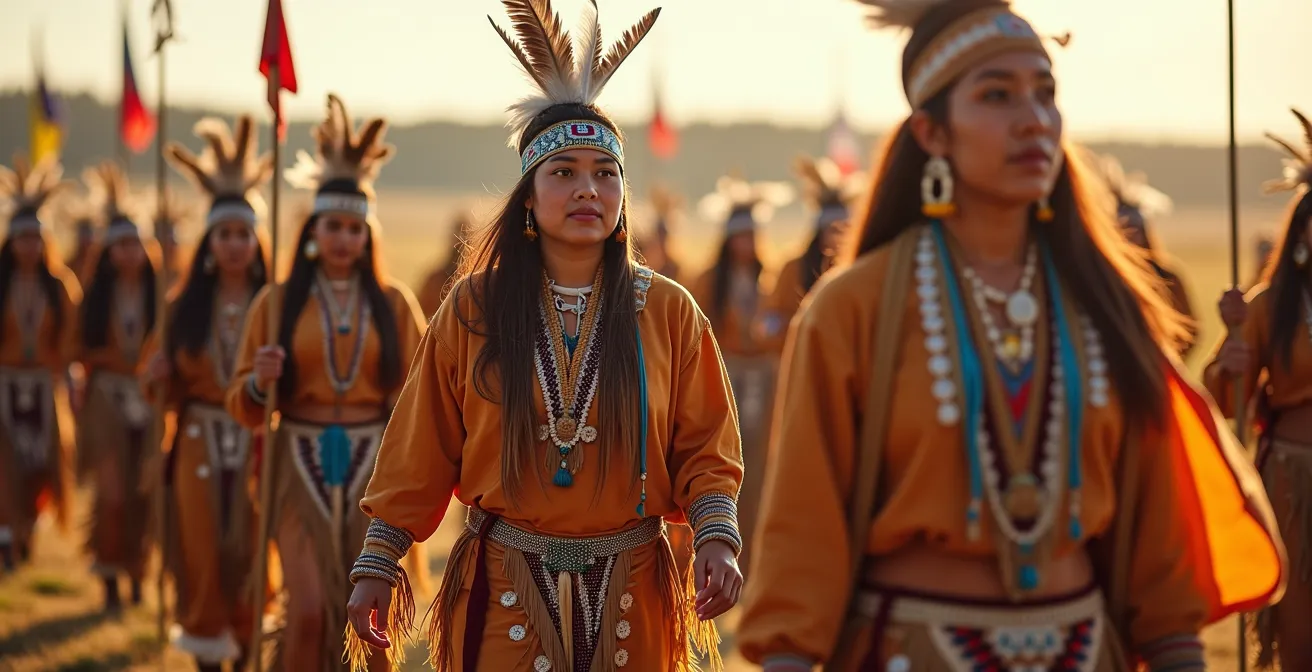
The vibrant colours, intricate beadwork, and powerful movement of the dancers are visually stunning, and the natural impulse is often to capture that beauty. However, a dancer’s regalia is not a costume. It is a deeply personal, often sacred, collection of items that can represent their family, clan, spirit helpers, and personal journey. Many pieces are priceless heirlooms passed down through generations or gifts of great significance. Therefore, photography requires a mindful and respectful approach.
The cardinal rule is to always ask for permission before taking a photo of an individual. A great time to do this is when a dancer is outside the main dance arbor, resting between songs. Never interrupt someone who is preparing, praying, or in the middle of a dance. A simple, polite question like, “Your regalia is so beautiful. Would you be comfortable if I took a photo?” goes a long way. If they decline, thank them for their time and move on without question. If they agree, it’s a kind gesture to ask if they have a social media handle you can use to tag them, so they can see and share the photo themselves.
The Master of Ceremonies (MC) is your best guide. They will often announce when photography is welcome, such as during an “Intertribal” dance where everyone is invited to join. They will also announce when it is strictly forbidden, such as during a prayer, an honour song, or a healing ceremony. Putting your camera away during these moments is a critical sign of respect.
To help clarify, here is a guide on the appropriate moments for photography:
| Appropriate Times | Never Appropriate |
|---|---|
| When dancers are resting outside the arbor | During prayer or blessing ceremonies |
| During intertribal dances | When dancers are preparing or adjusting regalia |
| After receiving explicit permission | During Grand Entry without MC approval |
| When MC announces photo time | When an eagle feather has fallen |
Prize money or spiritual gathering: which event offers the vibe you seek?
Not all Powwows are the same, and understanding the difference between a “competition” and a “traditional” Powwow will help you choose an event that aligns with the experience you are seeking. Both are powerful cultural celebrations, but they have different focuses and energies. A large, well-known event might be a competition Powwow, while a smaller gathering on a First Nation’s territory is more likely to be a traditional one.
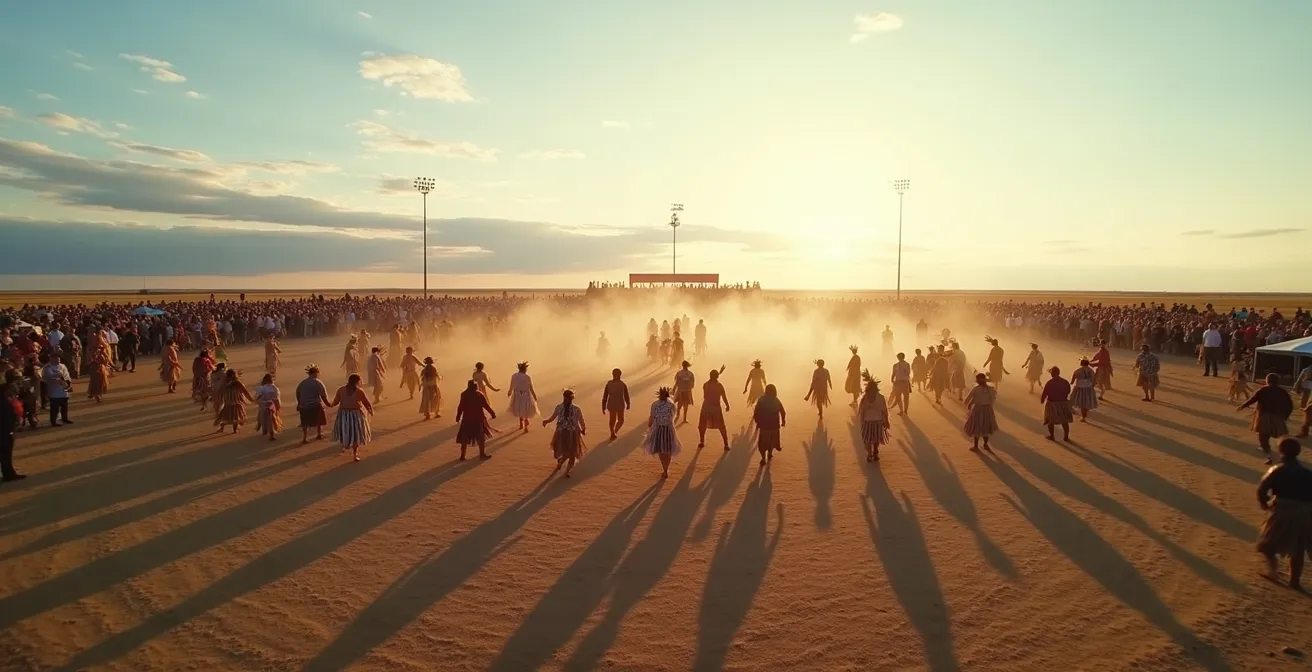
Competition Powwows, like the Manito Ahbee Festival in Winnipeg, are often large-scale events that draw hundreds or even thousands of dancers and many drum groups from across North America. Dancers compete in specific style categories for significant prize money. This prize money is not just for glory; it helps dancers offset the enormous cost of their craft. In fact, some estimates show an average annual investment of $5,000 to $15,000 per dancer for making regalia and travelling the “Powwow trail.” These events often feature large vendor markets and are geared towards both the Indigenous community and visitors.
Traditional Powwows are generally smaller, more intimate community-focused events. The primary purpose is not competition, but rather coming together to honour traditions, share songs and dances, celebrate family, and conduct spiritual ceremonies. There is no prize money; dancers are there for the spirit of the gathering and the well-being of the community. These events might include a community feast to which all are welcome.
This table breaks down the key differences:
| Competition Powwow | Traditional Powwow |
|---|---|
| Example: Manito Ahbee Festival, Winnipeg | Example: Community gatherings on reserves |
| Prize money ranges from $500-$50,000 | Focus on spiritual ceremonies and healing |
| 1000+ dancers, international participation | 50-200 participants, mostly local families |
| Judged dance categories and contests | Open dancing, no competition |
| Large vendor areas and tourism focus | Community feast and sharing focus |
The boundary mistake that is considered highly disrespectful
The most significant mistakes a guest can make often stem from a misunderstanding of boundaries—both visible and invisible. The most important physical boundary is the dance arbor itself. This circle is considered sacred ground. It is blessed before the Powwow begins and should be treated with the same reverence as an altar in a church. Unless you are a dancer or have been explicitly invited in by the MC (for example, during an Intertribal dance), you must not enter or cross the arbor.
Another critical protocol involves the eagle feather. The eagle is the most sacred bird, believed to carry prayers to the Creator. If a dancer drops an eagle feather, a special ceremony is required to retrieve it. As a guest, if you see a fallen feather, do not touch it or even go near it. Your role is to quietly alert the nearest official, dancer, or the MC, and they will initiate the proper protocol.
Beyond the physical, there are crucial social and emotional boundaries. Never touch a dancer’s regalia without explicit permission. Do not walk between two people who are having a conversation, especially if they are Elders. But perhaps the most important invisible boundary, particularly in the Canadian context of Truth and Reconciliation, involves personal stories.
In a Canadian context, it is disrespectful to press for personal stories related to trauma, such as residential school experiences, unless they are willingly shared.
– Indigenous Tourism Association of Canada, Cultural Protocol Guidelines
While a Powwow is a place of community and connection, it is not an invitation to ask invasive questions about an individual’s or family’s history with colonial trauma. Let the person you are speaking with lead the conversation. The focus of the day is celebration and resilience; your presence should support that, not detract from it.
When to arrive to witness the most important part of the ceremony?
If you can only attend a portion of the Powwow, make every effort to be there for the Grand Entry. This is the official start of the event and its most sacred and moving part. It’s the moment the community formally enters the sacred circle, and it sets the tone for the entire day. Plan to arrive at least 30 minutes before the scheduled start time to find a good spot and be settled before it begins.
The Grand Entry is a procession led by Elders and veterans carrying the Eagle Staffs and the flags of the host First Nations, as well as the Canadian, provincial, and other flags. The Eagle Staff is the most sacred item, representing the sovereignty and spirit of the Nation. As a sign of respect, everyone is asked to stand as the staffs and flags enter the arbor. You should remove your hat unless you are wearing traditional or religious headwear.
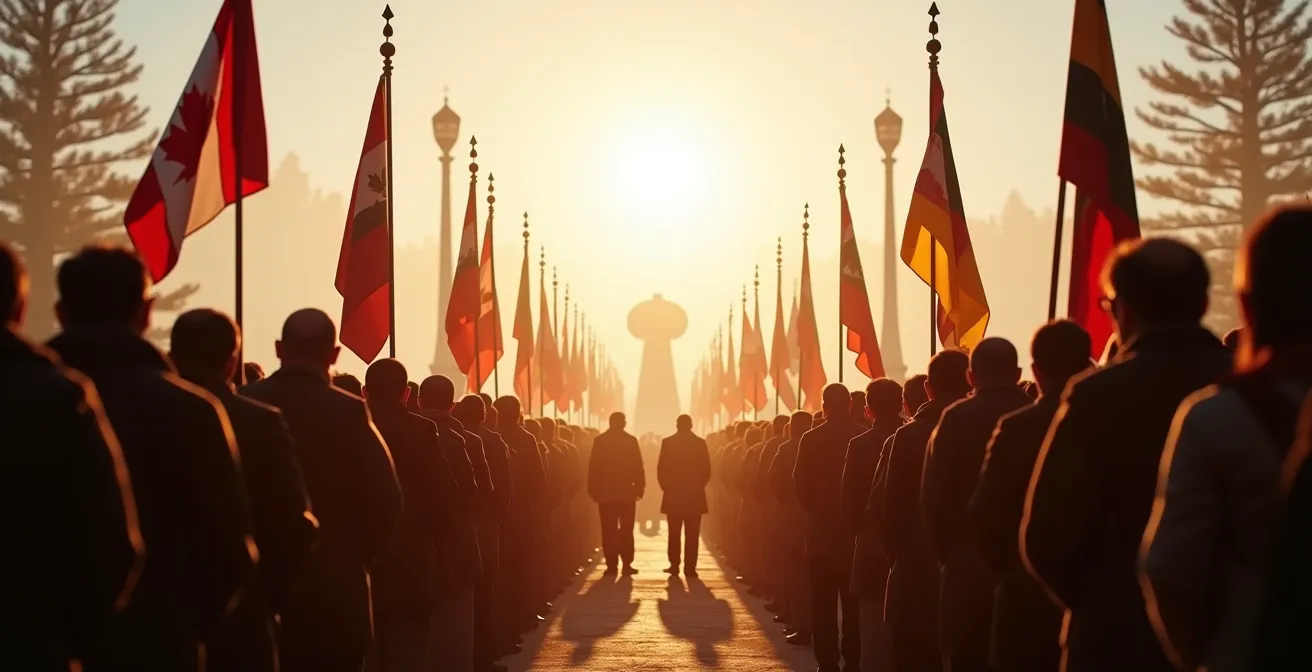
You will remain standing through the Flag Song, an opening prayer, and often a Veterans’ Song to honour those who have served. This is also when a Land Acknowledgment is typically given, recognizing the traditional territory on which the event is taking place. Listening respectfully to this acknowledgment is an important part of reconciliation and understanding the deep history of the land.
Case Study: Toronto Metropolitan University’s Grand Entry
TMU’s annual powwow provides a powerful example of how Canadian institutions can integrate protocol into modern events. The Grand Entry begins with a clear territorial recognition of the Dish With One Spoon territory, followed by the traditional flag and staff procession. This act creates a bridge between ancient Indigenous tradition and contemporary reconciliation efforts, educating all who attend.
When to visit city squares to see modern musical performances on June 21st?
While the Powwow trail is active throughout the summer, a unique and accessible opportunity to engage with Indigenous culture across Canada happens on June 21st, National Indigenous Peoples Day. This is a day of national celebration, and many cities and towns host free public events that showcase a wide spectrum of Indigenous artistry, from traditional to contemporary.
Urban centres, in particular, often become hubs for these celebrations. City squares and public parks are transformed into festival grounds featuring music, dance, art markets, and food. These events are specifically designed as a “front porch” to welcome non-Indigenous people into the celebration in a relaxed and accessible environment. While respect is always key, the protocols are often less formal than at a traditional Powwow.
Case Study: Toronto’s Nathan Phillips Square Celebration
On June 21st, Toronto’s Nathan Phillips Square hosts a massive Indigenous cultural celebration. The programming brilliantly showcases the dynamism of modern Indigenous identity, featuring everything from traditional drumming to performances by groundbreaking electronic artists like The Halluci Nation, who fuse powwow music with club beats. This urban event model is an excellent, welcoming entry point for those new to Indigenous cultural events.
Across the country, official statistics show over 200 public celebrations taking place annually on this day. Performances typically run throughout the afternoon and into the evening, with major musical acts often scheduled for after work hours, around 6 PM or later, to draw the largest crowds. Check your local city’s event listings or the website of a nearby Friendship Centre to find the schedule for a celebration near you.
Street party or sunset beach vibe: which celebration fits your style?
Indigenous culture in Canada is not a monolith; it is as diverse as the land itself. From the urban street festival vibe of an Indigenous Day Live concert to the profound spiritual atmosphere of a West Coast salmon feast, there is a vast spectrum of cultural gatherings. Understanding this diversity can help you find experiences that resonate with you and broaden your appreciation beyond the Powwow circle.
Your experience can vary dramatically based on geography and the specific Nation hosting. An urban festival in Toronto or Montreal might feature hip-hop artists and electronic fusion music, while a coastal gathering in British Columbia could revolve around canoe journeys and ceremonies tied to the ocean. On the Prairies, you might witness the fast, high-energy footwork of a Plains Cree Chicken Dance, which has its own distinct songs and protocol.
This table highlights just a few of the different styles of celebration you might encounter:
| Urban Festival Vibe | Coastal Ceremony Vibe | Prairie Traditional Vibe |
|---|---|---|
| Indigenous Day Live concerts | BC salmon feast ceremonies | Plains Cree Chicken Dance |
| Electronic/hip-hop fusion | Canoe gatherings at sunset | Traditional drumming circles |
| Toronto, Montreal venues | Pacific coastal communities | Saskatchewan, Alberta reserves |
| Relaxed protocols | Community-specific customs | Strict traditional protocols |
The key is to do a little research. Finding these events is easier than ever and is a great way to support Indigenous tourism and community organizations directly.
Action Plan: How to Find Indigenous Cultural Events Near You
- Check the websites of local Friendship Centres in your city for community event calendars and postings.
- Visit the main websites for provincial bodies like Indigenous Tourism BC or Tourisme Autochtone Québec for regional event listings.
- Follow the social media pages of local Band Councils, as they often post about community gatherings open to the public.
- Subscribe to the Destination Indigenous newsletter for a curated list of significant nationwide events.
- Search on social media platforms like Facebook for groups titled “[Your City] Indigenous Events” to find local happenings.
Key Takeaways
- The most respectful act is to understand the ‘why’ behind protocols, not just memorize rules.
- Sacred boundaries are physical (the arbor), spiritual (eagle feathers), and emotional (personal trauma stories).
- The Grand Entry is the heart of the ceremony; arrive early and stand to show honour to the veterans, the flags, and the Eagle Staffs.
How to visit ‘Ksan or Wanuskewin to understand pre-contact Indigenous life?
Perhaps the most profound way to prepare yourself to be a good guest at a Powwow is to take a step back and learn about the deep history of the land and its people *before* colonization. Contemporary ceremonies are a living link to traditions and worldviews that have existed for millennia. Visiting an Indigenous-led heritage park or cultural centre can provide invaluable context that transforms your understanding from simple observation to deep appreciation.
These sites are not dusty museums; they are vibrant centres of learning and cultural revitalization. They offer a “Step 0” on your journey of respectful understanding. By learning about the complex governance, science, and spirituality of pre-contact Indigenous life, you begin to dismantle the colonial narratives many of us were taught. This knowledge provides the “why” for so many of the protocols you will witness at a Powwow.
Case Study: Wanuskewin Heritage Park, Saskatchewan
Wanuskewin Heritage Park serves as an ideal gateway to understanding, showcasing 6,000 years of Northern Plains Indigenous history. Through guided tours of archaeological sites and interactive exhibits, visitors learn about traditional life, the deep scientific knowledge of the land, and the sophisticated social structures that existed long before European arrival. This context is crucial for appreciating the resilience and meaning behind contemporary ceremonies like the Powwow.
When you visit a site like Wanuskewin near Saskatoon or the ‘Ksan Historical Village in British Columbia, consider booking a tour with an Indigenous guide. Ask them about the connections between historical practices and the modern Powwow. This is your chance to ask questions in a space designed for education. By investing your time and money in these centres, you are not only enriching your own understanding but also directly supporting the preservation and sharing of Indigenous culture for future generations.
Ultimately, the most important protocol is to arrive with an open heart and a humble spirit. Your journey to becoming a respectful guest begins with the desire to learn, and by being here, you have already taken the most important step. We welcome you to join us in the celebration.