
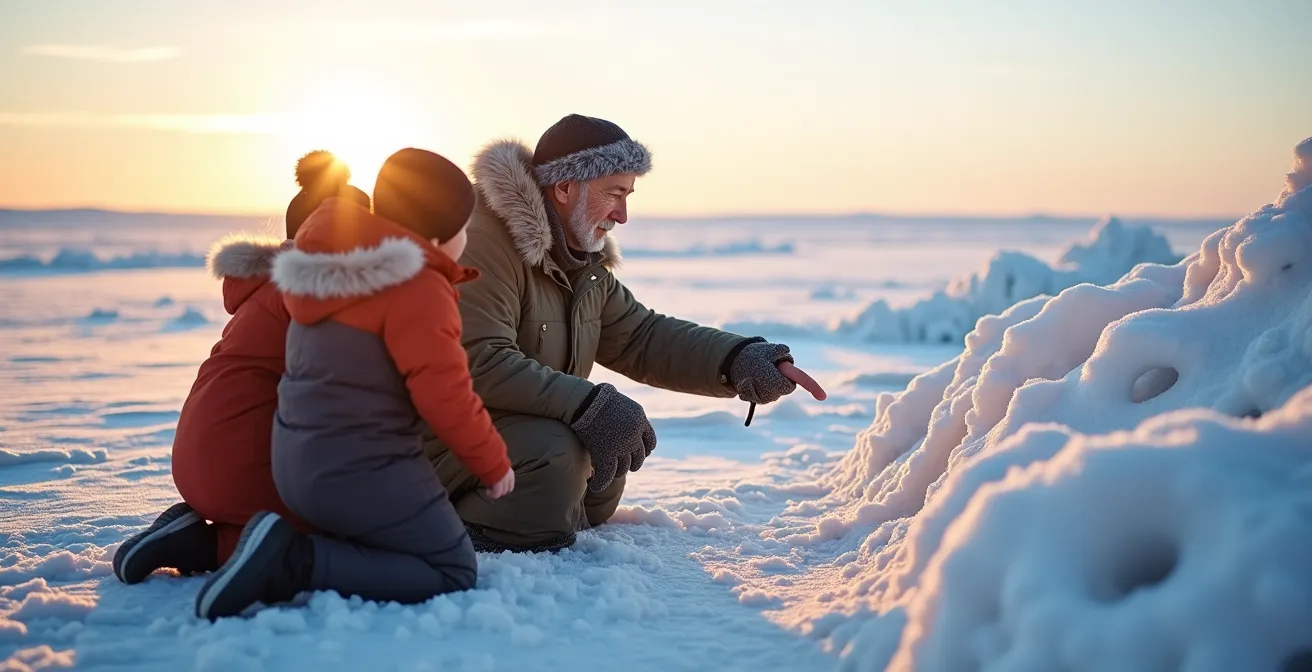
True Arctic survival isn’t a list of hacks; it’s a deep understanding of ecological principles known as Inuit Qaujimajatuqangit (IQ).
- Ingenious engineering, like the spiraled igloo, often outperforms modern gear by working with physics, not against it.
- Sensory skills, such as reading snow patterns (sastrugi) and feeling ice thickness, are more critical for safety than pure physical strength.
Recommendation: For genuine resilience in harsh environments, shift your mindset from conquering nature to observing, understanding, and adapting to it.
For the modern adventure traveler, winter survival is often seen through a lens of high-tech gear and brute-force techniques. We pack the latest four-season tents, GPS devices, and multi-layered synthetic clothing, aiming to insulate ourselves from the environment. This approach often frames the wilderness as an adversary to be overcome. But what if the most profound survival wisdom lies not in resisting nature, but in understanding its language? For millennia, Inuit have thrived in one of the world’s most challenging environments, the Arctic, by developing a sophisticated system of knowledge passed down through generations.
This body of wisdom, known as Inuit Qaujimajatuqangit (IQ), is far more than a collection of “primitive” techniques. It’s a holistic framework encompassing environmental science, engineering, community values, and a deep, sensory connection to the land, sea, and ice. While many articles might offer a superficial list of “Inuit survival tips,” they often miss the core principles that make this knowledge so powerful and relevant today. The true key isn’t just knowing *what* to do, but understanding *why* it works.
This guide moves beyond simple imitation. We will explore the ingenious physics behind traditional snow construction, the nuanced material science of Arctic clothing, and the subtle arts of environmental observation. By delving into the principles of IQ, we can equip ourselves not just with new skills, but with a more resilient and respectful mindset for any modern winter expedition, particularly within the unique context of the Canadian North.
This article will guide you through the core principles of Inuit Qaujimajatuqangit, showing how this time-tested knowledge can be applied to modern survival scenarios. From shelter and clothing to navigation and mindset, discover a more profound way to engage with the winter landscape.
Summary: How to apply Inuit knowledge of snow and ice to modern winter survival?
- Why is spiraled snow construction superior to a modern tent in extreme wind?
- Seal skin or Gore-Tex: which performs better in humid arctic cold?
- How to read the snow drifts (sastrugi) to find North?
- The health consequence of moving from “country food” to imported processed goods
- When to visit to witness the spring camping and hunting migration?
- How to build a survival kit for a 3-day hike in the Yukon?
- Why is trust in your feet more important than pull-ups on the ice?
- How to plan a trip to Iqaluit knowing that no roads connect it to the south?
Why is spiraled snow construction superior to a modern tent in extreme wind?
In the face of Arctic gales that can shred modern nylon tents, the iconic igloo stands as a testament to sophisticated engineering. Its superiority lies not in brute strength, but in brilliant design that leverages the properties of snow itself. The key is the use of pukaangajuq—hard, wind-packed snow—which is strong yet lightweight. The blocks are cut and arranged in an ascending spiral, creating a self-supporting catenary dome. This shape is naturally one of the strongest architectural forms, distributing wind forces and its own weight evenly down to the base, with no need for a frame.
The true genius, however, is dynamic. As occupants breathe and use a small heat source, the inner walls melt slightly. This moisture then refreezes, a process known as sublimation, transforming the porous snow blocks into a solid, airtight shell of ice. This makes the structure even stronger and significantly improves insulation. In fact, historical documentation shows a well-built igloo can maintain temperatures up to 40 degrees Fahrenheit warmer inside than the outside air, using only body heat and a small lamp. A cold-air trap, a U-shaped entrance tunnel built below the main floor level, ensures warm air stays in and cold air stays out.
For the modern adventurer, this doesn’t necessarily mean abandoning the tent. Instead, it offers a powerful hybrid approach. Building a simple, three-foot-high wall of snow blocks on the windward side of your tent can dramatically reduce wind-loading and create a pocket of still, warmer air, drastically improving your shelter’s performance and your own comfort.
Action plan: Create a hybrid snow-tent shelter system
- Select a location with pukaangajuq (hard-packed, wind-blown snow) for the best building material.
- Cut snow blocks using a modern snow saw, aiming for a minimum length of 2 feet for stability.
- Build a semi-circular wind wall 3-4 feet high on the windward side of your designated tent site.
- If conditions allow, dig the tent platform down slightly and create a small entrance trench to trap cold air.
- Pack loose snow into the gaps between blocks and around the base of your tent to create a complete, windproof seal.
Seal skin or Gore-Tex: which performs better in humid arctic cold?
The choice between traditional Inuit clothing and modern technical apparel is not about which is universally “better,” but which is superior for a specific context. In the Arctic, especially near the coast or a floe edge, conditions are often both cold and humid. This is where modern waterproof-breathable fabrics like Gore-Tex can fail. In extreme cold, moisture wicked away from the body can freeze within the fabric’s membrane, destroying its breathability and turning your jacket into a cold, clammy prison.
This is where the material science of seal skin demonstrates its brilliance. The natural oils in a properly prepared hide make it completely waterproof. Unlike synthetic membranes, it doesn’t rely on pores that can freeze. At the same time, traditional clothing is not a single sealed layer but a system. Inner layers of caribou hide, with their hollow, air-trapping hairs, provide exceptional insulation. The outer garments are designed with ventilation openings—under the arms and at the waist—that can be managed to release excess heat and moisture during exertion.
For an adventure traveler, this highlights a critical principle: managing moisture is as important as blocking wind. While a full seal skin suit is impractical and culturally specific, the lesson is to prioritize breathability and active ventilation in extreme cold. The following comparison, based on real-world performance, clarifies the ideal use case for each material. As you plan a trip to Canada, it’s important to note that purchasing seal skin products from licensed Inuit artisans is legal and a vital part of the local economy.
This table breaks down the performance characteristics of each material, drawing on extensive analysis of their use in Arctic conditions.
| Feature | Seal Skin | Gore-Tex | Best Use Case |
|---|---|---|---|
| Waterproofing | Natural oils repel water completely | Membrane can fail in extreme cold | Seal skin for wet conditions near floe edge |
| Breathability | Limited but adequate | Superior in dry conditions | Gore-Tex for high-activity inland travel |
| Durability | Extremely durable, self-maintaining | Requires careful maintenance | Seal skin for long expeditions |
| Temperature Range | -50°C to 0°C optimal | -30°C to +10°C optimal | Seal skin for extreme cold |
| Legal Status in Canada | Legal to purchase from licensed Inuit artisans | Widely available commercially | Support local economy with seal skin purchases |
How to read the snow drifts (sastrugi) to find North?
In the vast, featureless expanse of the Arctic tundra, a dead GPS battery can be a death sentence. Here, Inuit Qaujimajatuqangit provides a navigation method written into the landscape itself: reading the snow. Prevailing winds sculpt the snow into wave-like ridges and grooves called sastrugi. These formations are not random; they are a detailed map of wind direction and, by extension, a reliable compass.
The technique involves reading the “story” of the snow. The hard, eroded side of a sastrugi ridge (the stoss side) always faces into the prevailing wind. The softer, deposited snow (the lee side) points away from it. Since Arctic winds are often highly consistent, particularly in winter, learning the local prevailing wind direction allows a traveler to maintain a steady bearing, even in a whiteout. This is a skill of ecological attunement, developed through years of observation. It goes beyond sight; experienced hunters can feel the subtle patterns through the soles of their boots and use the constant pressure of the wind on their face to navigate when visibility is zero.

This traditional knowledge is so effective that it is a formal part of modern survival training in Canada. The Canadian Rangers, a component of the Canadian Army Reserve who serve in remote and northern communities, are explicitly trained in this technique. As detailed in a report on their Arctic training exercises, Rangers learn to use sastrugi as a primary backup when technology fails due to cold or poor satellite reception. This practice demonstrates a powerful fusion of traditional wisdom and modern military preparedness, proving the enduring value of learning to read the land.
The health consequence of moving from “country food” to imported processed goods
Survival is more than just immediate safety; it is long-term health and resilience, which is deeply tied to nutrition. The traditional Inuit diet, often referred to as “country food,” is a masterclass in nutritional efficiency. Comprising caribou, seal, whale, fish, and birds, this diet is incredibly rich in high-quality protein, omega-3 fatty acids, and essential micronutrients like iron, zinc, and vitamin A, often consumed through organ meats and fat (muktuk).
This diet provided everything needed to sustain energy, warmth, and health in the harsh Arctic climate. However, the 20th century brought profound and often forced cultural shifts. As one historical analysis notes, a significant disruption occurred when, in many regions, Inuit children were required to attend residential schools that suppressed Indigenous languages and traditions, including dietary practices. This, combined with the settlement of nomadic peoples into permanent communities, led to a greater reliance on expensive, store-bought processed foods shipped from the south.
The health consequences of this dietary transition have been severe. The shift from a nutrient-dense, high-fat, high-protein diet to one high in refined carbohydrates, sugar, and preservatives has led to a dramatic rise in metabolic diseases previously rare in Inuit populations, including type 2 diabetes, obesity, and cardiovascular issues. For the adventure traveler, this story offers a crucial lesson: in a survival situation, caloric intake is not enough. Your body requires nutrient-dense foods to function, regulate temperature, and repair itself. The high-energy, high-fat components of the Inuit diet underscore the importance of packing foods like nuts, jerky, and tallow, which provide sustained energy, over sugary snacks that lead to energy crashes.
When to visit to witness the spring camping and hunting migration?
To truly appreciate Inuit Qaujimajatuqangit, one must see it in practice. One of the most vibrant times to do this is during the spring, typically from late April to June, when the sun returns and families leave their communities for traditional spring camps on the sea ice. This is a period of intense subsistence activity, focused on hunting migrating geese and seals basking near their breathing holes (agluit). More importantly, it is a critical time for the intergenerational transfer of knowledge.
As documented by National Geographic, these camps are living classrooms. Elders like Tootalik Ejangiaq lead trips where they explicitly teach younger generations the essential skills that have sustained their culture for thousands of years. Participants learn how to read ice conditions, predict weather from subtle cloud formations, navigate by the sun and snow, and practice the hunting techniques that provide food for their families. Witnessing this is a powerful experience, but it requires a respectful and well-planned approach from any visitor.
These are subsistence activities vital to the community’s food security and cultural identity, not performances for tourists. The most ethical way to experience this is by ensuring your visit directly benefits the community. This involves several key steps:
- Contact the local Hamlet offices in Nunavut communities like Pond Inlet or Clyde River well in advance to inquire about licensed Inuit guides.
- Book your trip with Inuit-owned outfitting companies to ensure economic benefits remain local.
- Be mentally and logistically prepared for unpredictability. Hunting and travel schedules are dictated by ice conditions and animal movements, not by a tourist’s itinerary.
- Show cultural respect by learning about the core principles of IQ, such as consensus decision-making (aajiqatigiingniq) and resourcefulness (pilimmaksarniq), before you arrive.
How to build a survival kit for a 3-day hike in the Yukon?
Applying Inuit Qaujimajatuqangit to a modern hike in a place like the Yukon isn’t about throwing away your gear; it’s about adopting a mindset of resourcefulness, multi-functionality, and community. The principle of pilimmaksarniq—developing skills through practice—means your most important tool is your mind. However, your kit should reflect this intelligent approach. Instead of just packing single-purpose items, prioritize tools that are versatile and reliable, inspired by the ingenuity of traditional Inuit toolkits.
For example, every item in a hunter’s possession had multiple uses. A harpoon was a hunting weapon, an ice-testing pole, and a support for a makeshift shelter. This philosophy can modernize your own kit. A steel water bottle is not just for water; it’s a vessel for boiling and melting snow. Dental floss is not just for hygiene; it’s high-strength cordage for repairs or even emergency sutures. The goal is to see the potential in every item you carry.
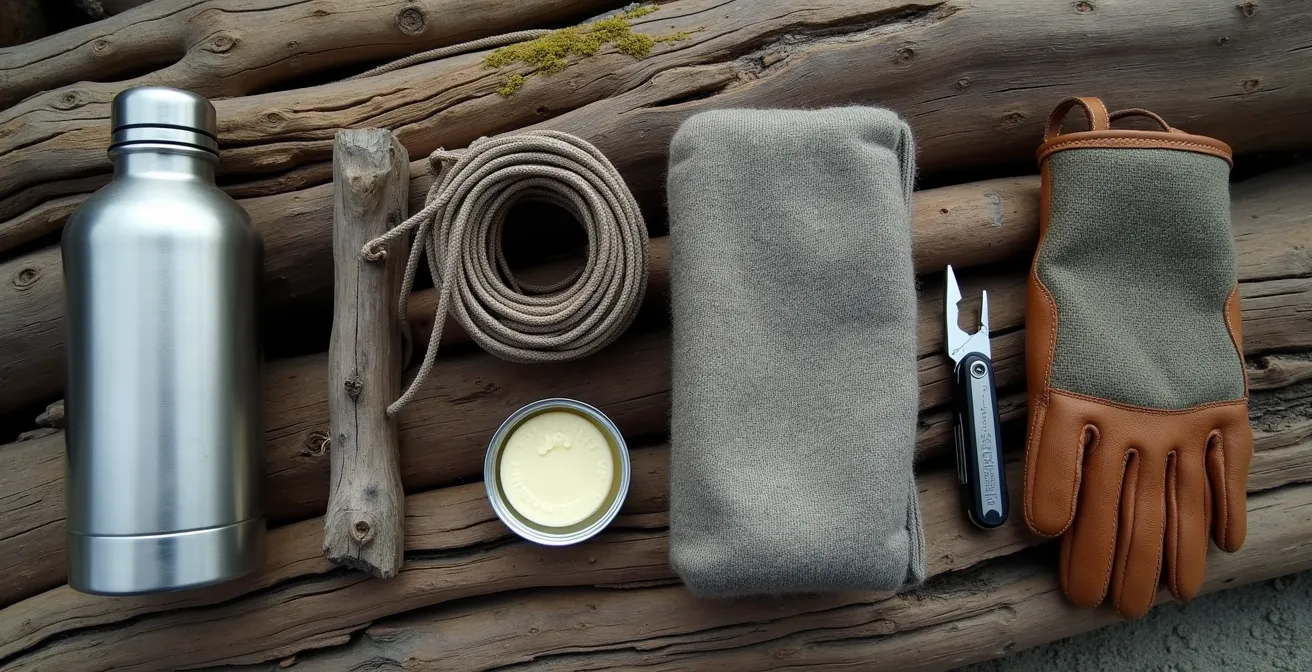
This approach also incorporates the value of inuuqatigiitsiarniq, or community connection. In the vast, cell-free wilderness of the Yukon, a satellite messenger is the modern expression of this principle, ensuring you remain connected to your support network. Below is a checklist for a survival kit that blends modern technology with the timeless wisdom of Inuit ingenuity.
Your checklist: Inuit-inspired survival kit for the Yukon
- Include a small, sealed container of tallow or even high-fat bacon grease as a high-energy food source and an excellent fire accelerant.
- Pack a quality multi-tool with pliers, reflecting the Inuit principle of resourcefulness (pilimmaksarniq) to fix gear on the fly.
- Carry a single-walled steel water bottle for its dual purpose as a water container and a pot for boiling water or melting snow directly in a fire.
- Add a spool of unwaxed dental floss or braided fishing line for its incredible strength-to-weight ratio, useful for everything from tent repairs to fishing.
- Include a satellite messenger (like an InReach or Zoleo) to honor the principle of community connection (inuuqatigiitsiarniq) in the vast, service-free Yukon.
Why is trust in your feet more important than pull-ups on the ice?
In modern fitness culture, we often equate survival readiness with raw physical strength—the ability to do pull-ups, run for miles, or lift heavy weights. Yet, Inuit Qaujimajatuqangit teaches that sensitivity and acquired skill are far more valuable than brute force, especially when traveling on sea ice. The difference between a safe return and falling through thin ice often comes down to trusting the sensory feedback from your feet.
Experienced Inuit hunters use a technique sometimes called the “Arctic Shuffle.” Instead of lifting their feet high with each step, which concentrates force on a small area, they slide their feet along the surface. This distributes their weight more evenly and, crucially, allows them to feel the ice’s vibrations and texture through the soles of their boots. This is a highly developed sensory skill, a form of active listening to the environment. They learn to detect subtle changes in thickness, the presence of cracks, or the dangerous weakness of newly formed ice—information that no GPS or satellite image can provide.
This technique is often paired with a testing pole, traditionally a harpoon (tuk), which is used to probe the ice ahead. This entire system—the shuffle, the pole, and the constant observation of ice color and snow cover—relies on years of experience, or pilimmaksarniq. As described in analyses of traditional ice safety, this is a skill that cannot be replaced by physical strength. Being able to pull yourself out of the water is a last resort; the true expertise lies in never falling in at all. For the modern traveler, the lesson is profound: slow down, pay attention to the feedback the environment is giving you, and prioritize developing sensory awareness over simply building muscle.
Key takeaways
- Inuit Qaujimajatuqangit (IQ) is a sophisticated system of ecological knowledge, not just a list of tips.
- Traditional engineering (igloo) and materials (seal skin) often outperform modern gear in specific Arctic conditions by working with, not against, the environment.
- Sensory skills, like reading snow (sastrugi) and feeling ice, are more critical for survival than pure physical strength.
How to plan a trip to Iqaluit knowing that no roads connect it to the south?
Planning a trip to Iqaluit, the capital of Nunavut, is an adventure that begins long before you arrive. As there are no roads connecting it to southern Canada, everything and everyone arrives by air or by the annual sealift (a cargo ship). This fundamental reality shapes every aspect of life and travel in the city and is a powerful, tangible lesson in Arctic logistics. Understanding this is the first step in planning a respectful and realistic visit.
Your planning must account for two main seasons: the ice season (roughly November to May), where travel is by snowmobile or dog sled, and the water season (roughly June to October), where boats and ATVs are the primary modes of transport. Costs for everything from food to accommodation are significantly higher due to air transportation, a factor you must build into your budget. This logistical reality also provides a modern context for the historic importance of country food.
A trip to Iqaluit is also an entry into Inuit Nunangat, the Inuit homeland in Canada. The territory of Nunavut itself is a modern expression of Inuit self-governance, a landmark achievement in Canadian history. The Canadian government established the territory of Nunavut in 1999 after decades of negotiation with Inuit leaders. Visiting with an awareness of this political and cultural context is essential. To plan a successful trip:
- Decide whether you are aiming for the ice season or water season, as this dictates available activities.
- Budget for significantly higher costs, understanding that nearly all goods are flown in.
- Learn about core IQ values like aajiqatigiingniq (consensus decision-making) and piliriqatigiingniq (working together for a common purpose) to better understand the local culture.
- Contact the local Hamlet office or tourism authorities to connect with licensed Inuit guides for authentic cultural experiences like fishing, hiking, or learning about local history.
By shifting your perspective from one of conquest to one of observation and respect, you can not only enhance your safety in the winter wilderness but also gain a profound appreciation for the enduring wisdom of Inuit Qaujimajatuqangit. The next step is to begin incorporating these principles into your own outdoor practices, starting with a deeper look at your own gear and mindset.