
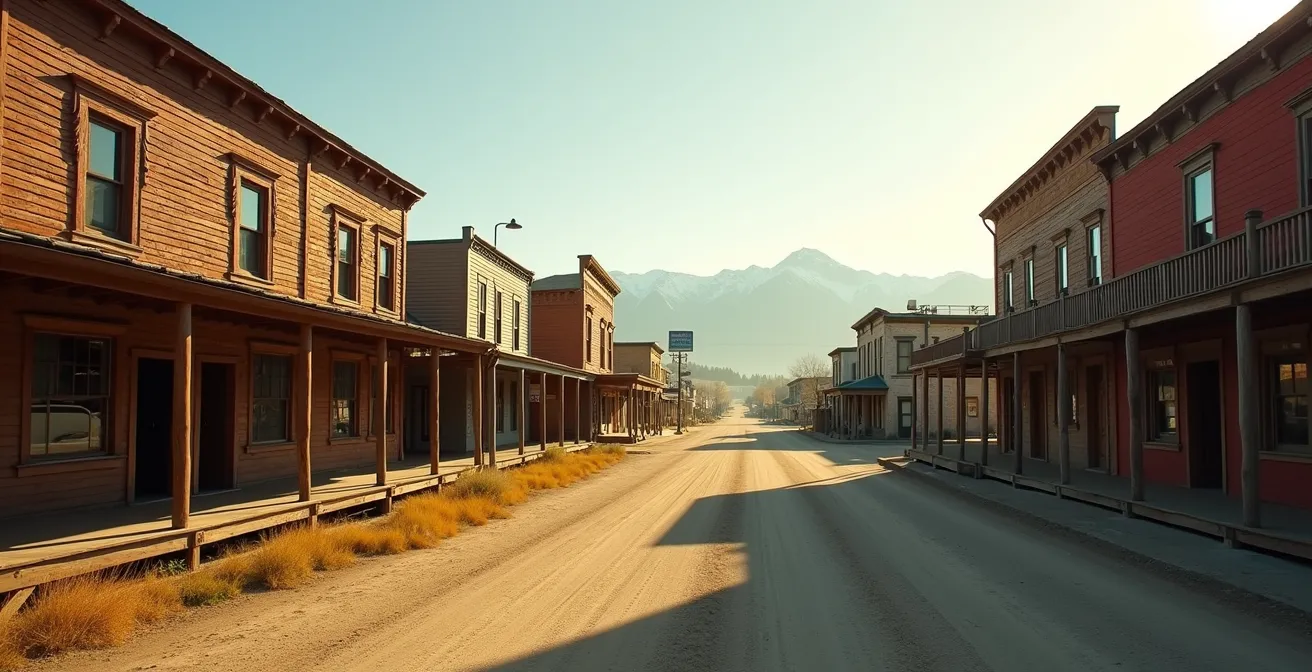
The true spirit of the Klondike isn’t found in a whiskey glass with a severed toe; it’s hiding in the town’s complicated history, the twisted foundations of its buildings, and the heavy black sand of its creeks.
- Most iconic experiences, like the Sourtoe Cocktail, are modern inventions that often mask a complex and sometimes dark settler-colonial history.
- Authentic connections to the Gold Rush era require seeking out practical skills (like gold panning), understanding the Indigenous perspective, and seeing the land itself as the main character.
Recommendation: Skip the biggest crowds and look for the stories in the margins—talk to locals, visit the Dänojà Zho Cultural Centre, and learn to read the landscape for the real gold.
So, you’ve made it to Dawson City. You came looking for the ghost of the Klondike, for the grit and glory of 1898 that you read about in Jack London or Robert Service. You’re picturing grizzled prospectors, the glint of gold, and the raw, untamed spirit of the North. Instead, the first thing you see is a long line of tourists waiting to join a club by letting a dehydrated human toe touch their lips. It’s a jarring welcome. Many visitors come here and think the Sourtoe Cocktail or the can-can shows at the casino are the authentic Gold Rush experience. They’re not.
Those are the polished bits, the ‘glitter’ designed for mass consumption. They are modern inventions, fun in their own right, but they often wallpaper over a much more complex and fascinating story. The real Dawson, the ‘grit’ you’re looking for, is still here, but it’s quieter. It’s in the way the buildings lean from the permafrost’s grip, in the stories of the Tr’ondëk Hwëch’in people whose land this has always been, and in the feeling you get when you finally see a flake of real gold shine in your pan. This isn’t a museum. It’s a living town wrestling with its past.
But here’s the secret: if you know where to look, you can step past the tourist facade and feel the real pulse of the Klondike. The key isn’t to see the sights, but to understand the forces that shaped them. This guide is about peeling back the veneer to find that raw, complicated, and unforgettable history. We’ll explore why the most famous rituals might not be what they seem, how to actually find gold, and where the true soul of this legendary town resides.
This article will guide you through the authentic heart of Dawson City, separating the historical truth from the tourist-friendly myths. You’ll learn where to find the real stories, how to engage with the landscape, and how to leave feeling like you’ve truly touched the spirit of the Klondike.
Summary: A Guide to the True Klondike Experience
- Why do travelers line up to drink whiskey with a dehydrated human toe?
- How to pan for gold in Bonanza Creek and actually find flakes?
- Vegas-style gambling hall or the darker side of history: where is the real Dawson vibe?
- The architectural quirk that makes Dawson’s buildings lean at odd angles
- When to drive the road to the Arctic Ocean to avoid tire-shredding shale?
- Why are the cliffs of PEI retreating by meters every year?
- The navigation mistake that leaves tourists stranded in unilingual areas
- How to plan a trip to Iqaluit knowing that no roads connect it to the south?
Why do travelers line up to drink whiskey with a dehydrated human toe?
The Sourtoe Cocktail is Dawson’s most famous ritual, but it’s a piece of modern folklore, not a Gold Rush tradition. Created in 1973, it has become a rite of passage for visitors. The spectacle is undeniable, and since its inception, the Sourtoe Cocktail Club has grown to include over 100,000 members from around the globe who have braved the mummified digit. The rule is simple: “You can drink it fast, you can drink it slow, but your lips must touch the toe.” It’s a bizarre, memorable story to take home, a badge of “northern” honor.
However, from a historian’s bar stool, the phenomenon is more complex. It’s a perfect example of the “settler-colonial paradox.” As one academic analysis on the topic points out, rituals like this allow tourists to claim an “authentic” northern identity while conveniently sidestepping the difficult history of Indigenous displacement and the harsh realities of the Gold Rush itself. It’s a performance of toughness that has little to do with the historical hardships of prospectors or the Tr’ondëk Hwëch’in people.
So, should you do it? That’s your call. But understand what it is: a brilliant piece of 1970s marketing, not a window into 1898. For a more authentic taste of Dawson’s history, consider these alternatives:
- Join a Parks Canada walking tour: Costumed interpreters bring the real stories of the Gold Rush to life.
- Visit the Dänojà Zho Cultural Centre: Hear the Gold Rush story from the perspective of the Tr’ondëk Hwëch’in, the First Nation whose homeland you are on.
- Have a quiet drink at the Westminster Hotel’s “Snake Pit”: This is where you’re more likely to find old-timers and local miners sharing stories, especially at the morning “breakfast club.”
How to pan for gold in Bonanza Creek and actually find flakes?
Forget the tourist troughs set up in town. The real thrill of the Klondike is feeling the icy water of a historic creek on your hands and seeing that flash of yellow in your pan. It’s not just about luck; it’s a skill. You’re looking for the “black sand concentrate”—heavy minerals like magnetite that settle in the same places as gold. Finding that is half the battle. To do it right, you need to go where the gold is and use the right technique.
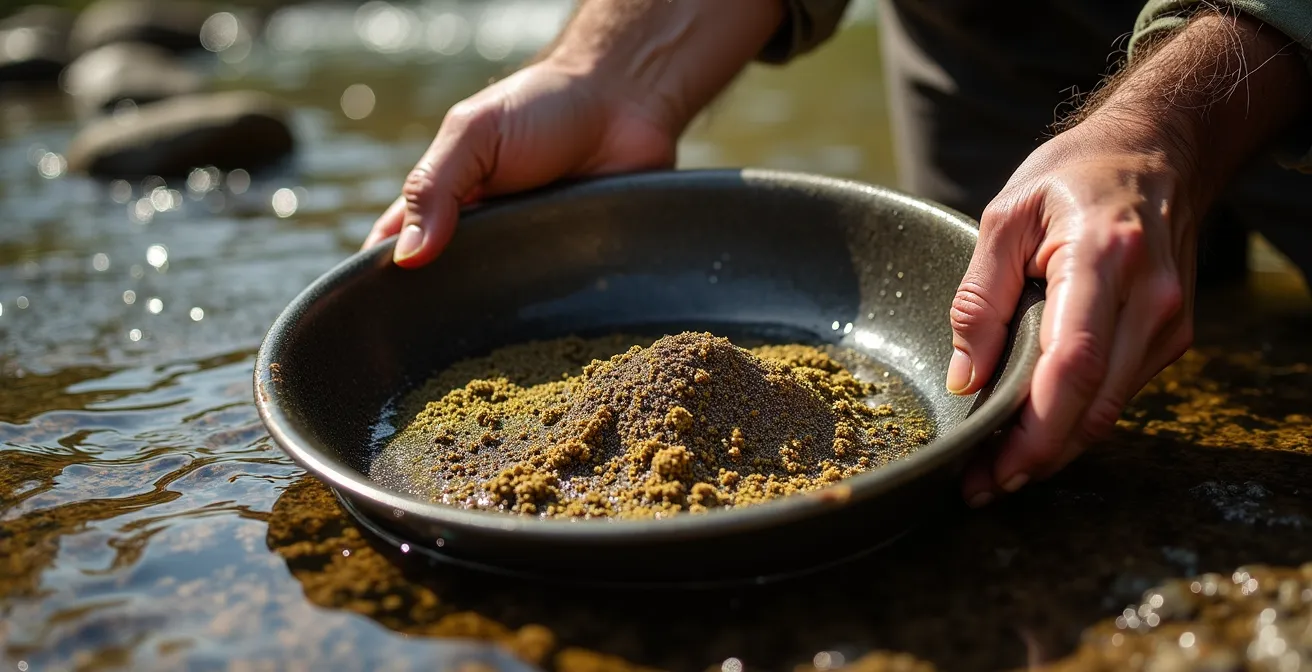
The image above captures the crucial moment: gently washing away the lighter gravel and sand to reveal the heavy concentrate at the bottom of the pan. It’s a rhythmic, patient process of shaking and dipping. Most tourists just wash everything out of their pan, gold included. You need to learn to let the water do the work, separating the dense gold from the worthless rock. Here’s a plan to get you started on finding your own flakes.
Your Action Plan: Authentic Gold Panning
- Equipment First: Before you go, rent a pan, shovel, and a small vial from a place like Claim 33, or buy your own kit in town. Don’t show up empty-handed.
- Location is Key: Head to Free Claim #6 on Bonanza Creek Road. It’s a section of the creek open to the public for recreational panning, but it’s not a theme park.
- Read the Creek: Don’t just dig anywhere. Gold is heavy. Look for inside bends of the creek where the water slows down and drops its heaviest load. Check behind large rocks where eddies form natural traps.
- Master the Motion: Fill your pan about three-quarters full of gravel. Submerge it, break up the clumps, and shake it vigorously side-to-side to let the heavy gold sink to the bottom. Then, use a gentle, forward-washing motion to let the lighter sand and pebbles spill over the edge.
- The Final Reveal: Once you’re down to a few spoonfuls of black sand, use a tiny bit of water to carefully swirl the contents and look for the tell-tale gleam of “colour.” Use a snuffer bottle to suck up the tiny flakes.
Vegas-style gambling hall or the darker side of history: where is the real Dawson vibe?
At first glance, Diamond Tooth Gertie’s Gambling Hall feels like pure glitter. With its can-can dancers, lively casino floor, and period costumes, it seems like a slice of Vegas transplanted to the Yukon. It’s loud, it’s fun, and it’s one of the most popular attractions in town. But to dismiss it as just another tourist trap would be missing a crucial part of the Dawson story. It represents the “Sourdough Myth” in its most polished form: a celebration of the boisterous, fortune-seeking spirit of the Gold Rush.
What most visitors don’t realize is that Gertie’s is not a corporate casino. It’s Canada’s oldest gambling hall, and it’s operated by the non-profit Klondike Visitors Association. Every dollar of profit is reinvested directly into preserving the town’s heritage and funding community projects. In a strange twist, the town’s most commercial-looking venture is also one of its key engines for historical preservation. It’s a perfect example of Dawson’s “settler-colonial paradox”: a romanticized version of history is used to fund the preservation of the real thing.
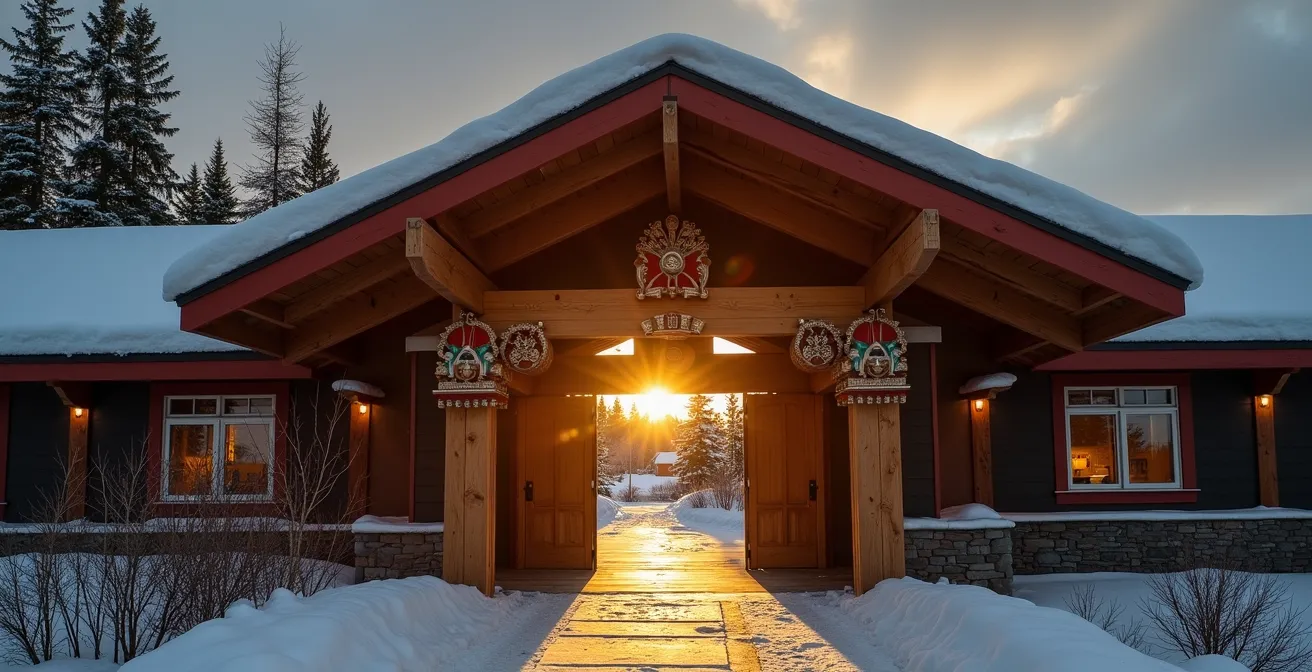
But this celebratory vibe is only one side of the coin. The other, darker side of the story is found just a short walk away, at the Dänojà Zho Cultural Centre. Here, the focus isn’t on the fortune-seekers, but on the Tr’ondëk Hwëch’in First Nation, who were displaced by the 100,000 stampeders. This history is quiet, contemplative, and profoundly important. As some historians argue, the popular Gold Rush narrative often serves a specific purpose.
Tourism maintains power dynamics in the North, where gold rush-based identities like the sourdough offer opportunities to avoid discussions concerning colonization.
– Academic researchers, NiCHE Environmental History analysis
The real vibe of Dawson isn’t in one place or the other. It’s in the tension between them. It’s in celebrating the energy of Gertie’s while also taking the time to listen to the quiet, vital stories at Dänojà Zho. To experience Dawson, you must experience both.
The architectural quirk that makes Dawson’s buildings lean at odd angles
Walk down any street in Dawson City and you’ll notice something strange: the buildings don’t stand up straight. Floors slope, doorways are crooked, and entire facades seem to slump at weary angles. This isn’t shoddy construction from 1898; it’s the signature of the North. You’re witnessing a slow-motion battle between human ambition and the powerful, invisible force of permafrost. Dawson is built on a wedge of frozen silt, ice, and gravel, and as the climate warms, that foundation is thawing and shifting beneath the town’s feet.
The original Gold Rush buildings were thrown up quickly, with foundations laid directly on the frozen ground. As long as the ground stayed frozen, they were stable. But heat from the buildings themselves, combined with rising ambient temperatures, causes the ice within the soil to melt, turning solid ground into a soupy muck. The result is called differential settlement—one side of a building sinks while the other stays put, causing the iconic lean. This ongoing process is a massive challenge for preservation. In fact, Parks Canada’s ongoing preservation efforts include managing over 17 of these historic, and often tilting, structures.
To truly appreciate the town’s architecture, you need to understand the constant struggle required to keep it standing. This isn’t a static museum; it’s an active conservation project on a scale seen almost nowhere else, as this summary of the impacts shows.
| Infrastructure Type | Permafrost Impact | Mitigation Strategy | Annual Maintenance Cost |
|---|---|---|---|
| Historic Buildings | 4-foot ground deflections causing structural lean | Cribbing systems with annual releveling | Ongoing adjustments required |
| Sewer/Water Lines | Pipe breaks from ground movement | Flexible connections and monitoring | Major repairs after breaks |
| Roads | Buckling and heaving | Elevated boardwalks, gravel replacement | Continuous maintenance |
| Modern Buildings | Foundation instability | Built on piles to bedrock, elevated design | Preventive design reduces costs |
The leaning buildings aren’t just a quirky photo op. They are a physical manifestation of Dawson’s fragility and resilience—a testament to the “Permafrost’s Grip.” They tell a story of a town clinging to a past that is literally sinking away.
When to drive the road to the Arctic Ocean to avoid tire-shredding shale?
From Dawson, the Dempster Highway beckons—a 740-kilometre gravel ribbon that leads you all the way to the Arctic Ocean at Tuktoyaktuk. It’s one of the world’s great road trips, but it’s not a Sunday drive. The road is built on a gravel berm to insulate the permafrost, and its surface is primarily composed of sharp, blasted shale that has a legendary appetite for tires. Choosing when to go isn’t just about weather; it’s about managing risk and your own sanity. A bad choice can leave you stranded with multiple flat tires hundreds of kilometres from help.
Timing is everything. Summer brings relentless dust and peak traffic, while spring means deep mud. For many locals, the sweet spot is late August or early September. The fall colours are spectacular, the mosquitos are gone, and the traffic has thinned out. But this window comes with its own risk: the first snowfalls. No matter when you go, you must be prepared. This isn’t a road you just decide to drive.
Local miners who drive the Bonanza/Hunker Loop daily warn that they ‘know the road like the back of their hand and will come tearing up behind you in their pick up trucks’ – the same aggressive local driving style applies to the Dempster, where experienced drivers navigate at speeds that seem reckless to tourists unprepared for the sharp shale and sudden weather changes.
– Local perspective, DawsonCity.ca
This local insight is crucial. You will be passed by trucks going much faster than you. Don’t try to keep up. Drive your own drive. Here’s a quick guide to planning your trip:
- June: Avoid. The road is often soft and muddy after the thaw, and it’s peak season for the Yukon’s “air force”—the mosquitos.
- July: Prime time, but you’ll contend with heavy tourist traffic and thick dust clouds that can reduce visibility to zero.
- Late August/Early September: The best window. You get stunning autumn tundra colours, fewer bugs, and less traffic. The trade-off is cooler temperatures and a real chance of early snow.
- Vehicle Prep: This is non-negotiable. Before leaving Dawson, outfit your vehicle with at least two full-size spare tires. The best protection is upgrading to heavy-duty, LT-rated 10-ply tires specifically designed for this terrain.
- Stay Informed: Check the Yukon 511 road report system daily for real-time conditions before you even think about hitting the road.
Why are the cliffs of PEI retreating by meters every year?
Sitting at a bar in Dawson, you hear stories from travelers who have crossed the country. One might talk about Prince Edward Island, on the other side of Canada, where the soft, red sandstone cliffs are visibly crumbling into the Atlantic. They speak of losing several meters of coastline each year to winter storms and rising sea levels. It’s a dramatic, tangible erosion. You can watch it happen. A place that was there last summer might be gone by the next.
It seems a world away from the Yukon, but it’s the same story told in a different language. In PEI, the enemy is the ocean, constantly battering the shore. Here in Dawson, the enemy is silent and works from below. The permafrost thaw is our erosion. It doesn’t crash and foam like the waves on the Atlantic, but it’s just as relentless. Where a PEI homeowner might watch their backyard get smaller, a Dawson building owner watches their foundation turn to mush.
The PEI cliffs are a loud, obvious warning about a changing environment. Our leaning buildings are a quieter, slower alarm. Both are stories of a landscape in flux, a battle between a place and the elemental forces that want to reclaim it. It’s a reminder that no matter where you are in this vast country, the ground beneath your feet is never as permanent as you think. The forces of nature are always at work, whether it’s the crashing sea or the silent thaw.
The navigation mistake that leaves tourists stranded in unilingual areas
Another story you’ll hear from cross-country travelers is about getting lost. Not just taking a wrong turn, but ending up culturally stranded. Someone will talk about driving through rural Quebec, relying only on their English-language GPS, and finding themselves in a village where every sign, every menu, and every person speaks only French. They’re not in physical danger, but they are completely isolated, unable to communicate or navigate their surroundings. They can see the world around them, but they can’t understand it.
That’s exactly what can happen to a visitor in Dawson City, even though everyone speaks English. If you arrive and only look for the things you expect—the can-can shows, the gambling hall, the Sourtoe—you’re sticking to a pre-packaged, unilingual experience. You are navigating with a tourist GPS. You will be functionally stranded, unable to read the deeper language of the town. You will see the leaning buildings but not understand the story of the permafrost. You will see First Nations art but not grasp the history of displacement and resilience behind it.
To avoid being culturally stranded in Dawson, you have to learn a bit of the local “language.” That language is history. It’s understanding the tension between the settler narrative and the Indigenous reality. It’s appreciating that a goofy toe-in-a-drink ritual is also a complex piece of cultural tourism. Without that context, you’re just looking at strange buildings and quirky traditions, as lost as a unilingual tourist in the heart of the Charlevoix.
Key Takeaways
- Authenticity is earned, not sold. The most memorable experiences in Dawson lie beyond the ticket counters and lineups.
- The land is the main character. Pay attention to the permafrost, the creeks, and the vast wilderness—they tell a deeper story than any show.
- History has multiple voices. To truly understand the Gold Rush, you must listen to both the celebratory settler stories and the vital, enduring perspective of the Tr’ondëk Hwëch’in.
How to plan a trip to Iqaluit knowing that no roads connect it to the south?
The final story that puts Dawson in perspective comes from a traveler who has been to Iqaluit, the capital of Nunavut. They talk about a city you can only reach by air. There are no roads connecting it to the rest of Canada. Its isolation is absolute and physical. Everything and everyone that arrives must fly. This creates a profound sense of remoteness; it is a world apart, defined by its disconnection.
Dawson City, by contrast, is connected. You can drive here. The Klondike and Alaska Highways are epic journeys that bring a steady stream of visitors. Yet, despite this physical connection, Dawson retains a powerful sense of isolation. It’s not a geographical isolation like Iqaluit’s, but a psychological and historical one. The sheer distance, the five-hour drive from the nearest city of Whitehorse, and the weight of its own larger-than-life legend keep it separate.
Planning a trip to Iqaluit requires logistical precision—booking flights, understanding the extreme costs, and preparing for a truly different environment. Planning a trip to Dawson requires a different kind of preparation. It’s not about overcoming a lack of roads, but about preparing your mindset. You have to be ready to look past the easy, accessible history on the surface and be willing to dig for the more remote, less-traveled stories. Dawson’s isolation isn’t in its lack of access, but in the depth of its character. It’s a place you can drive to, but to truly arrive, you need more than a full tank of gas.
So when you make your way to this legendary northern town, ask yourself what you’re really looking for. Is it the bright, loud, and easy-to-digest glitter? Or is it the complicated, quiet, and deeply resonant grit? The real gold of the Klondike is still here, waiting in the black sand for those patient enough to find it.