
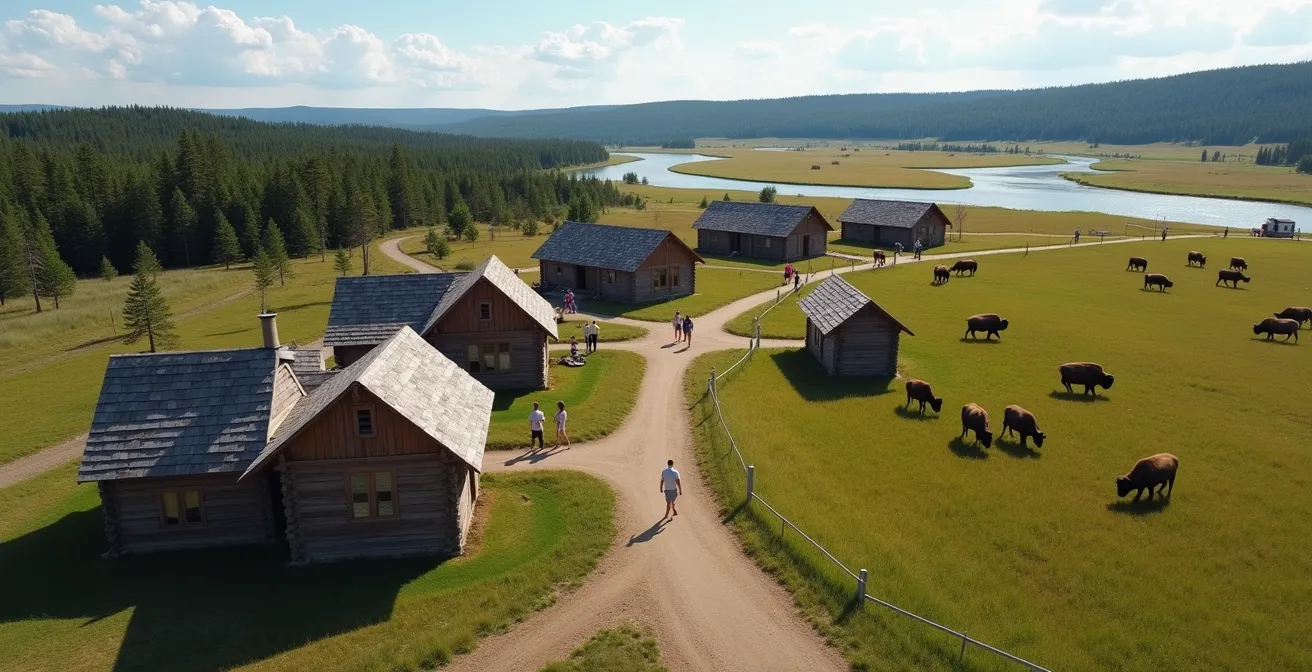
True understanding of Indigenous heritage sites comes from active participation in living culture, not just passive observation of historical artifacts.
- Oral histories are not myths; they are legally recognized records of a Nation’s relationship with their land.
- Traditional architecture, like cedar plank houses, is a sophisticated engineering response to a specific environment, not a primitive relic.
- Your visit becomes an act of reconciliation when you choose Indigenous-led experiences and ensure your support directly benefits the community.
Recommendation: Prioritize heritage sites that are Indigenous-owned and operated, offering interactive, Elder-guided programs that invite you to listen and learn.
There is a growing desire for authentic travel, a journey that connects us to place and people in a meaningful way. In Canada, this is especially true for Indigenous tourism; in fact, recent survey data shows that one in three international visitors expressed interest in these unique cultural experiences. Many arrive eager to learn but equipped with a collage of stereotypes—a mental checklist of tipis and totem poles that often has little to do with the specific Nation whose lands they are on. This can lead to a surface-level experience, a missed opportunity for genuine connection.
But what if the goal of a visit wasn’t simply to see artifacts behind glass or take photos of carvings? What if the key to a profound understanding of pre-contact life wasn’t just to look, but to listen? The true value of visiting a site like ‘Ksan Historical Village or Wanuskewin Heritage Park lies in shifting from a passive spectator to a respectful witness. It’s about learning to read the cultural landscape—from the engineering of a longhouse to the narrative woven into a pole—and recognizing the vibrant, living culture that continues to this day.
This guide is designed to help you make that shift. We will explore the sophisticated design of traditional homes, uncover the power of oral history as a legally valid record, learn to correctly interpret cultural symbols, and understand how your visit can be a meaningful act of support for Indigenous sovereignty. It’s an invitation to engage with history not as a static display, but as an ongoing story you have the privilege to hear.
To help you navigate this journey of understanding, this article breaks down the essential concepts for a respectful and enriching visit. The following sections will guide you through the key distinctions and knowledge needed to appreciate these cultural heritage sites on a deeper level.
Summary: A Visitor’s Guide to Living Indigenous History
- Why were cedar plank houses designed with removable roof boards?
- L’Anse aux Meadows or a reconstructed village: which offers better engagement?
- Why is listening to an Elder’s story more accurate than reading a plaque?
- The stereotype error that disappoints tourists looking for tipis on the West Coast
- How to ensure your entrance fee directly benefits the local First Nation?
- Artifacts or interaction: which offers a deeper understanding of current realities?
- Why is a mortuary pole distinct from a heraldic pole?
- How to read the hierarchy of figures on a totem pole correctly?
Why were cedar plank houses designed with removable roof boards?
When you stand before a traditional cedar plank house, you are not looking at a simple dwelling. You are seeing a marvel of architectural ingenuity designed for mobility and social expression. The iconic image of a West Coast longhouse is one of permanence, yet its design incorporates a brilliant system of portability that was central to the seasonal rhythms of life for nations like the Gitxsan.
The key lies in the construction. The main structure—a massive post-and-beam frame—was a permanent fixture in a village. However, the wall and roof planks were often individually owned by different families within the house group. These planks were meticulously crafted to be detached and transported. This wasn’t a flaw; it was a feature. This system allowed families to move essential parts of their homes between permanent winter villages and seasonal resource camps, such as those for the spring eulachon runs or summer salmon fishing on the Skeena River. This practice embodies a deep understanding of sustainability and modular design that predates modern concepts by centuries.
The removable planks also played a crucial social role. During a potlatch, a host’s ability to remove, transport, and reassemble their house planks was a powerful demonstration of wealth and status. It showcased their resources and the strength of their family group. Thus, the plank house was more than shelter; it was a dynamic tool for economic, social, and ceremonial life, perfectly adapted to the landscape.
This design philosophy reveals a worldview where homes are not static objects but are integrated into the very movement and cycles of the land and its people.
L’Anse aux Meadows or a reconstructed village: which offers better engagement?
Choosing a heritage site involves more than just picking a location; it’s about selecting the kind of experience you want to have. A visit to an archaeological site like L’Anse aux Meadows, a UNESCO World Heritage site marking a temporary Norse settlement, is fundamentally different from engaging with a living heritage site like ‘Ksan or Wanuskewin. While both are historically significant, they offer vastly different levels of cultural engagement and impact on reconciliation.
L’Anse aux Meadows is about observing the past of a departed culture through an academic, archaeological lens. Visitors are spectators to history. In contrast, sites like ‘Ksan (Gitxsan) and Wanuskewin (Northern Plains peoples) are Indigenous-led and community-controlled. Here, the visitor is invited not just to observe, but to participate in an ongoing story. You are not looking at a culture that has vanished; you are engaging with a living heritage that is present, evolving, and being actively shared by its members.
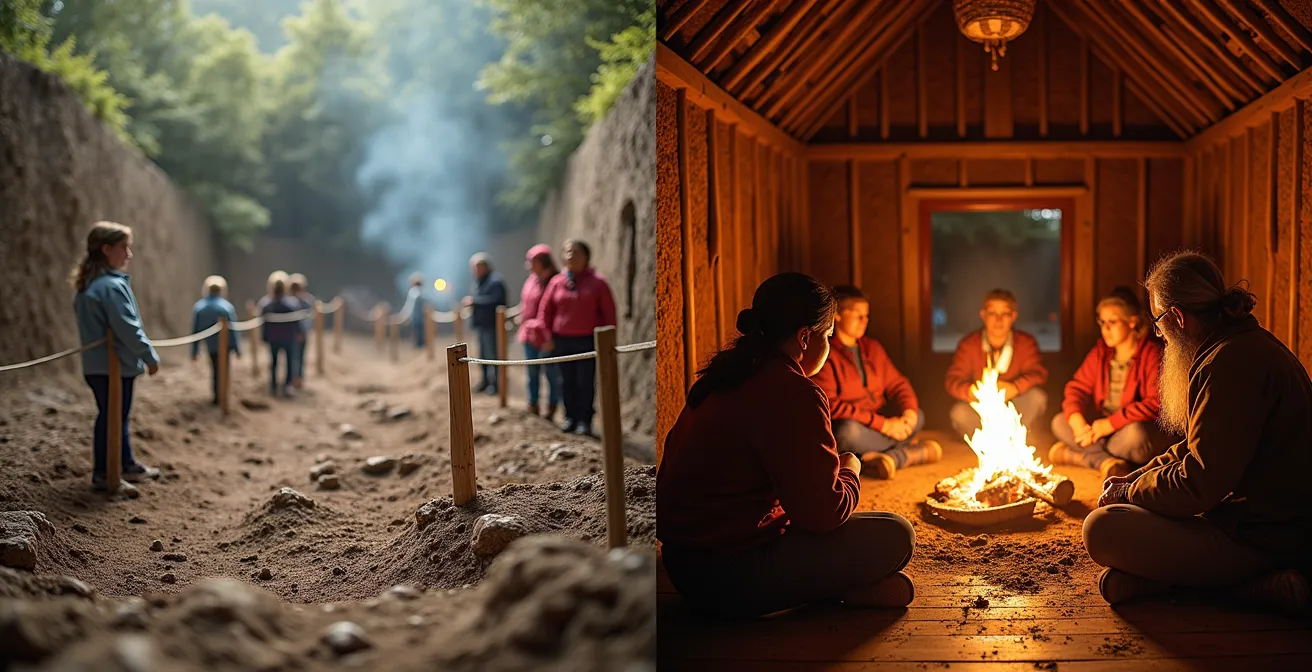
This distinction is crucial for any visitor seeking a deeper connection. At a living heritage site, interpretation is guided by Elders and knowledge keepers, grounding the experience in oral tradition rather than solely in academic findings. This shift transforms the visitor’s role from a passive consumer of information to an active listener who becomes part of the knowledge-sharing process.
The following table highlights the core differences between these two models of heritage presentation.
| Aspect | L’Anse aux Meadows (Archaeological) | ‘Ksan/Wanuskewin (Living Heritage) |
|---|---|---|
| Management Model | Federal/UNESCO top-down preservation | Indigenous-led, community-controlled |
| Cultural Status | Culture that departed (Norse) | Living culture still present |
| Visitor Role | Observer of historical evidence | Participant in ongoing story |
| Interpretation | Academic archaeological focus | Elder-guided oral tradition |
| Reconciliation Impact | Limited – external culture | Direct – promotes understanding |
Ultimately, choosing an Indigenous-led site offers a direct and meaningful contribution to reconciliation by fostering understanding and supporting the continuation of a vibrant culture.
Why is listening to an Elder’s story more accurate than a plaque?
In a world accustomed to written records, the idea that oral history could be more “accurate” than a museum plaque may seem counterintuitive. However, this perspective misunderstands the nature and rigour of Indigenous oral traditions. For First Nations like the Gitxsan and Wet’suwet’en, sacred oral histories, known as *adaawk* and *kungax*, are not simple folktales. They are meticulously preserved legal and historical archives that encode a Nation’s relationship to its territory, its laws, and its lineage.
These traditions are maintained through complex mnemonic systems and public witnessing. When a story is told in a ceremonial context, designated witnesses are responsible for memorizing it verbatim. Any deviation would be immediately corrected. This process ensures a level of accuracy and community validation that a static, unsigned plaque can never achieve. A plaque is an interpretation, often written by an outsider, frozen in time. An Elder’s story is a living transmission of knowledge, carrying context, nuance, and the spiritual weight of generations. It is an act of witnessing, not just reading.
The authority of these traditions is not just cultural; it is recognized in Canadian law. The landmark Delgamuukw court case fundamentally changed how the legal system views this knowledge. As the Supreme Court of Canada affirmed, oral history holds significant legal weight. The Gitxsan and Wet’suwet’en successfully used their oral histories as primary evidence of their historical and ongoing connection to their lands.
The Supreme Court of Canada’s ruling on December 11, 1997, addressed the use of oral history in testimony, recognizing that Aboriginal oral histories must be given significant weight in legal proceedings.
– Supreme Court of Canada, Delgamuukw v. British Columbia Decision
This precedent, as explained by legal analysts, transformed oral tradition from “myth” to legally admissible evidence, affirming that the Crown has a duty to consult with First Nations based on these histories. Therefore, when you listen to an Elder, you are engaging with a record more dynamic, context-rich, and legally significant than any text on a wall.
By choosing to listen, you are participating in a timeless process of knowledge-keeping and showing respect for a system of history that is both profound and legally binding.
The stereotype error that disappoints tourists looking for tipis on the West Coast
One of the most common cultural mistakes a visitor can make is to arrive on the Pacific coast of Canada expecting to see tipis. This expectation, born from a generalized and often Hollywood-driven image of “Indigenous people,” leads to disappointment and highlights a fundamental misunderstanding of Indigenous diversity. The tipi is a brilliant architectural solution, but it was developed for the specific needs of the mobile, buffalo-hunting nations of the Great Plains, where timber was scarce and portability was paramount.
On the West Coast, the environment is vastly different: a temperate rainforest with an abundance of monumental cedar trees and rich, permanent village sites along rivers and coastlines. In response to this specific ecology, nations like the Haida, Gitxsan, and Kwakwaka’wakw developed the cedar plank longhouse. These massive structures, sometimes hundreds of feet long, were perfectly suited to a wet climate and a more sedentary lifestyle based on fishing. The architecture is a direct reflection of the land itself.
To view West Coast culture through a “tipi lens” is to erase the unique ingenuity and distinct identity of the nations who call this place home. There is no single “Indigenous architecture”; there are hundreds of distinct traditions, each one a sophisticated response to a unique environment. Avoiding this stereotype is the first step toward genuine cultural appreciation.
The best practice for a visitor is to always start with two questions: “Which Nation’s territory am I on?” and “What is this land’s story?” This approach shifts the focus from a generic pan-Indigenous identity to the specific, local culture you are visiting. It opens the door to learning about the true architectural marvels of the region—the longhouses, the carved house posts, and the frontal totem poles that mark clan ownership and history.
By appreciating the plank house for what it is—a unique and brilliant adaptation—you begin to see the culture with clarity and respect.
How to ensure your entrance fee directly benefits the local First Nation?
As a cultural tourist, one of the most powerful ways to engage in reconciliation is with your wallet. Supporting Indigenous-led tourism is a direct investment in cultural revitalization, language preservation, and community well-being. However, not all sites that feature Indigenous culture are actually Indigenous-owned or operated. It is crucial to do a little research to ensure your visit contributes to economic sovereignty rather than cultural appropriation.
An authentic experience is one where the Nation itself is in control of its narrative and the economic benefits derived from it. When a First Nation owns and manages a heritage site, they ensure the stories are told correctly, the protocols are respected, and the revenue is funneled back into the community to support everything from education to Elder care programs. This creates a sustainable model where tourism becomes a tool for self-determination.
Fortunately, verifying Indigenous ownership is straightforward. Indigenous Tourism Canada has an accreditation program called the “Original Original” seal, which guarantees a business is at least 51% Indigenous-owned and controlled. Looking for this seal on a website is the easiest way to confirm authenticity. Additionally, exploring the “About Us” section of a site’s webpage can reveal its governance structure—look for a Board of Directors with clear First Nation representation or operation by the local Band Council.
Action Plan: Verifying Indigenous Ownership and Benefit
- Check the ‘About Us’ page for governance structure – look for Band Council operation or non-profit board with clear First Nation representation.
- Search for the ‘Original Original’ accreditation seal from Indigenous Tourism Canada, verifying at least 51% Indigenous ownership.
- Review if the site is listed on provincial Indigenous tourism association websites (e.g., Indigenous Tourism BC, Indigenous Tourism Ontario).
- Look for transparency about how revenues support community programs – education, language revitalization, Elder programs.
- Extend your impact by patronizing other Indigenous-owned businesses in the area – restaurants, galleries, guide services often listed on the heritage site’s website.
This conscious choice transforms you from a mere consumer into a supportive partner in the preservation and celebration of living Indigenous cultures.
Artifacts or interaction: which offers a deeper understanding of current realities?
A museum filled with artifacts under glass can teach us about the materials and tools of the past. But an artifact, isolated from its story and its people, can only offer a fragment of understanding. It presents culture as a static object, a relic of a time gone by. For a truly deep understanding of Indigenous realities, both past and present, nothing can replace direct interaction with knowledge keepers.
Sites like Wanuskewin Heritage Park embody this philosophy. Designated a National Historic Site for its nearly 6,400 years of Northern Plains peoples’ history, Wanuskewin is much more than an archaeological site. Through its living culture programs, it provides visitors with opportunities to engage directly with the history and ongoing traditions of the land. As a candidate for UNESCO World Heritage designation, Wanuskewin’s model is one of global significance, demonstrating how tourism can be a powerful vehicle for education and reconciliation. To learn more about their approach, you can visit their official site at Wanuskewin.com.
When you participate in a workshop, walk the land with a guide, or sit and listen to a story, the experience becomes relational. An artifact can’t answer your questions, convey emotion, or correct your misconceptions. A storyteller can. This interaction creates accountability; as a listener, you become a carrier of that story, charged with sharing it respectfully. You are no longer just learning *about* a culture; you are learning *from* it. This is the heart of living heritage.
This approach connects the past to the present in a powerful way. It helps visitors understand that Indigenous cultures are not confined to history books; they are vibrant, contemporary, and continuously evolving. It bridges the gap between the ancient artifacts being unearthed and the modern-day aspirations of the communities descended from those who made them.
Ultimately, while artifacts provide evidence, it is human interaction that provides meaning, context, and a genuine path toward understanding current realities.
Why is a mortuary pole distinct from a heraldic pole?
To the untrained eye, all totem poles might look similar—towering cedar monuments covered in carved figures. However, lumping them all together is like saying all books are the same. Different types of poles serve vastly different functions, and understanding these distinctions is a key step in developing cultural literacy. Two of the most important, yet often confused, types are mortuary poles and heraldic poles.
A mortuary pole has a specific funerary purpose. It is designed to house the remains of a high-ranking individual, which are placed in a bentwood box and set within a cavity in the pole. The figures carved on it relate to the deceased’s clan and accomplishments. Its raising is part of a specific set of funerary rites and ceremonies, marking the passing of an important person.
A heraldic pole, on the other hand, is not a funerary object. It is a public declaration, a legal document carved in cedar. It displays a family’s crests, lineages, and, most importantly, its rights and claims to specific territories, stories, and resources. Raising a heraldic pole, often during a potlatch, is a major public event where other clans must be present to witness and validate these claims. This act of witnessing makes the pole’s declarations legally binding under Indigenous law. ‘Ksan Historical Village’s collection, with its vast array of ceremonial items, showcases the world in which these poles function as both art and law.
The following table clarifies the fundamental differences:
| Aspect | Mortuary Pole | Heraldic Pole |
|---|---|---|
| Primary Function | Funerary object containing remains | Legal document and family history |
| Contents | Bentwood box with deceased’s remains | Family crests, rights, and stories |
| Ceremonial Context | Specific funerary rites | Public declaration at potlatch |
| Legal Significance | Marks passing of individual | Validates territorial claims |
| Witnesses Required | Family and clan members | Multiple clans for validation |
Recognizing this difference allows a visitor to move beyond simple aesthetic appreciation and begin to understand the complex social and legal systems encoded in these magnificent monuments.
Key Takeaways
- True understanding comes from engagement, not just observation. Prioritize interactive experiences led by Indigenous knowledge keepers.
- Indigenous architecture and art are sophisticated, purpose-driven systems. Learn their “language” to appreciate their true meaning.
- Your visit is an opportunity for economic reconciliation. Consciously choose to support Indigenous-owned and operated tourism ventures.
How to read the hierarchy of figures on a totem pole correctly?
One of the most pervasive misconceptions about totem poles is captured in the English idiom “low man on the totem pole,” implying least important. This is completely wrong. Learning to read the narrative of a pole requires unlearning this idea and embracing a different way of seeing. A totem pole is not a ladder of importance; it is a visual story.
The figures on a pole are characters in a narrative that often documents family history, rights, or significant events. Their position is about narrative flow, not a top-to-bottom ranking. In many traditions, the figure at the bottom is actually the most important, representing the primary crest of the pole’s owner or the foundation of the story being told. To read a pole, you must look for the relationships between the figures: Is one wearing another as a hat? Is a figure emerging from another’s mouth? Are they intertwined? These connections are the grammar of the story.
Here is a basic guide to help you begin to interpret these incredible narratives:
- Start at the bottom: The foundational figure often grounds the entire story and can represent the main owner or crest.
- Look for relationships: The way figures interact (touching, transforming, containing) is the key to the plot. It shows connection and lineage.
- Identify the narrative flow: Instead of a ranking, see it as a sequence of events or a cast of characters related to a central theme. The pole tells a story, not a hierarchy.
- Note regional variations: Carving styles and narrative conventions differ significantly between Nations like the Gitxsan, Haida, and Kwakwaka’wakw. There is no single universal way to read a pole.
- Always ask which Nation created it: The most important step is understanding the specific cultural context. A guide from that Nation can unlock the pole’s true meaning.
This shift in perspective is a final, crucial step in your journey. It allows you to see these poles not as silent objects, but as powerful, speaking documents that continue to proclaim the identity, history, and rights of the people who raised them.
Frequently Asked Questions About Visiting Indigenous Heritage Sites
Why don’t West Coast Indigenous peoples use tipis?
West Coast nations developed cedar plank houses suited to temperate rainforests with abundant wood, permanent village sites, and heavy rainfall. Tipis were brilliantly designed for the Plains nations’ mobile buffalo-hunting lifestyle where wood was scarce but hides were plentiful.
What architectural forms are actually found on the West Coast?
Traditional West Coast architecture includes massive cedar plank longhouses, some reaching 200 feet in length, with distinctive painted facades, carved house posts, and frontal totem poles marking clan ownership.
How can visitors avoid perpetuating stereotypes?
Always ask ‘Which Nation?’ and ‘What land?’ when visiting Indigenous sites. Each nation developed unique architectural responses to their specific environment – there are over 200 distinct First Nations in Canada with diverse building traditions.
Does ‘low man on the totem pole’ mean least important?
No, this English idiom is completely incorrect. The bottom figure is often the most important, serving as the foundation of the entire narrative and frequently representing the most significant family crest.