
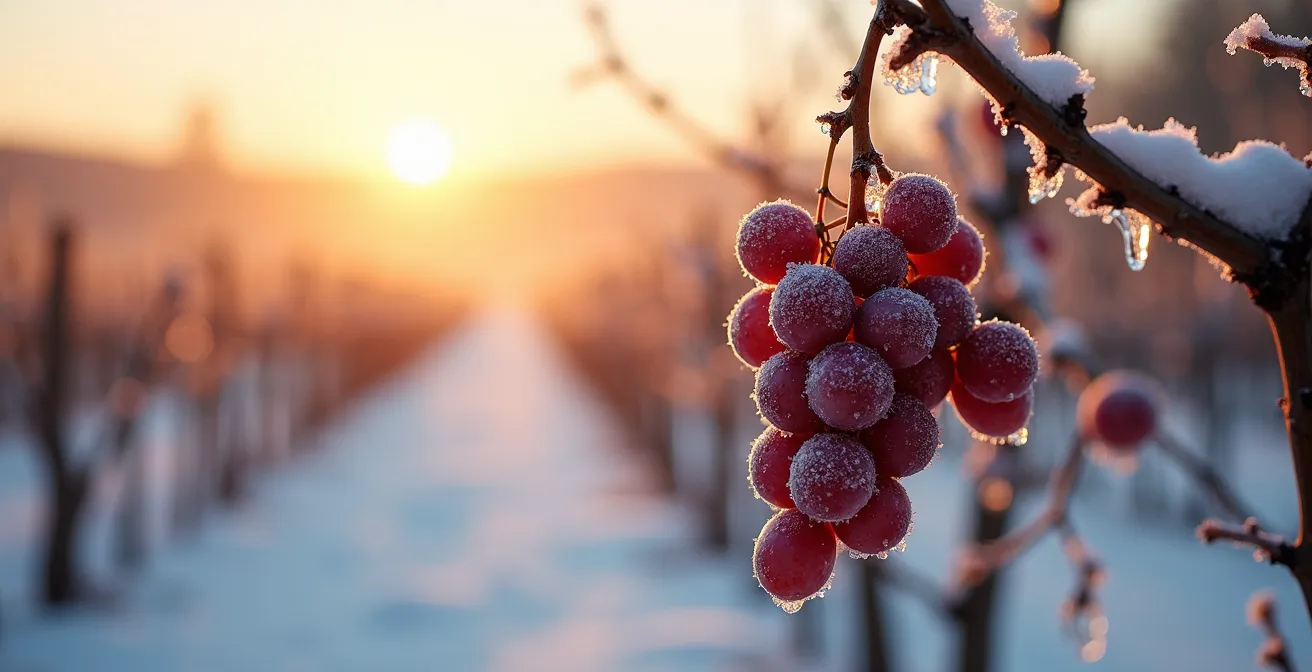
The high price of Canadian Icewine is not due to risk, but to a legally-enforced guarantee of quality and flavour concentration that table wine cannot match.
- Authentic Icewine requires grapes to freeze naturally on the vine at -8°C, concentrating sugars and acids into a low-yield, high-value essence.
- The Vintners Quality Alliance (VQA) designation is a legal assurance that 100% of the grapes are Canadian and have met these stringent production standards.
Recommendation: Instead of viewing Icewine as an expense, approach it as an investment in a unique sensory experience, best enjoyed chilled and paired with rich foods or complex cheeses.
To stand before a bottle of authentic Canadian Icewine is to confront a paradox. The slender 375ml bottle often carries a price tag that rivals, or even surpasses, that of a premium full-sized bottle of table wine. For many, this induces a moment of sticker shock, a quiet question of “Why?”. The common answer you might hear revolves around risk—the perils of leaving grapes on the vine into the depths of a Canadian winter, battling birds, rot, and unpredictable weather. While true, this explanation is incomplete. It frames Icewine as a product of chance rather than one of calculated, legislated artistry.
The real story of its value lies not in the gamble, but in the guarantee. The cost is a direct reflection of a meticulous, non-negotiable process enshrined in Canadian wine law. Originating as German *Eiswein*, the practice was perfected in Canada, where our climate provides the ideal, consistent conditions for its production. The journey from vine to “liquid gold” is one of extreme concentration, where quantity is sacrificed for an unparalleled quality of flavour, aroma, and acidity. Understanding this process transforms the perception of price from a barrier into a beacon of authenticity and sensory excellence.
This guide moves beyond the surface-level explanations. As a sommelier, I will walk you through the precise science of the harvest, the meaning behind the VQA seal on the bottle, the distinct terroirs that shape its character, and the proper ways to serve and enjoy this national treasure. By the end, you will not only understand the price but appreciate the immense value sealed within each precious drop.
To fully grasp the dedication behind each bottle, this article will explore the legally mandated production standards, the unique Canadian regions, the art of reading the label, and the best ways to experience Icewine, from serving it at home to visiting the wineries themselves. Here is a look at the journey we will take.
Summary: The art of ice: Why authentic Canadian Icewine commands a premium
- Why must grapes be picked at exactly -8°C to qualify as Icewine?
- Limestone mineral or desert heat: which region produces the Pinot Noir you prefer?
- How to read the bottle to ensure you are getting 100% Canadian grapes?
- The error of aging Icewine too long or serving it at room temperature
- When to visit Niagara to taste the new vintage in the snow?
- Canola, wheat, or flax: how to tell what is growing in the yellow and blue fields?
- More meat or sweeter taste: which lobster version is the better deal?
- How to attend a winery workshop to learn the art of food and wine pairing?
Why must grapes be picked at exactly -8°C to qualify as Icewine?
The magic number of -8°C (17°F) is not an arbitrary guideline; it is the cornerstone of Canadian wine law and the VQA (Vintners Quality Alliance) standard for Icewine. At this precise temperature, the water inside the grapes freezes solid, but the sugars, acids, and flavour compounds do not. When these frozen grapes are pressed, the ice remains behind, allowing vintners to extract a tiny amount of highly concentrated, syrupy must. This natural concentration process is what gives Icewine its signature intensity and luscious sweetness, balanced by a vibrant acidity. The law is strict: grapes must freeze naturally on the vine, a process that cannot be artificially replicated.
This legal requirement ensures a minimum sugar level in the juice. According to Canadian wine law and VQA regulations, the must has to reach a reading of at least 35 degrees Brix. This is a significantly higher standard of concentration than in many other parts of the world, including Germany. It is this legislated quality, this non-negotiable protocol, that begins to explain the price. Winemakers are not just waiting for a frost; they are waiting for the exact conditions that legally qualify their harvest as the authentic article.
The 1999 Incident That Solidified VQA Rules
The seriousness of the “natural freeze” rule was cemented after an incident in 2000. Following a mild winter in 1999, a producer in British Columbia attempted to circumvent the rules by physically transporting grapes up a mountain to find colder temperatures. This action prompted a swift regulatory crackdown, leading to stricter enforcement. The VQA rules now unequivocally state that the grapes must achieve their frozen state in the vineyard where they were grown, ensuring the wine’s character is a true expression of its specific place and vintage.
Therefore, the -8°C mandate is the first and most critical gatekeeper of quality. It forces an incredibly low yield but guarantees an incredibly high concentration of flavour, transforming a simple grape into the essence of winter.
Limestone mineral or desert heat: which region produces the Pinot Noir you prefer?
While the title mentions Pinot Noir, a grape that can make exquisite red Icewine, the principle applies to all varietals: terroir is king. Canada’s two primary Icewine regions, Ontario’s Niagara Peninsula and British Columbia’s Okanagan Valley, produce distinctly different styles of this liquid gold, shaped by their unique climates and geology. While Ontario dominates in sheer volume, with an output of over 800,000 litres in a single year, the discerning palate will find value in understanding the nuanced differences between the regions.
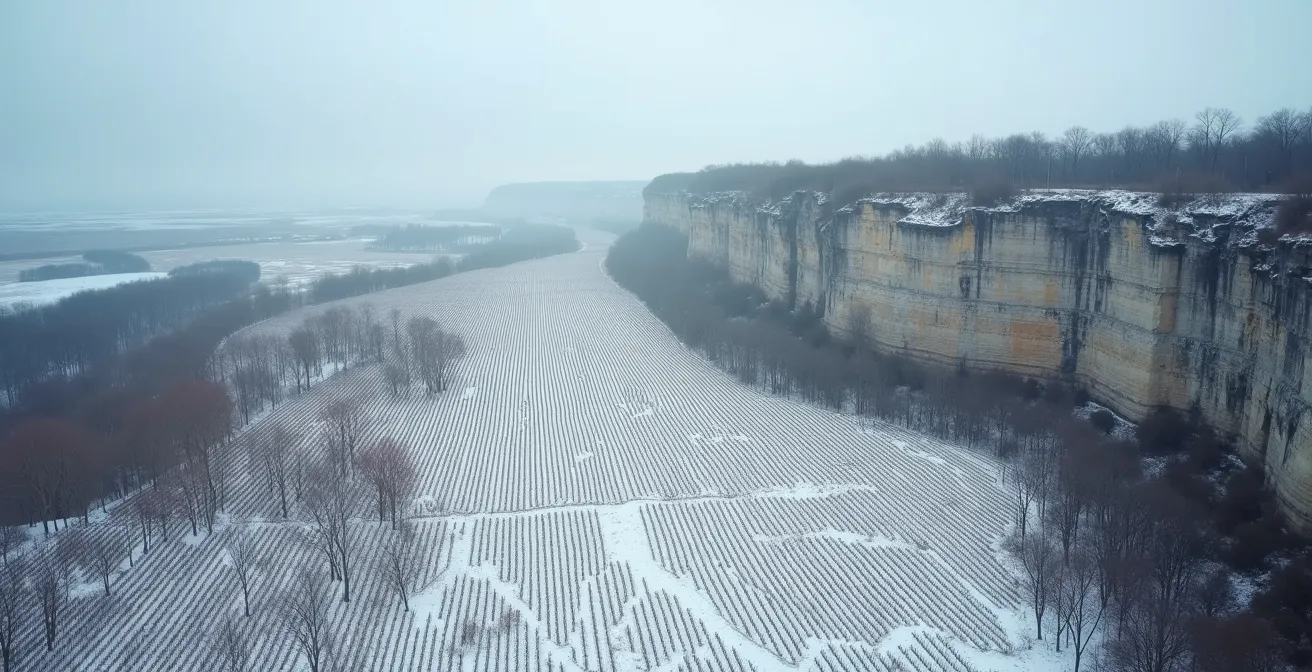
The Niagara Peninsula, nestled between Lake Ontario and the Niagara Escarpment, benefits from a unique microclimate. The lake moderates temperatures, and the limestone-rich soils of the “bench” escarpment impart a distinct minerality. This terroir is particularly suited to grapes like Vidal, a thick-skinned hybrid that can withstand the harsh winter conditions and is susceptible to “noble rot” (Botrytis cinerea), adding layers of complexity like honey and marmalade to the final wine. Riesling from Niagara often shows notes of tropical fruit balanced by that signature acidity.
Conversely, the Okanagan Valley in British Columbia is a semi-arid desert. The hot, dry days and cool nights lead to grapes with intense, pure fruit flavours and racy acidity. Riesling is the star here, producing Icewines that are often more fruit-forward, crisp, and precise compared to their more complex Niagara counterparts. The choice between them is not about which is “better,” but about personal preference: do you favour the complex, botrytized, mineral-driven profile of Niagara, or the pure, vibrant, fruit-focused character of the Okanagan?
| Region | Climate | Primary Grape | Terroir Impact |
|---|---|---|---|
| Niagara Peninsula | Humid, Lake Ontario influence | Vidal (thick-skinned hybrid) | Potential for noble rot (Botrytis), complex tropical notes |
| Okanagan Valley, BC | Dry, desert-like conditions | Riesling | Purer fruit-forward profile, crisp acidity |
How to read the bottle to ensure you are getting 100% Canadian grapes?
In a global market where imitation is rampant, knowing how to authenticate a bottle of Canadian Icewine is crucial. The Vintners Quality Alliance (VQA) is your single most important ally. This seal is not a marketing sticker; it is a legal guarantee of origin and quality. It certifies that the wine is made from 100% Canadian-grown grapes and has met all the stringent production standards, including the -8°C harvest. The prevalence of fraudulent products is staggering; the Canadian Vintners Association has estimated a counterfeit rate as high as 50% in some Southeast Asian markets. This fact alone underscores why paying the premium for a VQA-certified bottle is an investment in authenticity.
But the VQA seal is just the beginning. The label holds a wealth of information that allows you to trace the wine’s specific origins, which directly impacts its flavour profile and quality. Looking for a specific regional appellation, such as ‘Niagara Peninsula’ or ‘Okanagan Valley’, guarantees that 100% of the grapes were grown in that designated area, offering a true taste of its unique terroir. The label will also specify the vintage (the year the grapes were harvested) and the varietal (the type of grape used, like Vidal, Riesling, or Cabernet Franc). Learning to decipher these details empowers you to make an informed choice and ensures you are getting the genuine, high-quality product you are paying for.
Your action plan: Verifying authentic Canadian VQA Icewine
- One Word Only: Look for ‘Icewine’ written as a single, protected term on the label. If it is spelled ‘Ice Wine’ (two words), it is not VQA-certified.
- Find the Medallion: Verify that the official VQA medallion is displayed on the bottle, indicating its provincial origin (either ‘VQA Ontario VQA’ or ‘BC VQA’).
- Check the Appellation: Look for a specific regional designation like ‘Niagara Peninsula’ or ‘Okanagan Valley’. This guarantees 100% of grapes are from that region, offering a higher tier of quality and terroir expression.
- Confirm the Bottle Size: Authentic Canadian Icewine is almost exclusively sold in 375ml (or sometimes 200ml) bottles. Be wary of smaller or unusual formats.
- Purchase from Reputable Sources: For a 100% authenticity guarantee, buy from official provincial liquor boards like the LCBO, SAQ, or BCL, or directly from the winery.
By following these steps, you are not just buying a bottle of wine; you are acquiring a piece of legally protected Canadian agricultural art, secure in its origin and quality.
The error of aging Icewine too long or serving it at room temperature
One of the most common misconceptions about Icewine is that, due to its sweetness, it should be treated like a simple dessert beverage—served warm and consumed quickly. This is a fundamental error that can rob you of the complex sensory experience you’ve invested in. The key to unlocking Icewine’s potential lies in temperature. Its high sugar content is brilliantly balanced by an equally high, piercing acidity. Serving it at room temperature masks this acidity, making the wine taste cloying and one-dimensional. The ideal serving temperature is between 10-12°C (50-54°F). This can be achieved by placing the bottle in the refrigerator for about two hours before serving. This chill elevates the acidity, which in turn lifts the complex aromas of tropical fruit, honey, and stone fruit, creating a vibrant and refreshing experience on the palate.
Another point of confusion is aging. While many Icewines are beautiful upon release, the idea that they cannot or should not be aged is false. In fact, high-quality Icewines, particularly those made from Riesling or Cabernet Franc, have remarkable aging potential. As Wine Country Ontario notes in its guidelines:
High-quality Riesling or Cabernet Franc Icewines from top Canadian vintages can age beautifully for over a decade, developing complex notes of marmalade, toffee, and nuts
– Wine Country Ontario, Icewine Aging Guidelines
Proper cellaring allows the wine’s primary fruit notes to evolve into a stunning array of tertiary aromas, adding layers of depth and complexity. So, while you can certainly enjoy a young Icewine, holding onto a top-vintage bottle can yield an extraordinary reward down the line. To ensure you are serving it perfectly, whether young or old, follow these simple temperature guidelines:
- Chill the bottle to 10-12°C (50-54°F) before opening.
- For rapid chilling, place the bottle in an ice bucket with water and salt for about 15 minutes.
- A classic Canadian winter tip: place the bottle in clean, fresh snow for 20-30 minutes.
- Once opened, a resealed bottle of Icewine will keep beautifully in the refrigerator for several weeks, thanks to its high sugar content acting as a natural preservative.
When to visit Niagara to taste the new vintage in the snow?
To truly understand the soul of Icewine, one must experience the landscape from which it is born. There is no better time to do this than during the annual Niagara Icewine Festival, a multi-weekend celebration held every January. This is not just a tasting event; it’s an immersion into the culture of Canadian winter winemaking. Wineries across the region open their doors, offering unique pairings and experiences that connect you directly to the vintage. The festival’s “Discovery Pass” is your passport to this world, providing a curated series of tasting experiences at various estates.
Imagine sipping a newly released vintage, its sweetness and acidity dancing on your tongue, while surrounded by the very snow-covered vineyards where the grapes were harvested just weeks before. The festival transforms the entire region, with highlights like the elegant Cool As Ice Gala and the enchanting Niagara-on-the-Lake Icewine Village, where Queen Street becomes an outdoor celebration of wine, food, and ice sculptures. Visiting during this time offers a profound, visceral connection to the wine, transforming your understanding from an intellectual appreciation to an emotional one.

Planning Your Trip: The 2025 Niagara Icewine Festival
The festival typically runs across three weekends in January. For 2025, the dates are set for January 10-12, 17-19, and 24-26. A Discovery Pass, priced around $57.50, grants access to six distinct winery experiences. Marquee events include the Cool As Ice Gala at the historic Niagara Parks Power Station on January 18, and the lively Niagara-on-the-Lake Icewine Village, which transforms the town’s main street into a winter wonderland on the weekends of January 18-19 and 25-26. It is the ultimate pilgrimage for any Icewine enthusiast.
This firsthand experience, tasting the wine in its native, frozen element, provides the ultimate justification for its price. You are not just buying a beverage; you are buying a story, a climate, and a uniquely Canadian tradition.
Canola, wheat, or flax: how to tell what is growing in the yellow and blue fields?
While the vast, colourful fields of the Canadian Prairies represent an immense scale of agricultural production, Icewine tells a story of value, not volume. The question isn’t about identifying commodity crops, but about understanding the profound economic and agricultural difference between them and the grapes destined for Icewine. A field of canola produces tonnes of oil, a high-volume, low-margin product. In contrast, a vineyard row of frozen grapes produces a mere fraction of its potential volume, but each drop is exponentially more valuable. This is the essence of Icewine’s price: it is an economy of concentration.
Consider the raw numbers. It takes an astonishing amount of grapes to produce a single, small bottle of Icewine. As the experts at Wine Country Ontario point out, the sacrifice is immense:
It takes about 3.5 kilograms of Riesling grapes or three kilograms of Vidal grapes to produce one 375-millilitre bottle of Icewine – the same grapes would produce six to seven times as much table wine
– Wine Country Ontario, Icewine Production Facts
This statistic is the heart of the matter. The winemaker makes a conscious decision to sacrifice up to 85% of their potential table wine production to create a small quantity of this elixir. This economic choice, dictated by the pursuit of quality over quantity, is built into every bottle. While the vast prairie fields generate wealth through scale, Canada’s Icewine industry generates a remarkable $70 million in retail value from just 2.5 million bottles annually. It is a boutique industry focused on creating a luxury good, where the value is measured not in tonnes per acre, but in the intensity of flavour captured in each frozen grape.
So, while the golden fields of canola are a symbol of Canada’s agricultural breadth, the snow-dusted vines of Niagara and the Okanagan are a symbol of its depth, representing a commitment to quality that commands a premium.
More meat or sweeter taste: which lobster version is the better deal?
This question, seemingly about seafood, elegantly pivots to one of the most sophisticated and surprising aspects of Icewine: its incredible versatility in food pairing, especially with rich, savoury dishes. The old rule of “dessert wine for dessert” is a limiting platitude. The true connoisseur understands that Icewine’s secret weapon is its high acidity. When paired with a rich food like butter-poached lobster, the wine’s sweetness complements the natural sweetness of the shellfish, while its razor-sharp acidity cuts through the richness of the butter, cleansing the palate and preparing it for the next bite. It’s a dynamic and exciting pairing that elevates both the food and the wine.
The “better deal” is not about choosing a type of lobster, but about unlocking a better dining experience by using Icewine as a powerful culinary tool. This principle extends beyond lobster to a range of decadent foods. The wine’s dual nature of sweetness and acidity makes it a perfect partner for seared scallops, foie gras, rich pâtés, and salty, complex blue cheeses. The wine acts as both a complement and a contrast, creating a gastronomic experience that is far more interesting than a simple sweet-on-sweet dessert pairing. A young, vibrant Riesling Icewine might be perfect for seafood, while an older, nuttier Vidal Icewine could be stunning with a cheese course.
Ultimately, understanding how to pair Icewine opens up a new world of possibilities. It transforms the bottle from a simple after-dinner treat into a versatile and valuable component of a fine dining experience, further justifying its position as a premium product in any sophisticated cellar.
Key takeaways
- The -8°C harvest rule is a legal VQA mandate, not a suggestion, ensuring extreme flavour concentration.
- The VQA seal is a guarantee of 100% Canadian origin, protecting you from a market with high rates of counterfeit products.
- Icewine’s value comes from its incredibly low yield; the grapes for one bottle of Icewine could make 6-7 bottles of table wine.
How to attend a winery workshop to learn the art of food and wine pairing?
Reading about the art of pairing is one thing; experiencing it firsthand is another. The best way to deepen your appreciation for Icewine is to learn directly from the experts who create it. Many of Canada’s top wineries offer dedicated workshops and tasting experiences designed to demystify the art of food and wine pairing. These sessions move beyond generic advice, offering curated, hands-on opportunities to understand how Icewine’s sweetness and acidity interact with different culinary components like salt, fat, and spice.
These workshops are more than just tastings; they are educational investments. You gain practical knowledge that you can apply at home, transforming the way you host dinners and enjoy wine. Wineries like Inniskillin, the pioneer of modern Canadian Icewine, offer tours that include specific chocolate pairings, while others, like Wayne Gretzky Estates, focus on pairings with fine Canadian cheeses. These experiences provide the context and confidence to use Icewine as the versatile culinary tool it truly is.
The Peller Estates 10Below Icewine Lounge
For a truly unique educational experience, Peller Estates in Niagara-on-the-Lake has created an immersive “10Below Icewine Lounge.” This igloo-like structure is kept at -10°C, simulating the exact conditions of the winter harvest. Visitors can don parkas and step inside to sample various Icewines, including their Oak Aged Vidal, while learning about the production process from a wine consultant. The experience includes expertly chosen food pairings, providing a memorable and tangible lesson in why temperature and context are so crucial to the enjoyment of Icewine. It’s available year-round, making it an accessible way to connect with the heart of the harvest.
Attending a workshop is the final step in your journey from a curious buyer to an informed enthusiast. A selection of top wineries across Canada offer exceptional pairing experiences:
- Inniskillin Estates (ON): Offers historic tours with specific Icewine and chocolate pairings in their Founders’ Hall.
- Mission Hill Family Estate (BC): Hosts seasonal pairing dinners in their stunning underground cellar in the Okanagan Valley.
- Nk’Mip Cellars (BC): Canada’s first Indigenous-owned winery provides unique cultural food pairings that connect wine to the land.
- Trius Winery (ON): Features an annual Icewine-themed dinner in their Red Barrel Cellar during the January festival.
- Wayne Gretzky Estates (ON): Provides “No. 99” tasting experiences that often feature pairings with a selection of Canadian cheeses.
Now armed with a deeper understanding of Icewine’s legislated quality and sensory complexity, the next logical step is to confidently explore this category. Begin by visiting your local VQA-approved retailer and applying your new knowledge to select a bottle that speaks to a specific region or grape varietal that intrigues you.
Frequently asked questions about Why is authentic Icewine so expensive compared to table wine?
Why does Icewine pair well with rich seafood like lobster?
The razor-sharp acidity in Canadian Riesling Icewine cuts through butter and cream sauces, while the wine’s residual sweetness complements the natural sweetness of lobster meat.
What other seafood pairs well with Canadian Icewine?
Seared scallops, foie gras, and rich pâtés all benefit from Icewine’s balance of sweetness and acidity.
Should Icewine be served before or after the seafood course?
Icewine can be served as a starter with pâté or foie gras, or alongside the main seafood course when paired appropriately.