
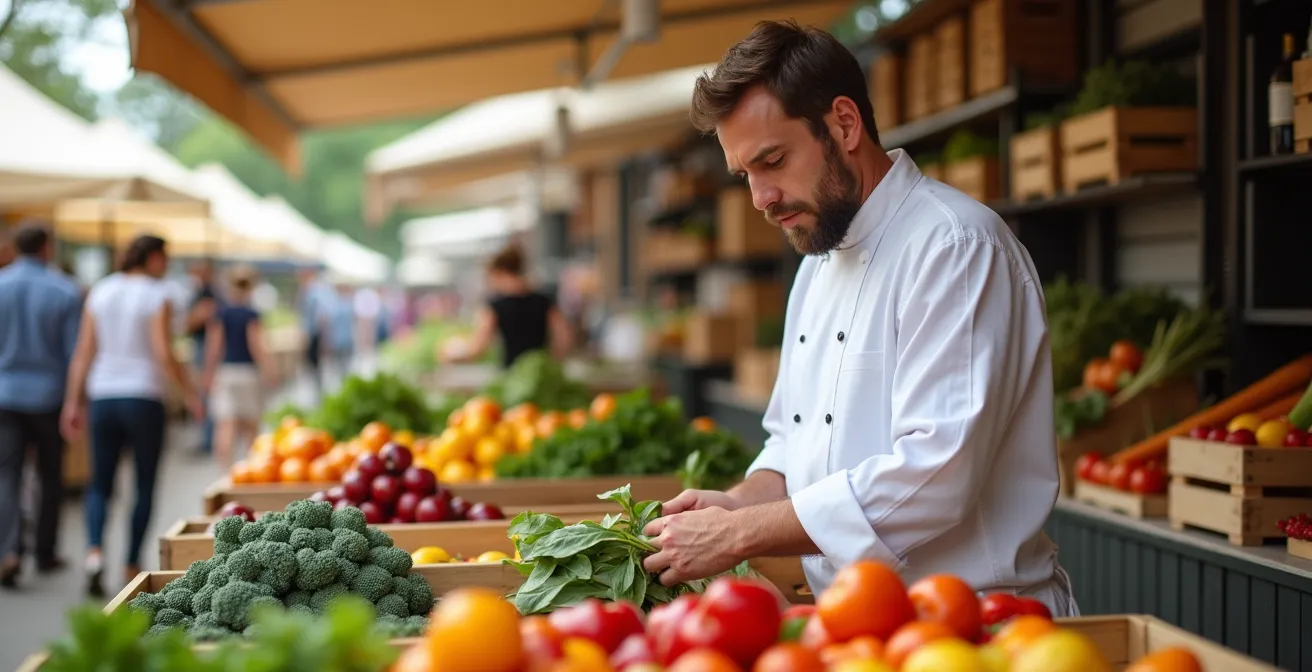
To truly shop like a chef, you must abandon the tourist mindset and adopt a strategy of professional procurement.
- The best value comes from primo ingredients at opening, not discounted leftovers at closing.
- Authenticity isn’t just a label; it’s a verifiable trail from a specific farm or region to the vendor’s stall.
Recommendation: Shift your goal from simply ‘buying food’ to ‘sourcing components,’ where every choice—from market selection to timing—is a deliberate step in crafting an exceptional meal.
The moment you step into one of Canada’s great public markets, like Granville Island in Vancouver or St. Lawrence in Toronto, the sensory overload is immediate. The vibrant colours, the symphony of voices, the intoxicating smells—it’s a thrilling chaos designed to overwhelm. For most visitors, it’s a delightful maze where they wander, sample, and buy what looks good. But watch a local chef navigate the same space. There’s no aimless wandering. Every movement is precise, every conversation is strategic, and every purchase is a calculated decision. They aren’t just shopping; they are executing a culinary mission.
Many guides will tell you to “go early” or “talk to vendors.” This is basic advice. The real craft lies in understanding the subtle codes and rhythms of the market ecosystem. It’s knowing how to spot a genuinely tree-ripened Okanagan peach versus a cosmetically perfect import, or why a chef planning a traditional Quebec Réveillon dinner heads to Jean-Talon Market while one curating a gourmet New Year’s Eve menu chooses Atwater. This isn’t about finding the obvious; it’s about uncovering quality through practiced expertise.
But what if the secret to mastering these markets wasn’t about having a longer shopping list, but about having a sharper strategy? The key is to shift your mindset from a passive consumer to an active procurer. This guide will move beyond the platitudes and decode the professional’s playbook. We will deconstruct iconic Canadian dishes to understand their components, learn the techniques to verify regional authenticity, and reveal the strategic thinking that dictates which market to visit, what time to arrive, and how to bring your precious haul home intact. Prepare to transform your next market visit from a simple trip into a masterclass in culinary sourcing.
This article provides a complete framework for navigating Canada’s premier public markets with the discerning eye of a chef. The following sections break down every aspect of this strategic approach, from deconstructing a signature dish to making the final call on a guided tour.
Summary: How to Shop at a Canadian Public Market Like a Chef
- Why is this specific sandwich considered Toronto’s signature dish?
- How to tell if the peaches are truly from the Okanagan or imported?
- Huge variety or gourmet specialty: which Montreal market suits your shopping list?
- The error of buying fresh sausages that you can’t bring back across the border
- When to arrive at the market to get end-of-day discounts from vendors?
- West Coast seafood or Boreal game: which culinary region suits your palate?
- The storage mistake that melts your cheese haul in a hot car trunk
- Are guided food tours in Toronto’s Kensington Market worth the $100 price tag?
Why is This Specific Sandwich Considered Toronto’s Signature Dish?
Understanding a local market begins with deconstructing its most iconic dish. In Toronto’s St. Lawrence Market, that dish is unequivocally the peameal bacon sandwich. It’s more than just a snack; it’s a taste of the city’s history. To shop like a chef, you must understand the ‘why’ behind the ingredients. The sandwich’s status isn’t an accident but a direct result of Toronto’s industrial past as “Hogtown.” The entire identity of the area is built on this history, and the sandwich is its most delicious artifact. According to historical records, the peameal bacon style was developed in the 19th century by William Davies, a pork packer whose company became the largest pork exporter in the British Empire and cemented the city’s nickname.
A chef doesn’t just buy peameal bacon; they analyze its construction. The classic sandwich is a study in simplicity, but perfection lies in the details. The foundation must be a fresh-baked Kaiser roll, chosen for its ability to provide a soft-yet-sturdy contrast to the meat. The bacon itself, sourced from a quality center-cut loin, should be sliced into thick slabs—about a quarter to a third of an inch—and griddled so the edges become crisp while the center remains succulent. While purists insist on nothing more, a chef considers strategic upgrades. A touch of honey mustard can cut through the richness, and for a more substantial meal, additions like aged Canadian cheddar or a fried egg elevate it from a simple sandwich to a complete dish. In 2016, the peameal bacon sandwich was officially named Toronto’s signature dish, solidifying its cultural importance.
How to Tell if the Peaches are Truly From the Okanagan or Imported?
A chef’s primary skill in a market is discernment—the ability to distinguish true quality and origin from clever marketing. Nowhere is this more crucial than with seasonal produce like British Columbia’s famed Okanagan peaches. An imported peach can look the part, but it will never deliver the same flavour as one ripened by the region’s dry, intense heat. Your first line of defense is certification. Look for official ‘BC Grown’ logos on vendor displays. If you don’t see one, ask to see their certification. A legitimate seller will be proud to show it.
Next, engage in what chefs call vendor intelligence. Instead of asking “Are these local?”, ask a more specific question: “Which orchard are these from?” A genuine seller will instantly respond with a specific name like ‘Keremeos’ or ‘Oliver.’ Hesitation is a red flag. The most definitive test, however, bypasses conversation entirely: the stem-end smell test. A true tree-ripened Okanagan peach emits an intense, sweet, and floral aroma from the spot where it was attached to the branch. An imported peach, picked green for shipping, will have a faint, grassy, or non-existent smell. This single sensory check is often all a professional needs to confirm authenticity.
Finally, a chef shops with a calendar in mind. They know that early-season Redhaven peaches arrive in July, but the legendary, intensely sweet Freestone varieties don’t peak until August. Buying “Okanagan” peaches in June is a sign that you’re either misinformed or being misled. This combination of visual verification, direct questioning, and sensory analysis is the core of strategic produce procurement.
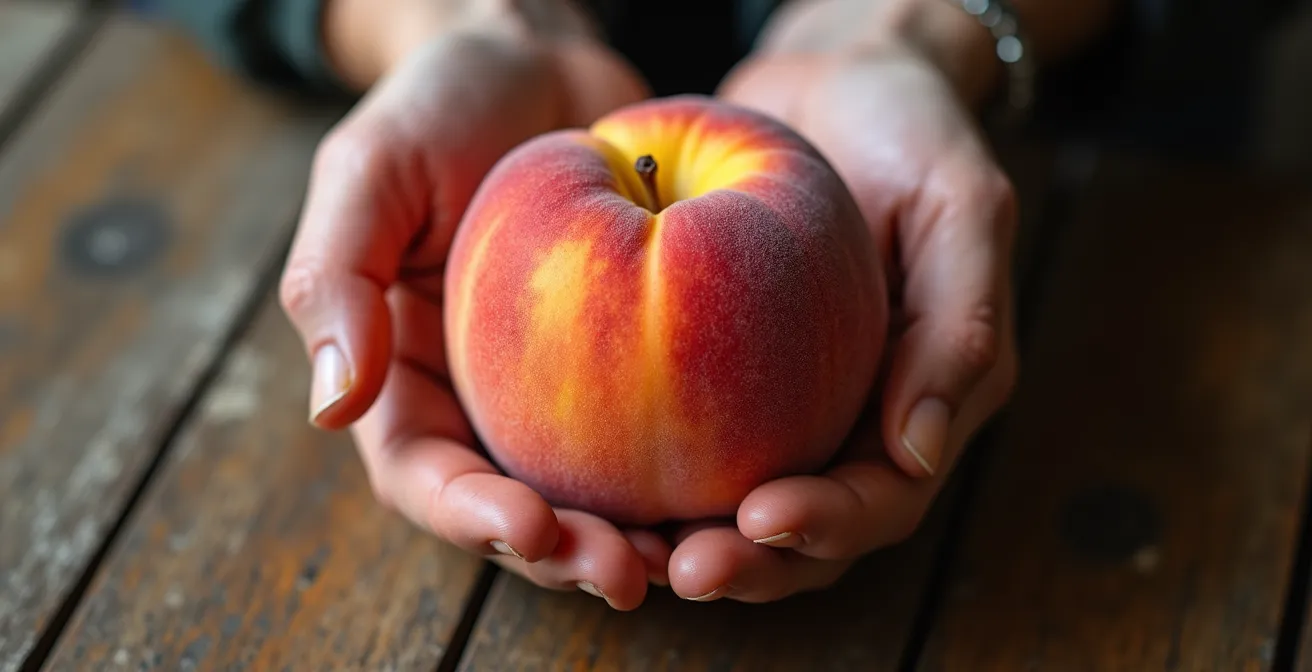
As you can see, the fuzzy texture and deep, natural colour blush are hallmarks of a peach that has ripened on the tree, absorbing every last bit of sun before being picked.
Huge Variety or Gourmet Specialty: Which Montreal Market Suits Your Shopping List?
A key element of strategic procurement is selecting the right venue for the mission. In a city like Montreal, with multiple world-class markets, a chef never just “goes to the market.” They choose a market based on the specific culinary objective. Are you planning a large, traditional Christmas Réveillon for the whole family, or an intimate, high-end New Year’s Eve dinner for two? The answer dictates your destination. This is the essence of mission-based shopping.
For volume and variety, especially for classic Quebecois holiday fare, Jean-Talon Market is the professional’s choice. As Montreal’s largest market, its strength lies in the sheer breadth of local producers. It’s the ideal place to source everything for a tourtière, stock up on a wide array of Quebec ciders, and find all the root vegetables and maple products needed for a large feast. Conversely, when the mission is about sourcing a few exquisite, high-impact items, chefs pivot to Atwater Market. Its art-deco building houses a curated collection of high-end butchers and artisanal fromageries, making it the perfect destination for procuring premium cuts of meat and rare cheeses for a gourmet menu. The choice isn’t about which market is “better,” but which is the right tool for the job.
For chefs looking to balance quality with a less chaotic experience, Marché Maisonneuve serves as an insider’s secret, offering fantastic local Quebec products with minimal tourist crowds and easier parking. This three-tiered approach ensures maximum efficiency and quality for any culinary project.
This comparative data, based on an analysis of Montreal’s market landscape, highlights how professionals make their selection.
| Market Feature | Jean-Talon Market | Atwater Market | Marché Maisonneuve (Chef’s Secret) |
|---|---|---|---|
| Best For | Volume shopping for Réveillon | Gourmet New Year’s Eve | Quality without crowds |
| Specialty Vendors | Quebec cider, maple products | High-end butchers, fromageries | Local Quebec products |
| Parking | Underground parking available | Near Lachine Canal (limited) | Easier neighborhood parking |
| Pre-orders | Many vendors accept | Premium vendors prefer | More flexible |
| Tourist Crowds | Heavy on weekends | Moderate | Minimal |
The Error of Buying Fresh Sausages That You Can’t Bring Back Across the Border
For American food lovers visiting Canada’s incredible markets, a common and heartbreaking error is stocking up on delicious, fresh artisanal products—like uncooked sausages or certain meat pies—only to have them confiscated at the border. Customs regulations, particularly from the USDA and CBP, are notoriously strict about fresh, uncooked meat products. A chef, especially one working near the border, understands these rules are non-negotiable and plans accordingly to avoid wasting money and magnificent food.
The strategic solution isn’t to give up, but to pivot. The first and best option is to request federally-inspected, vacuum-sealed versions of the products. Many high-end butchers at places like Granville Island Market are equipped to provide this, as it certifies the product for travel. If that’s not possible, shift your focus to items that are fully cooked, cured, smoked, or commercially packaged and shelf-stable. These products, like a smoked kielbasa or a canned tourtière, typically have a different regulatory status and are far more likely to clear customs without issue.
However, the most creative chef’s trick is to deconstruct the flavour. If you can’t bring the sausage home, buy the unique spice blend used to make it. Many artisanal producers sell their signature mixes separately. This allows you to legally transport the “secret” of the flavour profile across the border and recreate the dish at home using your own local meat. It’s the ultimate culinary souvenir: not just the food, but the knowledge to make it yourself. Always verify the latest guidelines before you shop, as rules can and do change.
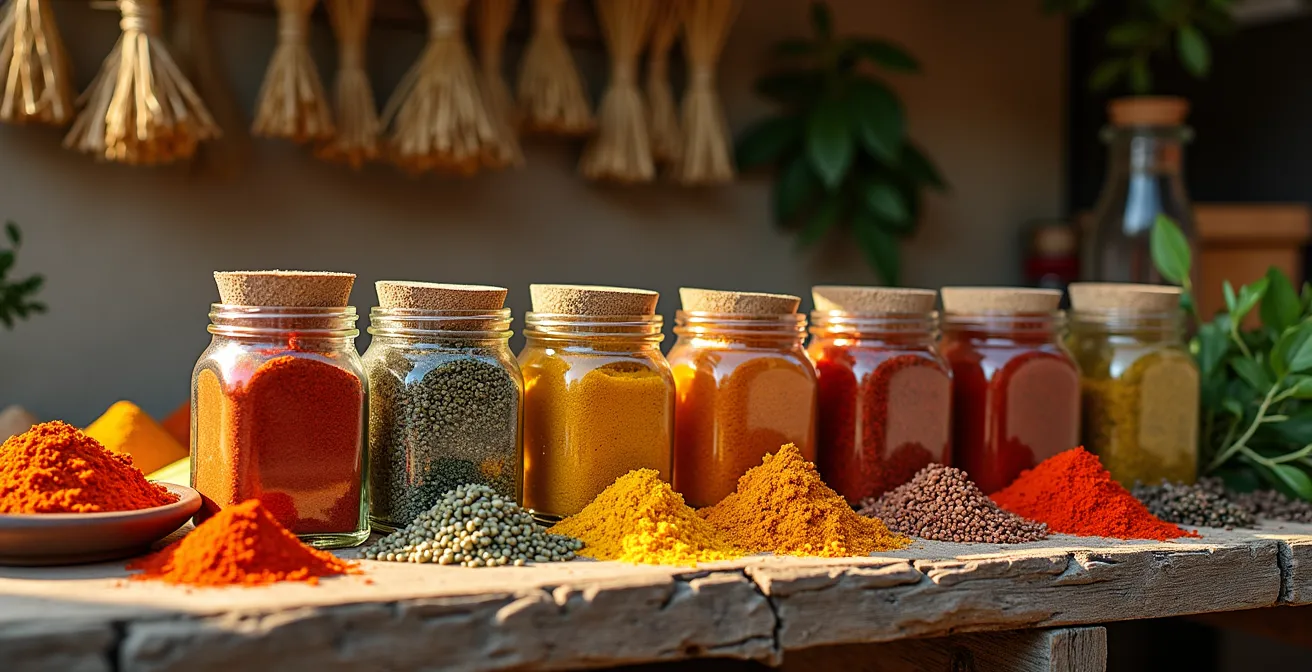
This image of vibrant spice blends perfectly illustrates the chef’s workaround: if you can’t take the finished product, take the essence of its flavour.
When to Arrive at the Market to Get End-of-Day Discounts from Vendors?
Here is one of the biggest myths of market shopping: that the best deals are found at the end of the day. While it’s true you might get a discount on leftover produce, a professional chef knows that quality trumps a bargain every time. The true “value” isn’t in saving a few dollars on picked-over greens; it’s in securing the absolute best, prime ingredients at the start of the day. A chef’s strategy for value is built on relationships and timing, not on scavenging for markdowns.
The best time to arrive at the market is right at opening, especially on a weekday like Tuesday or Wednesday. This is when the selection is at its peak and, more importantly, when vendors are fresh and have time to talk. This is the moment for vendor intelligence. Building a rapport over time leads to far better long-term benefits than any one-time discount. A vendor who knows you appreciate quality will set aside the best products for you, give you a heads-up on incoming seasonal items, and offer better prices on bulk purchases without you even having to ask. It’s a long-term investment in sourcing.
As acclaimed Chef Alex Chen notes about his relationships at Granville Island, it’s about a shared passion that develops over years. In a Vancouver Magazine feature, he says:
Brian at Seafood City—he and I have been talking since I was an apprentice. He saw me grow up. We talk about food, we talk about our families.
– Chef Alex Chen, Vancouver Magazine
If you must hunt for discounts, target weekday afternoons about one to two hours before closing. The crowds are gone, but the selection isn’t completely depleted. Focus your requests on highly perishable items like berries or baked goods, and use a bulk-buy script: “If I take all five of these, what’s the best price you can do?” But never forget the chef’s golden rule: the best ingredients are worth the full price.
West Coast Seafood or Boreal Game: Which Culinary Region Suits Your Palate?
Shopping like a chef also means understanding and appreciating Canada’s distinct culinary terroirs. The country’s vast geography creates wildly different flavour profiles, and a great market acts as a hub where these regions converge. Your choice between West Coast seafood and Boreal game isn’t just about preference; it’s about seasonality, cooking style, and the story you want to tell on the plate. A chef thinks about the origin story of the flavour.
The West Coast seafood offering, epitomized by the stalls at Granville Island, is defined by the cold, clean waters of the Pacific. Its flavour profile is briny, delicate, and clean. This region is best celebrated during spring and summer, with highlights like sweet spot prawns, succulent Dungeness crab, and rich, oily wild salmon. Sustainability is a key part of this terroir, and chefs always look for the Ocean Wise certification, a Vancouver-based program that guarantees responsible harvesting. These pristine flavours pair beautifully with the crisp acidity of an Okanagan Pinot Gris.
In contrast, Boreal game, found in specialty butchers in markets across the country, speaks of Canada’s vast forests. The flavour profile is rich, earthy, and complex, derived from the animals’ natural diet of wild berries and forest vegetation. This cuisine is perfectly suited for hearty autumn and winter feasts like Thanksgiving or Christmas. Featured items include lean venison, robust wild boar, and noble elk. The sustainability marker here is adherence to provincial hunting regulations. These deep flavours call for a wine with structure and earthy notes, like an Ontario Cabernet Franc.
This overview, drawn from an analysis of Canadian regional cuisine, helps frame the choice.
| Aspect | West Coast Seafood | Boreal Game |
|---|---|---|
| Best Season | Spring/Summer celebrations | Thanksgiving/Christmas feasts |
| Featured Items | Spot prawns, Dungeness crab, wild salmon | Venison, wild boar, elk |
| Flavor Profile | Clean, briny from cold Pacific waters | Rich, earthy from wild berry/forest diet |
| Wine Pairing | Okanagan Pinot Gris | Ontario Cabernet Franc |
| Sustainability Cert. | Ocean Wise certification | Provincial hunting regulations |
The Storage Mistake That Melts Your Cheese Haul in a Hot Car Trunk
A chef’s responsibility for an ingredient doesn’t end at the point of purchase; it extends all the way to the kitchen. The final, and often most-neglected, step of strategic procurement is post-purchase temperature control. You can spend a fortune on exquisite, artisanal Canadian cheeses from makers like Gunn’s Hill or Fromagerie du Presbytère, only to ruin them with one simple mistake: leaving them in a hot car. The trunk of a car, especially during a southern Ontario summer, can reach temperatures that will cause delicate cheeses to “sweat” out their butterfat, permanently destroying their texture and flavour in as little as 15 minutes.
To prevent this tragedy, a chef follows a strict temperature control protocol. First, a high-quality cooler bag with frozen ice packs is non-negotiable market equipment. It’s as essential as a wallet. Second, the shopping route is planned in reverse. Temperature-sensitive items like cheese, seafood, and fresh meats are always the very last things to be picked up before heading directly to the car. Third, the cooler bag never goes in the trunk. It rides in the air-conditioned cabin of the car, protected from extreme heat.
Once home, the protocol continues. Never wrap artisanal cheese in plastic wrap, which suffocates it and traps moisture, encouraging mould. The proper method is to use specialized cheese paper or waxed paper, which allows the cheese to breathe while preventing it from drying out. This preserves the integrity of the product that the cheesemaker worked so hard to create and that you worked so hard to source.
Your Action Plan: Chef’s Temperature Control Protocol for Market Hauls
- Pack a high-quality cooler bag with frozen ice packs as non-negotiable market equipment.
- Plan your shopping route to pick up temperature-sensitive items (cheese, seafood) last before leaving.
- Never use the car trunk in summer; place the cooler bag in the air-conditioned cabin instead.
- Recognize the danger zone: in hot July Ontario weather, even 15 minutes can ruin products, while a cool October in Vancouver allows more flexibility.
- Re-store cheese properly post-trip: avoid plastic wrap and use specialized cheese paper or waxed paper for artisanal Canadian cheeses.
Key Takeaways
- Adopt a professional mindset: Your goal is “strategic procurement,” not just “shopping.”
- Quality over bargains: The best value is found in prime ingredients and vendor relationships at opening, not in end-of-day discounts.
- Plan your mission: Choose your market and timing based on a specific culinary objective, whether it’s a large family feast or a gourmet dinner.
Are Guided Food Tours in Toronto’s Kensington Market Worth the $100 Price Tag?
Finally, the strategic chef must consider the value of outsourcing expertise. In a dense and diverse neighbourhood like Toronto’s Kensington Market, is it better to explore on your own or invest in a guided food tour? The answer depends on your most valuable resource: time. For a first-time visitor or someone on a tight schedule, a well-run tour can be an incredible investment. The $100 price tag isn’t just for food; it’s for curation, efficiency, and narrative.
A good tour guide provides skip-the-line access at popular vendors, guarantees a taste of at least six or seven iconic dishes, and weaves in the rich history of the neighbourhood—context you would miss on your own. As some analyses of Toronto food tours show, you’re paying for a structured, 2.5-hour experience that maximizes discovery. Verified reviews often highlight that guides select gems you’d never find alone, turning a potentially overwhelming experience into a foodie’s delight.
However, for the adventurous foodie, the repeat visitor, or the chef-minded individual who relishes the hunt, the DIY approach offers its own rewards. Armed with the strategies in this guide, you can create your own tour for about half the price. The trade-off is time and effort. You’ll need to do your own research, you may have to wait in line, and you might miss a hidden spot. There is no right or wrong answer. The decision comes down to a simple calculation: do you want a guaranteed, curated experience, or the thrill and freedom of self-discovery? A chef knows the value of both.
| Tour Aspect | Guided Tour ($100) | DIY Alternative ($50) |
|---|---|---|
| Food Samples | 6+ guaranteed tastings with skip-the-line access | Self-selected items, potential wait times |
| Duration | 2.5-3 hours structured experience | Self-paced, may miss hidden spots |
| Historical Context | Professional guide shares neighborhood history | Self-research required |
| Vendor Access | VIP treatment, vendor demonstrations included | Regular customer experience |
| Best For | First-time visitors, time-constrained tourists | Adventurous foodies, repeat visitors |
Your next visit to a Canadian market isn’t just a shopping trip; it’s a culinary mission. Start applying these strategies today to transform your results and truly bring home the best flavours the country has to offer.