
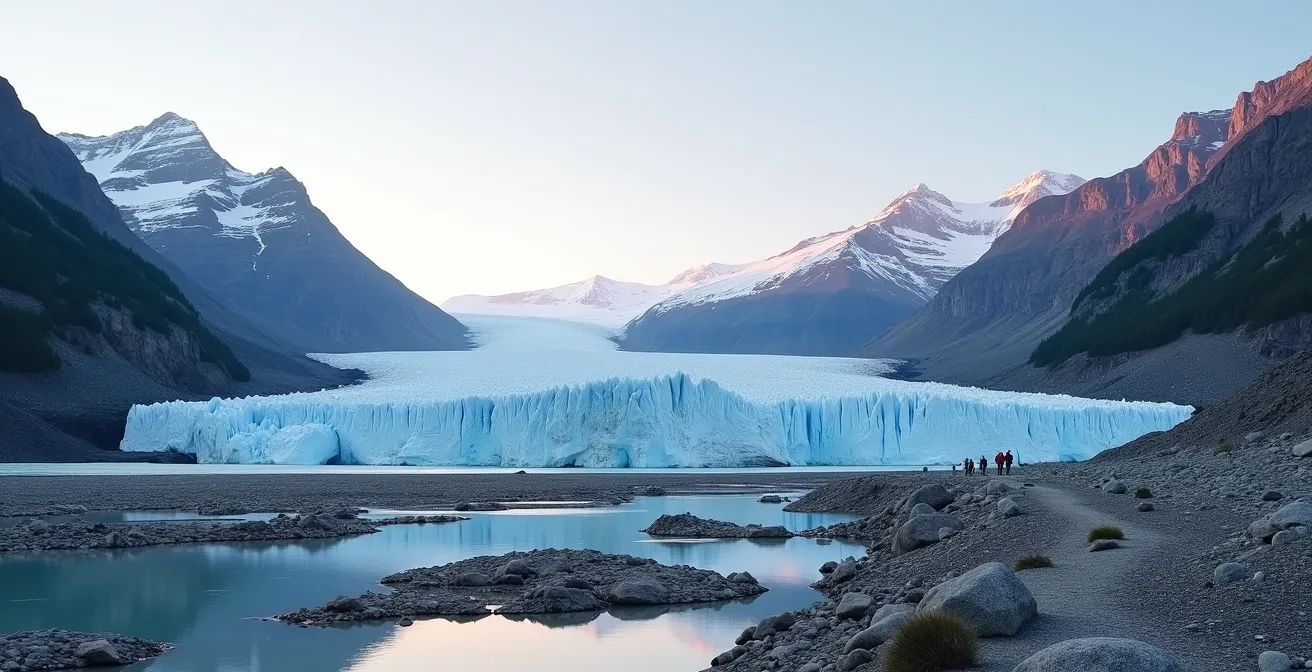
The most meaningful way to experience the Athabasca Glacier is not by joining the largest crowd, but by choosing the smallest footprint.
- Mass-market bus tours offer limited perspective and have a high environmental impact, contributing to the very problem visitors come to see.
- Low-impact alternatives like guided hikes, Indigenous-led tours, and off-peak visits provide a deeper connection and understanding of the glacier’s fragile state.
Recommendation: Reframe your visit from passive sightseeing to active, conscious witnessing. Opt for an ACMG-certified guide who can provide ‘cryo-literacy’—the ability to read the ice and understand its story.
As a geologist and guide in the Canadian Rockies, I’ve had the privilege of walking on the Athabasca Glacier for years. I’ve also had the heartbreaking duty of measuring its retreat. The question is no longer *if* you should see it, but *how*. Many visitors arrive with a single goal: a photo from the deck of a giant Ice Explorer bus, a quintessential Canadian Rockies experience. This approach, however, is part of a “meltwater economy” that overlooks a profound truth: the glacier is not a theme park attraction. It’s a living, dying entity, a barometer of our planet’s health.
But what if the most impactful visit wasn’t about standing on the ice, but about understanding it? This guide is built on a different premise, one I share with every group I lead: we must shift from passive seeing to conscious witnessing. This means trading crowded platforms for intimate encounters, choosing experiences with high “experience density” over high volume, and learning a degree of “cryo-literacy” to read the story the ice is telling us. It’s about understanding the consequences of every footstep and making choices that honour the very thing we came to admire.
Together, we will explore not just how to access this magnificent landscape, but how to do so with the respect and awareness it urgently demands. We’ll delve into the science of its decline, the practicalities of a safe and meaningful visit, and the conservation victories that offer a sliver of hope. This is your guide to becoming a steward of the ice, not just a spectator.
This article provides a comprehensive roadmap for a responsible and unforgettable encounter with the Columbia Icefield. The following sections will guide you through the critical choices and knowledge needed to plan your visit with awareness and respect.
Summary: How to Responsibly Witness the Athabasca Glacier Before It Vanishes
- Why are the icefields shrinking faster than predicted in the last decade?
- How to walk on a glacier with a guide without risking a crevasse fall?
- Columbia Icefield Adventure or hiking the toe: which offers the better view?
- The hidden hazard of entering glacial caves during summer melt
- When to visit the glaciers to avoid the mid-day tourist rush and slush?
- Why do your entry fees increase if you stay overnight in the backcountry?
- Why spending $500 on a helicopter drop offers better value than a crowded bus tour?
- How to reach Moraine Lake now that personal vehicles are banned?
Why are the icefields shrinking faster than predicted in the last decade?
The shrinking of the Athabasca Glacier is not a distant, abstract concept; it’s a measurable crisis happening in real-time. According to monitoring by Parks Canada, the glacier has receded more than 1.5 km and lost over half its volume in the last 125 years, with 2023 marking a record year for ice melt. This isn’t just about rising global temperatures; it’s about a deadly feedback loop exacerbated by regional factors unique to Western Canada. The primary culprit is a change in the glacier’s albedo, or its ability to reflect sunlight.
Pristine, white ice acts like a mirror, reflecting solar radiation back into space. But as Canadian summers have become defined by intense wildfire seasons, a fine layer of dark soot and ash settles on the icefield. This darkens the surface, causing it to absorb more solar energy, which in turn accelerates melting. This is a form of glacial forensics we can see with our own eyes: the once-brilliant white is now streaked with the grey and black residue of distant fires. This accelerated melt creates more surface water, which further darkens the ice and absorbs even more heat.
This paragraph introduces the complex issue of accelerated melt. To truly grasp the visual evidence of this phenomenon, the image below shows the stark contrast between clean ice and soot-covered surfaces.
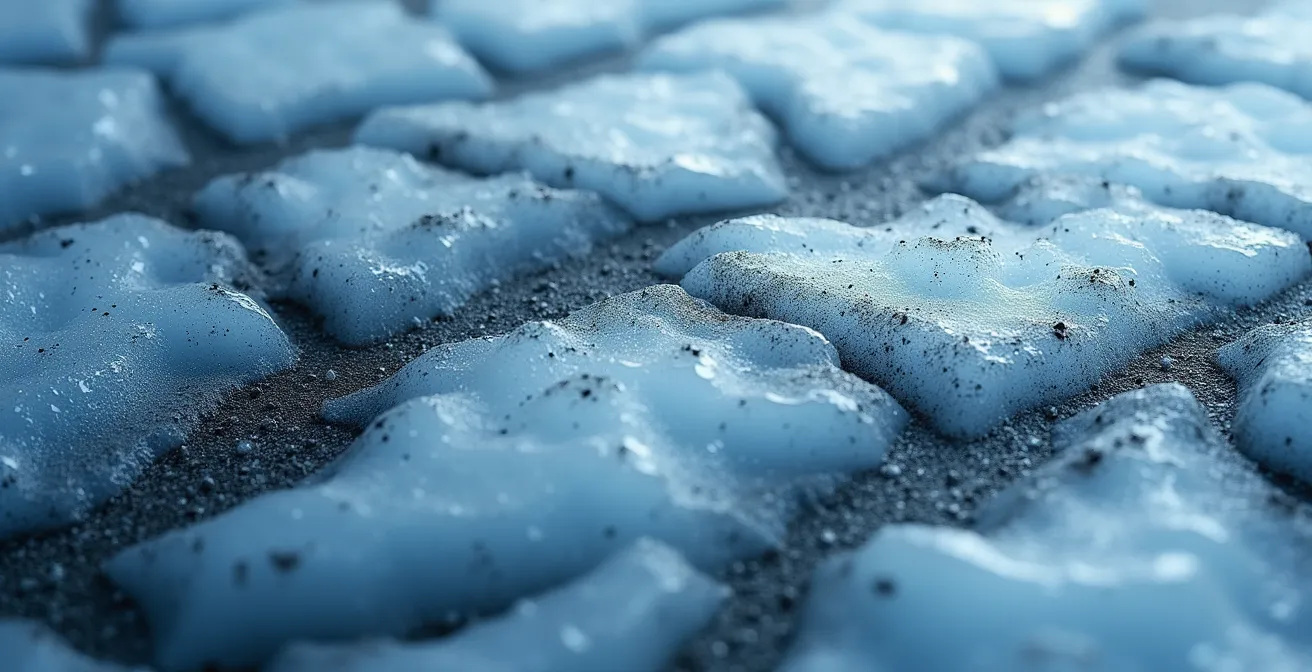
As you can see, the dark particulate matter from wildfire smoke becomes embedded in the ice, fundamentally changing its properties. This visual evidence underscores the urgent reality: the Athabasca Glacier is not just melting; it’s being cooked from the surface down by a combination of a warming climate and the direct impact of regional environmental changes. Every year, the line of retreat moves further, a silent testament to a system pushed past its breaking point.
How to walk on a glacier with a guide without risking a crevasse fall?
A glacier is a moving river of ice, and its surface is a landscape of hidden dangers. The serene beauty masks a world of deep crevasses, hidden water channels called moulins, and unstable snow bridges. The forces that carve these features are invisible and relentless, making an unguided walk on the ice a life-threatening gamble. This is why Parks Canada issues stark warnings. As they state officially, “The glacier is dangerous! For your safety do not cross the barriers“. The only safe way to traverse this environment is with a certified professional who possesses “cryo-literacy”—the ability to read the subtle language of the ice.
In Canada, the gold standard is a guide certified by the Association of Canadian Mountain Guides (ACMG). These professionals are trained not just in navigation and rope safety, but in the specific science of glaciology. They understand the seasonal dynamics of the Athabasca, know where new crevasses are likely to form, and can identify the subtle colour and texture changes that signal danger. They provide the essential equipment, like crampons, and implement the safety systems, like roping teams together, that make a glacier walk possible.
Hiring a guide transforms your visit from a risky endeavour into an unparalleled educational experience. You are not just walking; you are learning to see the glacier as a dynamic system. Following their lead is non-negotiable for anyone wishing to step beyond the designated viewpoints.
Essential Safety Steps for Glacier Walking with ACMG Guides
- Choose only Association of Canadian Mountain Guides (ACMG) certified guides who have specialized glacier training and local knowledge of the Athabasca’s changing conditions.
- Wear proper crampons provided by your guide—these metal spikes attach to your boots for essential traction on ice.
- Stay roped together in a team formation, maintaining tension on the rope at all times to arrest any potential falls.
- Follow your guide’s exact footsteps and never venture beyond marked safe zones.
- Listen for water sounds beneath the ice which indicate dangerous moulins or subglacial streams.
- Watch for sagging snow bridges and colour changes in ice (blue indicates solid ice, white may hide crevasses).
Columbia Icefield Adventure or hiking the toe: which offers the better view?
The question of the “better view” at the Athabasca Glacier is a trap. It implies that all experiences are equal, differing only by vantage point. The reality is that your choice of how to see the glacier is the most significant decision you’ll make, defining both your environmental impact and the quality of your connection to the ice. It’s a question of experience density: do you prefer a brief, crowded, high-impact glimpse or a longer, more intimate, and educational encounter? The mass-market Columbia Icefield Adventure—the tour on the large, all-terrain Ice Explorer vehicles—is the most famous option, but it comes at a cost that isn’t just financial.
These diesel-powered vehicles transport hundreds of people per hour onto a designated patch of the glacier. While accessible, the experience is often rushed, and your perspective is limited. In contrast, hiking options offer a more personal and profound connection. A simple walk to the toe of the glacier, following the well-marked trail, allows you to physically trace the glacier’s dramatic retreat over the decades. For the more adventurous, the Wilcox Pass trail on the opposite side of the valley provides a breathtaking panoramic view of the entire icefield, putting its immense scale and fragility into perspective. These human-powered options are not only free but also align with a philosophy of minimal impact.
The following table, based on information from local operators like the Banff Jasper Collection, breaks down the trade-offs to help you make a conscious choice.
| Aspect | Ice Explorer Bus Tour | Toe of Glacier Hike | Wilcox Pass Trail |
|---|---|---|---|
| Environmental Impact | High – diesel vehicles, mass tourism | Low – walking only | Minimal – trail hiking |
| Physical Difficulty | Easy – accessible to all | Moderate – 30-45 min uphill walk | Challenging – 8km mountain trail |
| View Quality | On glacier surface, limited perspective | Close-up glacier terminus view | Panoramic aerial view of entire icefield |
| Cost (CAD) | $100-150 per person | Free with park pass | Free with park pass |
| Time Required | 2.5-3 hours total | 1-2 hours | 4-5 hours |
| Educational Value | Guided commentary included | Self-guided with trail markers showing retreat | Self-guided with interpretive signs |
A Responsible Alternative: Indigenous-Led Tours
For an even deeper level of connection, consider experiences that weave cultural knowledge with natural science. Operators like IceWalks have partnered with Zuc’min Guiding to offer tours led by Indigenous Interpretive Guides. These unique excursions focus on “understanding of the Athabasca Glacier’s critical hydrological role, supporting ecosystems and communities across North America,” as highlighted by a recent initiative promoting appreciation of this vital water resource. This represents a powerful shift from simple sightseeing to a culturally sensitive and environmentally conscious way to witness the glacier.
Your Responsible Tour Audit: 5 Points to Verify Before Booking
- Certification Check: Is the guide or company ACMG certified for glacier travel? This is the Canadian standard for safety and professionalism on ice.
- Group Size: Does the operator limit group size? Smaller groups (typically under 12) have a lower physical impact on the ice and allow for a more personal, educational experience.
- Educational Component: Does the tour promise deep interpretation (geology, ecology, Indigenous knowledge) beyond just a walk and a photo opportunity?
- Environmental Policy: Does the operator have a public stance on sustainability, use carbon-offset programs, or contribute to local conservation efforts?
- Itinerary Transparency: Do they clearly explain the route, safety protocols, required fitness level, and what is not permitted to ensure guest and glacier well-being?
The hidden hazard of entering glacial caves during summer melt
The allure of a glacial ice cave is undeniable. The ethereal blue light filtering through tonnes of ancient ice creates a scene of otherworldly beauty, often shared widely on social media. However, these formations are arguably the most dangerous places on a glacier, especially during the summer melt season. They are not permanent structures; they are transient features carved by meltwater, and their stability is zero. Entering one is like stepping inside a structure made of melting sugar, where the roof could collapse without any warning.
The turquoise streams of water that create these caves are a sign of instability. As temperatures rise, water flows both over and within the glacier, constantly eroding the ice. A beautiful cave you see one day could be a pile of rubble the next. Worse still, these caves can hide deep moulins or terminate abruptly in unstable ice cliffs. The danger is not theoretical. As Wikipedia contributors note, ” hidden crevasses have led to the deaths of unprepared tourists,” and a tragic incident on the glacier in 2020 served as a horrific reminder of these risks. The perceived beauty is a powerful lure that can lead to fatal consequences.
The following image captures the deceptive beauty of meltwater channels, which are the architects of these unstable ice caves and portals to hidden dangers like moulins.
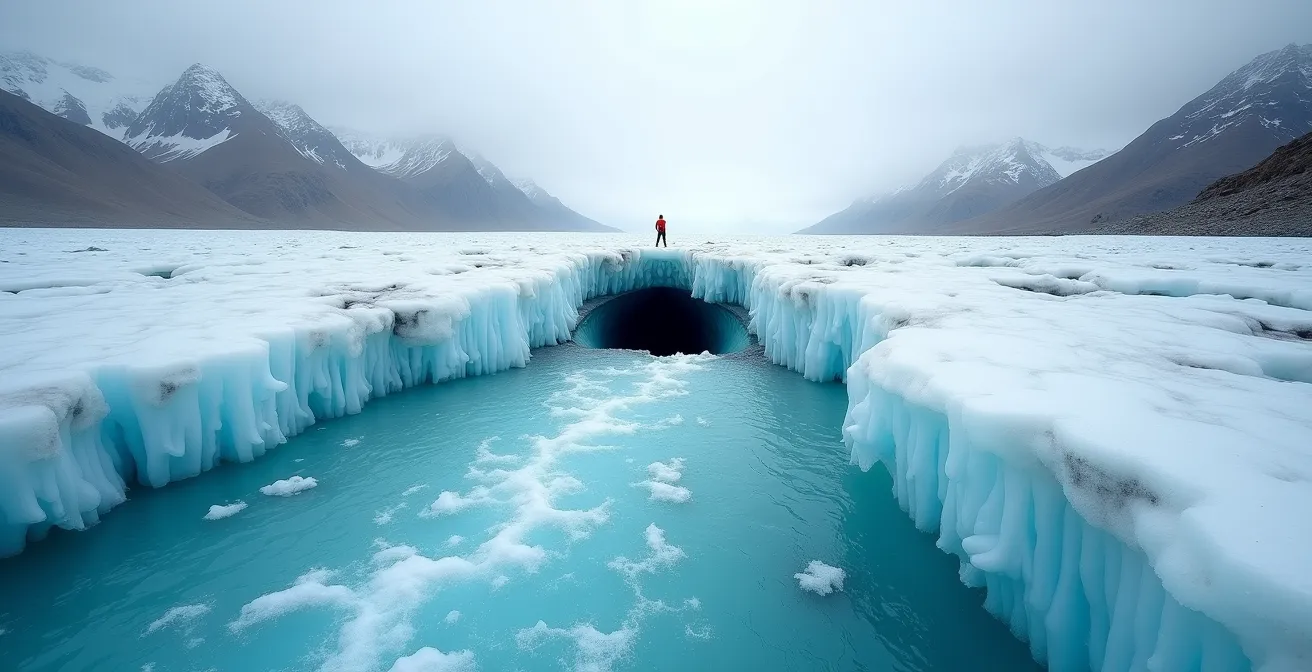
No photograph is worth your life. The official guidance from Parks Canada and every certified guide is unequivocal: do not enter any ice cave, especially in summer. They are not safe, they are not stable, and they are not tourist attractions. Admire the blue ice from a safe distance, under the supervision of a professional guide, and understand that the most beautiful features are often the most treacherous.
When to visit the glaciers to avoid the mid-day tourist rush and slush?
Timing is everything when visiting the Athabasca Glacier. A mid-day visit in July or August often means sharing the experience with thousands of other people, navigating crowded parking lots, and walking on soft, slushy ice that has been baking in the sun. This peak-hour rush not only diminishes the sense of wonder but also concentrates human impact on the fragile environment. For a more profound and respectful visit, strategic planning is essential. The key is to think like a photographer or a guide: go when the crowds are gone and the ice is at its best.
The absolute best times to visit are during the shoulder seasons—specifically late September or early October. During this period, visitor numbers can drop by as much as 70%. The cooler temperatures mean the ice surface is much firmer and more stable, providing better traction and a more authentic glacier experience. The air is often clearer, and the first dustings of new snow on the surrounding peaks create a stunning visual contrast. If you must visit in the summer, the principle is to avoid the 10 a.m. to 4 p.m. window. An early morning arrival (before 9 a.m.) rewards you with firm ice, solitude, and beautiful morning light. Similarly, a late afternoon visit allows you to witness the golden hour as the tour buses depart.
Local guides often report that September visits offer the best possible balance, combining stable weather with “minimal impact on the glacier” due to the significantly reduced foot traffic. Planning your visit for these off-peak times is a simple yet powerful way to enhance your experience while reducing your environmental footprint.
A Photographer’s Timeline for Optimal Glacier Visits
- Visit in late September for drastically reduced crowds and firmer ice conditions due to cooler temperatures.
- Arrive at the toe parking lot by 6:00 AM for sunrise alpenglow photography on the surrounding peaks.
- Schedule guided glacier walks before 9:00 AM when the ice is firmest and tour groups have not yet arrived.
- Consider visiting one hour before sunset (check seasonal times) to enjoy the golden light as crowds are departing.
- Book accommodations at nearby Wilcox Creek Campground to ensure you have early morning access before the day-trippers arrive.
- Plan weekday visits in the shoulder seasons (May or early October) for potentially 70% fewer visitors than a peak summer weekend.
Why do your entry fees increase if you stay overnight in the backcountry?
At first glance, the Parks Canada fee structure can seem complex. You pay a daily entry fee to get into Jasper National Park, but if you decide to camp overnight in the backcountry, an additional Wilderness Pass is required. This isn’t a cash grab; it’s a fundamental principle of user-pays conservation. The increased fee directly reflects the increased cost and logistical effort required to manage and protect these remote, sensitive areas. Your daily park pass funds the infrastructure everyone uses: highways, viewpoints, and front-country visitor centres. The Wilderness Pass, however, is a direct investment in the wild.
The revenue from these passes funds a suite of critical services that don’t exist in the front-country. This includes the maintenance of remote hiking trails, the operation of backcountry warden patrols, extensive human-wildlife conflict mitigation programs (especially for grizzly bears), and, crucially, the search and rescue operations that are an inherent risk of backcountry travel. By staying overnight, you are venturing into a higher-risk, higher-impact environment, and the fee structure ensures that users of these specific services contribute to their upkeep. This philosophy is at the core of the Parks Canada mandate, which, in their own words, aims to foster enjoyment of the glacier “in ways that ensure its ecological integrity for present and future generations“.
Essentially, you are paying for a higher level of stewardship required to keep the backcountry both wild and safe. It’s a direct contribution to preserving the very wilderness you’ve come to experience, ensuring that resources are available to manage your impact and assist you if things go wrong.
Why spending $500 on a helicopter drop offers better value than a crowded bus tour?
The idea of a $500 helicopter trip might seem like an extravagant luxury, but when you reframe “value” as experience density rather than cost per minute, the logic becomes clear. A crowded bus tour offers low-density value: you share a sliver of ice with a hundred other people for a short time. A premium, small-group experience—whether it’s a heli-hike, a private mountaineering course, or a specialized tour—offers high-density value. You are paying for solitude, expert knowledge, exclusive access, and a profoundly deeper connection to the environment.
While helicopter access is one option, the principle extends to a range of high-quality, low-volume tourism. For a similar investment, you could book a multi-day mountaineering course with a private ACMG guide, where you don’t just see the glacier, you learn the skills to travel on it independently. You could join a specialized Indigenous-led cultural tour that provides a perspective no bus commentary ever could. Or you could participate in a premium small-group tour, like the “Ice Odyssey,” which offers access to an “exclusive area of the glacier” and in-depth interpretation on its history and environmental challenges.
The “better value” comes from what you take away: not just a photo, but skills, knowledge, and a genuine understanding of the cryosphere. It’s an investment in a transformative experience, one that minimizes your physical footprint while maximizing your intellectual and emotional engagement. These experiences support a more sustainable tourism model, proving that visitors are willing to pay for quality over quantity.
Maximizing Value in Premium Glacier Experiences
- Book private ACMG guide-led mountaineering courses that teach you essential glacier travel skills over several days.
- Consider sunrise photography tours that grant access to prime locations before the mass tourism rush begins.
- Join specialized Indigenous-led cultural tours for a unique and profound perspective on the icefield’s significance.
- Invest in a multi-day backcountry camping experience at a location like Wilcox Creek for repeated, crowd-free access to glacier views.
- Choose tour operators who partner with research institutions, offering citizen science opportunities to contribute to glacier monitoring.
- Select certified carbon-neutral tour operators who actively offset the environmental impact of their operations.
Key Takeaways
- The glacier’s melt is accelerating due to regional factors like wildfire soot, making responsible tourism more urgent than ever.
- Your choice of tour is an environmental decision. Low-impact, small-group options offer a more profound connection than mass-market bus tours.
- Strategic timing is crucial. Visiting in shoulder seasons or during off-peak hours dramatically improves your experience and reduces your impact.
How to reach Moraine Lake now that personal vehicles are banned?
The decision by Parks Canada to ban personal vehicles on the road to Moraine Lake was a landmark moment in Canadian conservation management. For years, the iconic lake was a case study in over-tourism, with parking lots filling before sunrise and thousands of cars creating traffic jams and stressing wildlife. The ban, while an adjustment for visitors, is an undeniable conservation success story. It represents a critical shift in philosophy: prioritizing the health of the ecosystem over unlimited access. The result is a calmer, quieter, and more pleasant experience for visitors, and, more importantly, a less-stressed environment for the area’s wildlife, including grizzly bears.
Reaching the lake now requires a bit of planning, but the available options are efficient and sustainable. The Parks Canada shuttle service and the regional Roam Public Transit are the most popular methods, offering regular and reliable access from Banff and Lake Louise. For those seeking a more active approach, cycling the traffic-free road is a spectacular experience, especially with the help of an e-bike rented from Lake Louise village. This new system encourages visitors to think collectively and use shared resources, reducing overall emissions and congestion. It proves that managing human access is one of the most powerful tools we have to protect our most treasured natural spaces.
The success at Moraine Lake serves as a hopeful blueprint for other sensitive areas. It demonstrates that with thoughtful management and a willingness to adapt, we can find a better balance between visitation and preservation, ensuring these landscapes endure for generations to come.
Current Transportation Options to Moraine Lake
- Book the Parks Canada shuttle service online well in advance, as reservations for the summer season open in the spring and fill up quickly.
- Use the Roam Transit public bus service from the Banff townsite, which runs a regular schedule during the peak season.
- Consider purchasing the Roam Super Pass for unlimited travel on all regional routes, offering excellent value for multi-day visits.
- Cycle the Moraine Lake Road during designated hours for a crowd-free and rewarding physical challenge.
- Rent e-bikes in Lake Louise village to make the uphill journey to the lake more accessible and enjoyable.
- Join guided tour groups that include transportation to Moraine Lake as part of their package, simplifying your logistics.
Your journey to the icefields begins not on the highway, but in the choices you make right now. Plan your visit as a conscious witness, not just a tourist, and become part of a more respectful future for these frozen giants.
Frequently Asked Questions about Visiting the Columbia Icefield
What is the basic daily park entry fee?
To enter Jasper or Banff National Parks, you need a Park Pass. According to Parks Canada’s 2024 fee schedule, the daily rate is approximately $11 CAD per adult or $22 CAD for a vehicle with a group/family. Children 17 and under are free.
What additional services does the Wilderness Pass fund?
The Wilderness Pass is required for overnight backcountry camping and directly funds services essential for remote areas. This includes backcountry trail maintenance, warden patrols for safety and compliance, human-wildlife conflict mitigation (especially bear management), and the vital search and rescue operations in Jasper National Park.
Is the Discovery Pass better value for multiple visits?
If you plan to visit multiple national parks or stay for more than a week, the Discovery Pass offers the best value. It provides unlimited admission to all of Canada’s national parks for a full year. The annual cost is roughly $75.25 for an individual adult or $151.25 for a family or group of up to seven people in one vehicle.