
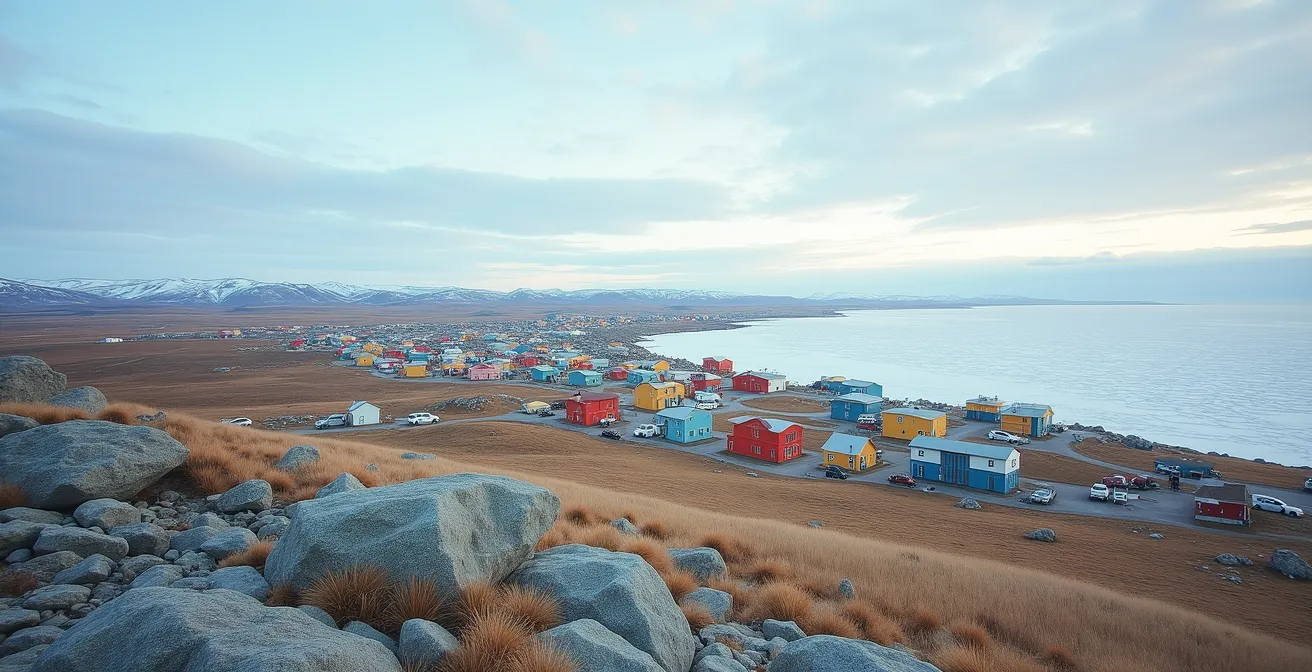
Planning a trip to Iqaluit is not about booking sights; it’s about mastering a system of isolation where logistics become a core part of the adventure.
- High costs are a direct result of an air-only supply chain, making every item a precious commodity.
- Extreme, unpredictable weather has the final say on all travel, demanding flexibility and buffer days in your itinerary.
Recommendation: Approach your planning with a focus on self-sufficiency, safety, and cultural respect, understanding that every logistical challenge is an insight into life in the Canadian Arctic.
For the intrepid traveler, Iqaluit represents a final frontier within Canada—a capital city unreachable by road, floating in the vastness of the tundra. The immediate questions are logistical puzzles: How do you get there? What does it cost? How do you survive? Many guides will tell you to fly from Ottawa, pack warm, and book a tour. While true, this advice barely scratches the surface of the realities of navigating Nunavut.
The common approach focuses on the “what” but misses the crucial “why.” Why are flights and groceries so expensive? Why is a two-day weather delay considered normal? The challenge of visiting a remote community like Iqaluit is often seen as a barrier. But what if the true key wasn’t to fight the logistics, but to understand and embrace them? This isn’t just about travel planning; it’s about engaging with a unique system of isolation, where understanding the supply chain is as important as choosing a hotel.
This guide abandons the platitudes and dives into the operational mechanics of an Arctic journey. We will dissect the logistical friction that defines life in the North, from the price of food to the life-saving choice in satellite technology. By the end, you will not only have a plan to visit Iqaluit, but you will also have a profound appreciation for the resilience, knowledge, and infrastructure that make life possible at the top of the world.
To help you navigate these unique challenges, this article breaks down the essential logistical pillars of planning your trip. The following summary provides a roadmap to mastering each aspect of your Arctic journey.
Summary: A Logistical Guide to Planning Your Iqaluit Trip
- Why does a bag of grapes cost $20 CAD in a Northern grocery store?
- How to check if the hamlet you are visiting allows alcohol possession?
- Frobisher Inn or local B&B: which offers a better connection to the community?
- The itinerary mistake of not padding your Arctic trip with 2 extra buffer days
- What clothing is essential when the wind chill hits -50°C even in spring?
- Spot X or Garmin inReach: which device saves lives when the network is dead?
- Haida Gwaii or Torngat Mountains: which remote cultural site changes your worldview?
- How to apply Inuit knowledge of snow and ice to modern winter survival?
Why does a bag of grapes cost $20 CAD in a Northern grocery store?
The sticker shock experienced in an Iqaluit grocery store is a visitor’s first, tangible lesson in Arctic logistics. That $20 bag of grapes isn’t a luxury item; it’s a stark illustration of a complex and fragile supply chain entirely dependent on air freight. With no roads connecting Nunavut to southern Canada, every single item—from fresh produce to construction materials—must be flown in. This reality creates immense “logistical friction,” where distance, weather, and fuel costs compound to inflate the price of every good.
Think of it as a system of isolation. The cost of an apple includes its purchase price, its portion of the fuel for a 2,000-kilometre flight from Ottawa, the specialized handling required in cold climates, and the operational costs of the airline and the local store. The federal Nutrition North Canada subsidy helps reduce prices on certain healthy foods, but the fundamental economic equation remains: if it’s in Iqaluit, it arrived by air, and that cost is passed on to the consumer. This isn’t a simple case of high prices; it’s the direct, visible cost of remoteness.

As this image of perfectly fresh produce suggests, the quality is often high, but it comes at a premium. Understanding this isn’t just about budgeting for your trip; it’s a fundamental insight into the daily economic reality for residents. Appreciating the journey that a simple piece of fruit has taken is the first step toward understanding the unique challenges and resilience of Canada’s North.
How to check if the hamlet you are visiting allows alcohol possession?
Beyond the logistics of supply chains, navigating the Canadian Arctic requires a deep respect for local governance and social regulations. A critical and often overlooked aspect is the patchwork of alcohol laws across Nunavut. Unlike in southern provinces, liquor regulations are not uniform; each of the 25 communities has the right to determine its own system. These fall into three categories: unrestricted, restricted, or completely prohibited. Arriving with alcohol in a prohibited community is a serious offense, making verification a non-negotiable step in your planning.
Iqaluit itself is an “unrestricted” community, meaning adults can legally purchase and consume alcohol according to the territory-wide Nunavut Liquor Act. However, if your itinerary includes travel to smaller, surrounding hamlets, you must assume nothing. For example, a community may be designated as “restricted,” requiring you to apply for a permit from the local Alcohol Education Committee *before* bringing any alcohol in. As Destination Nunavut clarifies in its official guide, this autonomy is a right of self-determination. They state that in an unrestricted community like Iqaluit, “The laws surrounding importation and consumption follow the Nunavut Liquor Act,” but this is the exception, not the rule territory-wide.
Failing to respect these local laws is not just a legal risk; it’s a profound sign of disrespect to the community’s self-governance. Before you pack or purchase any alcohol, completing a simple audit is essential for any responsible traveler.
Action Plan: Verifying Local Alcohol Regulations
- Identify points of contact: Start with the official Nunavut Liquor and Cannabis Commission (NULC) website, which is the primary source for regulations.
- Collect existing information: Locate the “Community Status List” on the NULC site to find the specific designation (Unrestricted, Restricted, or Prohibited) for every hamlet you plan to visit.
- Confront with your plans: For any community listed as “Restricted,” you must contact the local Alcohol Education Committee to apply for an import permit. Do not proceed without it.
- Assess your inventory: Note that even for travel into Nunavut as a whole, a permit is needed if you bring more than 3 litres of spirits, 9 litres of wine, or 26 litres of beer, as per a guideline from Destination Nunavut.
- Integrate into your itinerary: Factor in the time needed to apply for and receive permits. If visiting a “Prohibited” community, your plan must be to have zero alcohol in your possession upon arrival.
Frobisher Inn or local B&B: which offers a better connection to the community?
Your choice of accommodation in Iqaluit is more than a question of comfort; it’s a strategic decision that will define your connection to the community. The city offers several full-service hotels, like the well-known Frobisher Inn, which provide a familiar, Southern-style experience. They are comfortable, reliable, and offer standard amenities like restaurants and concierge services. However, this comfort can also create a “tourist bubble,” insulating you from the daily life and rhythms of the town.
For the intrepid traveler seeking genuine cultural immersion, a local Bed & Breakfast (B&B) is often the superior choice. B&B hosts are not just providing a room; they are often lifelong residents who act as invaluable cultural interpreters and local guides. They offer a direct portal into the community, providing insider knowledge on everything from which local artists and carvers to visit, to when a community feast might be happening. This is where you move beyond being a tourist and become a guest. As one traveler noted, discussions with others revealed a clear preference: “it seemed Accommodations By The Sea is the best option… followed by The Discovery Lodge Hotel in second.” This highlights how local B&Bs often gain a stellar reputation through word-of-mouth for the authentic experience they provide.
The choice ultimately depends on your travel goals. If your priority is a seamless, predictable stay with familiar comforts, a hotel is a safe bet. If your goal is to understand the fabric of the community and have spontaneous, meaningful encounters, a B&B is an unparalleled logistical and cultural asset.
This comparative table, based on information from various travel guides like one from Wikitravel, breaks down the key differences to help you make an informed decision.
| Aspect | Frobisher Inn/Hotels | Local B&B |
|---|---|---|
| Community Connection | Limited – tourist bubble environment | Direct portal to local life and conversations |
| Cultural Interpretation | Professional but standard services | B&B hosts act as cultural interpreters and local guides |
| Local Knowledge | Concierge services available | Insider tips on carvers, artists, community events |
| Atmosphere | Familiar, comfortable, Southern-style | Authentic Northern home experience |
| Availability | 4 full-service hotels in Iqaluit | Several well-equipped B&Bs with spectacular views |
The itinerary mistake of not padding your Arctic trip with 2 extra buffer days
In most travel planning, a tight, efficient itinerary is a sign of success. In the Arctic, it’s a recipe for disaster. The single most critical mistake a visitor can make is failing to account for “The Weather Veto.” In Nunavut, weather is not an inconvenience; it is the ultimate authority on all movement. Flights are frequently delayed or cancelled for days at a time due to blizzards, high winds, or—counterintuitively—thawing conditions that destabilize gravel runways.
Assuming your flights will run on schedule is a gamble you are almost guaranteed to lose. A non-flexible itinerary with a tight connection back south can lead to missed international flights and significant financial loss. The rule of thumb among seasoned Arctic travelers is to pad your itinerary with a minimum of two, and ideally three, extra buffer days. These aren’t “wasted” days; they are essential insurance against the logistical friction of the North. They can be placed at the end of your trip in Iqaluit, offering an opportunity for deeper, unplanned local immersion, or in your southern gateway city (Ottawa or Montreal) where accommodation is cheaper if you get stranded.
Case Study: The Weather Veto in Action
The power of weather over Arctic logistics was starkly demonstrated in Pangnirtung, a community near Iqaluit. An article in the National Observer reported that in January alone, four separate flights delivering essential food were cancelled. The cause wasn’t a blizzard, but above-freezing temperatures that melted and destabilized the community’s only runway. This case study is a powerful reminder that delays can happen for a multitude of weather-related reasons, and they impact everything, from personal travel to the basic food supply.
Embracing this uncertainty is part of the mindset required for Arctic travel. Locals refer to it as “Nunavut Time.” A delay isn’t a crisis; it’s an opportunity for a spontaneous conversation at the airport or an extra day to explore. Build flexibility into every booking and purchase comprehensive travel insurance that specifically covers weather-related delays.
What clothing is essential when the wind chill hits -50°C even in spring?
Dressing for the Arctic is not about fashion; it’s a technical exercise in survival. The temperatures in Iqaluit can be brutally cold, with wind chills plummeting to -50°C or lower, even in March and April. The common advice to “pack warm clothes” is dangerously inadequate. You need a specific, high-performance layering system designed to manage moisture, trap heat, and block wind. The most critical principle is: cotton is your enemy. Once it gets damp with sweat, it loses all insulating properties and rapidly chills your body.
Your system must be built on a foundation of merino wool or synthetic base layers that wick moisture away from your skin. The mid-layer should be fleece or down for insulation, and the outer layer must be a high-quality, windproof parka. A parka with a real or faux fur ruff around the hood is not a style choice; it’s a functional tool that disrupts airflow and creates a pocket of warmer air around your face, preventing frostbite. Equally important is protecting your extremities. Arctic-rated boots (brands like Baffin or Sorel are standard), insulated mittens (which are far warmer than gloves), and a full-face balaclava are non-negotiable.
The cost of this specialized gear can be prohibitive, but there are solutions. As Arctic Tours Canada points out for Yellowknife—a principle that applies to Arctic travel in general—there are often rental options available for visitors, allowing you to access high-grade parkas and boots without the massive investment. This makes a safe trip much more accessible.

Essential Arctic Clothing Checklist for Extreme Cold
- Base Layer: Start with merino wool or synthetic thermal underwear. Ensure no cotton touches your skin.
- Insulated Parka: Select a parka that is at least thigh-length, with a prominent fur ruff for critical face protection against wind.
- Winter Boots: Your boots must be rated to at least -40°C. Sorel or Baffin are the recommended standards for a reason.
- Face & Eye Protection: Ski goggles are essential to prevent eyelashes from freezing shut in high winds, complemented by a balaclava or face mask for full coverage.
- Arctic Mittens & Sunscreen: Choose fleece-lined, waterproof mittens over gloves for superior warmth, and don’t forget high-SPF sunscreen for the 24-hour sun reflecting off the snow in late spring.
Spot X or Garmin inReach: which device saves lives when the network is dead?
Once you step outside of Iqaluit’s town limits, you are truly on your own. Cellular service vanishes instantly, and the vast, beautiful landscape becomes an environment with zero margin for error. For any travel on the land or sea ice—whether by snowmobile, dogsled, or even a short hike—a reliable satellite communication device is not a recommendation, it is an essential piece of life-saving equipment. The two leading contenders for personal use are the Spot X and the Garmin inReach.
While both offer two-way messaging and an SOS function, their underlying technology creates a critical difference for Arctic travel. The Spot X operates on the Globalstar satellite network, which has known coverage gaps at extreme northern latitudes. In contrast, the Garmin inReach uses the Iridium satellite network, which provides true pole-to-pole coverage. For travel in Nunavut, this makes the Garmin inReach the unequivocally superior and more reliable choice. In an emergency, you cannot afford to be in a coverage gap.
However, owning the device is only half the solution. As safety experts and local authorities consistently advise, the true value of any satellite device is secondary to having a pre-filed trip plan. Before heading out, you must leave a detailed itinerary—including your route, your expected return time, and your equipment—with the local RCMP detachment. This is your primary safety net. The satellite device is your last resort for when that plan goes wrong.
This decision is critical for anyone venturing beyond town. This table, drawing from comparative data provided by sources like Voyageur Tripper, clarifies the most important distinction for Arctic travel.
| Feature | Garmin inReach | Spot X |
|---|---|---|
| Satellite Network | Iridium (true pole-to-pole coverage) | Globalstar (limited at extreme northern latitudes) |
| Arctic Reliability | Excellent – full coverage in Nunavut | Limited – coverage gaps possible |
| Two-way messaging | Yes | Yes |
| SOS Function | Yes – direct to rescue centers | Yes – to emergency contacts |
| Recommendation | Best choice for Canadian Arctic | Better for southern regions |
Key Takeaways
- The high cost of all goods in Iqaluit is a direct reflection of a fragile, air-only supply chain from southern Canada.
- “The Weather Veto” is absolute; all itineraries must include at least two buffer days to account for inevitable flight delays.
- For safety beyond town limits, a Garmin inReach device is non-negotiable due to its superior Iridium satellite coverage in the high Arctic.
Haida Gwaii or Torngat Mountains: which remote cultural site changes your worldview?
The logistical hurdles of reaching Iqaluit naturally lead to a deeper question: why make the journey? For many, the answer lies in the pursuit of a profound cultural experience that can shift one’s perspective. Canada is home to several powerful Indigenous-led tourism experiences, but they offer very different paths to a worldview change. Comparing a trip to the Torngat Mountains in Nunatsiavut (the Inuit homeland of Labrador) with a visit to Haida Gwaii in British Columbia illustrates this point.
A journey to Haida Gwaii is an encounter with cultural renaissance and political resurgence. You witness the strength of the Haida Nation through restored totem poles, thriving art studios, and a visible, active movement of self-governance. The worldview shift comes from seeing a vibrant Indigenous culture reclaiming its sovereignty and artistic heritage in the modern world. The experience is more structured, with museums, community access, and a more developed tourism infrastructure.
In contrast, a trip to the Torngat Mountains National Park, part of the broader Inuit homeland that includes Nunavut, is a humbling encounter with deep time and land-based spirituality. It is an expedition into a place where the landscape itself is the primary cultural text. The worldview shift here is not about witnessing a political revival, but about feeling your own insignificance against a spiritual geography of immense power and antiquity. It is about understanding the Inuit connection to place through profound isolation and wilderness immersion. While Haida Gwaii is a different nation on a different coast, the experience in the Torngats offers a continuum of the land-based spirituality you will feel in Iqaluit.
The choice between them, as detailed in this Lonely Planet overview and other cultural guides, is not about which is “better,” but about what kind of transformation you are seeking.
| Aspect | Haida Gwaii (BC) | Torngat Mountains (Nunatsiavut) |
|---|---|---|
| Worldview Change | Witnessing Indigenous cultural renaissance and sovereignty | Humbling encounter with spiritual geography and deep time |
| Cultural Focus | Art revival, language restoration, political resurgence | Land-based spirituality, Inuit connection to landscape |
| Experience Type | Museums, totem poles, active communities | Wilderness immersion, ancient sites, isolation |
| Accessibility | More developed tourism infrastructure | Remote, expedition-style travel required |
| Connection to Iqaluit | Different coast, different Indigenous nation | Part of Inuit homeland continuum |
How to apply Inuit knowledge of snow and ice to modern winter survival?
The ultimate logistical challenge of the Arctic is survival itself. While modern travelers arrive with high-tech gear, the most sophisticated and effective survival tool remains Inuit Qaujimajatuqangit (IQ)—the vast body of traditional Inuit knowledge. This is not a historical artifact; it is a living, practical science of the land. For a visitor, learning even a few basic principles of IQ can dramatically enhance both safety and appreciation for the environment. The name Iqaluit itself, meaning ‘place of many fish’ in Inuktitut, is a testament to this deep knowledge of place.
A core element of IQ is a highly nuanced understanding of snow and ice. Inuit have a rich vocabulary to describe different types of snow, not for poetic reasons, but for practical survival. For instance, learning to identify ‘pukak’ (the crystalline, sugary bottom layer of snow) is crucial because it provides the best insulation for building an emergency shelter. In contrast, ‘siqsuq’ is hard, wind-blown snow, perfect for cutting into blocks to build a windbreak or a more structured iglu. This knowledge transforms a uniform white landscape into a readable text of resources and dangers.
The same applies to sea ice. IQ teaches one to assess its strength and stability by its color: deep blue ice is old, thick, and safe to travel on, while grey or dark ice is new, thin, and a deadly hazard. Learning to spot pressure ridges indicates ice movement and potential weak points. This ancient knowledge, passed down through generations, is the most reliable operating manual for the Arctic. Engaging with it, even at a basic level, is the final and most profound step in mastering Arctic logistics.
- Learn to identify ‘pukak’ – crystalline bottom-layer snow ideal for insulation in shelters.
- Recognize ‘siqsuq’ – compacted wind-blown snow perfect for cutting building blocks.
- Assess sea ice color: blue indicates old, strong ice; grey means new, weak ice to avoid, as noted by guides like Travel Nunavut.
- Look for pressure ridges as indicators of ice movement and potential danger zones.
- Understand how to build a quinzee (snow dome) by piling and hollowing out snow, ensuring a vital ventilation hole at the top.
Start planning your Iqaluit journey not just by booking flights, but by embracing the logistical challenges as the first step of your Arctic immersion. A successful trip is measured not by a checklist of sights, but by your ability to adapt to and respect this unique and demanding environment.