
In summary:
- Responsible exploration is not about rules, but about understanding the forest as a single, interconnected organism.
- Look for key visual cues like a multi-layered canopy and “pit-and-mound” terrain to distinguish ancient forests from managed ones.
- Fallen trees, or “nurse logs,” are not dead space; they are the cradle of new life and essential for regeneration.
- Your choice of visit, from free boardwalks to remote tours, impacts both your experience and the ecosystem’s preservation.
- Personal safety and forest health are linked; always be aware of hazards like “widowmakers” and local conditions like tides and mud.
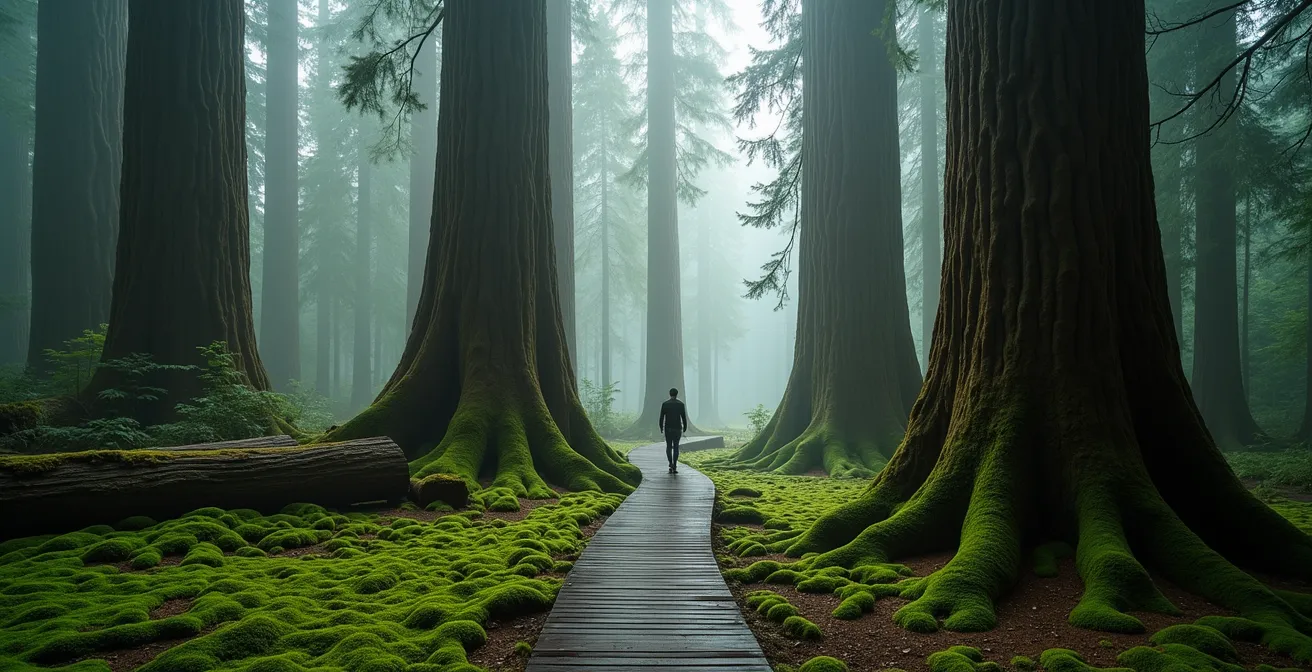
Standing in Cathedral Grove, neck craned to see the tops of 800-year-old Douglas Firs, it’s easy to feel a sense of profound awe. This is a place of giants, a living cathedral that predates most buildings on our continent. Many visitors arrive with the best intentions, dutifully following the primary rule: “stay on the boardwalk.” And while that is the most critical first step, it is also the beginning, not the end, of responsible exploration. True respect for these ancient places goes beyond following rules; it comes from understanding.
The common advice to “pack it in, pack it out” and “don’t touch the trees” is vital, but it treats the forest as a museum of individual artifacts. This view is incomplete. An old-growth rainforest is not a collection of trees. It is a single, breathing, interconnected organism. The real magic—and the real fragility—lies in the systems you cannot see: the vast, sensitive web of roots and mycelial fungi just beneath the soil, the complex societies living in the canopy hundreds of feet above, and the slow, deliberate cycle of death and rebirth that sustains it all. This guide is an invitation to see this forest as a conservation officer does: not just as a spectacle, but as a complex, living system that we have a shared duty to protect.
For those who prefer a visual introduction, the following video offers a beautiful immersion into the landscapes and atmosphere of the archipielago, perfectly complementing the practical advice in this guide.
This article is structured to deepen your understanding of this incredible ecosystem. We will move from identifying the unique characteristics of an ancient forest to understanding its life cycles, planning your visit, and ensuring your safety, all while learning how to be a true steward of these irreplaceable Canadian treasures.
Summary: A Deeper Look into BC’s Old-Growth Forest Ecosystems
- How to visually tell the difference between a managed forest and an ancient one?
- Why are fallen trees essential for the regeneration of the rainforest?
- Accessible boardwalks or remote boat access: which rainforest trip fits your budget?
- The camping mistake of pitching a tent under a dead branch in a storm
- How to photograph the dark forest floor without a tripod?
- How does a remote resort handle sewage without polluting the pristine lake?
- Why do Douglas Firs grow distinct ecosystems in their upper branches?
- How to hike the West Coast Trail without underestimating the mud and tides?
How to visually tell the difference between a managed forest and an ancient one?
At first glance, a forest is a forest. But an ancient, old-growth ecosystem like Cathedral Grove has a structure and complexity that is starkly different from a second-growth or managed forest. The latter often resembles a plantation: trees of uniform age and size, planted in rows, with a simple, sparse understory and an unnerving silence. An ancient forest, by contrast, is a symphony of organized chaos. Its very existence is a testament to resilience, a story told in its structure. Shockingly, less than 1% of the original, productive old-growth forests remain on Vancouver Island, making the ability to recognize them a crucial first step in appreciating their rarity.
To train your eye, look for these tell-tale signs of a truly ancient ecosystem:
- Multi-layered Canopy: Unlike the uniform ceiling of a managed forest, you’ll see towering giants, middle-aged trees, and young saplings all occupying different vertical spaces, competing for and sharing light.
- Pit-and-Mound Topography: The forest floor is not flat. It’s a rolling landscape of pits (where old trees were uprooted) and mounds (where they decomposed), a physical history of centuries of fallen giants.
- Abundant Woody Debris: The floor is littered with logs in various stages of decay, along with standing dead trees, known as snags. These are not signs of a messy forest but of a healthy, functioning one.
- Complex Understory and Epiphytes: Look for a rich diversity of shrubs, ferns, and mosses. Tree branches will be draped in life, hosting epiphytic gardens of lichens and ferns that are ecosystems in their own right.
Even the sound is different. The layered structure of an old-growth forest creates a complex, layered soundscape, absorbing and reflecting sound in a way a simple, single-layer forest cannot. You are not just seeing a difference; you are feeling and hearing it.
Why are fallen trees essential for the regeneration of the rainforest?
In our tidy, human world, a fallen tree is something to be cleared away. In the world of the rainforest, a fallen giant is the beginning of a new chapter. These massive logs, known as “nurse logs,” are the lifeblood of forest regeneration. They are the single most important element in ensuring the forest’s future, a process that can be slow and deliberate. According to BC government data, old-growth forests can take between 140 and 250 years to develop their characteristic structures, and often much longer.
This process is beautifully illustrated right on the trails of Cathedral Grove, where you can see the legacy of past events.
Case Study: Cathedral Grove’s Storm and Rebirth
Following a massive windstorm in 1997 that toppled many giants, the forest was forever changed. While tragic, these fallen trees became architects of the grove’s recovery. By opening the canopy, they let in light. As they decomposed, they released centuries of stored nutrients back into the soil. Most importantly, their decaying trunks provided the perfect, elevated, and nutrient-rich platform for the next generation of seedlings to take root, safe from the dense undergrowth on the forest floor.
As a nurse log slowly decays, it acts like a giant sponge, retaining moisture through dry summer months. Its surface becomes a fertile bed for moss, which in turn creates the perfect substrate for the tiny seeds of Western Hemlock and other species to germinate. Over decades, you will see a perfectly straight line of young trees—a “colonnade”—growing along the spine of the fallen log, their roots eventually reaching the forest floor below.
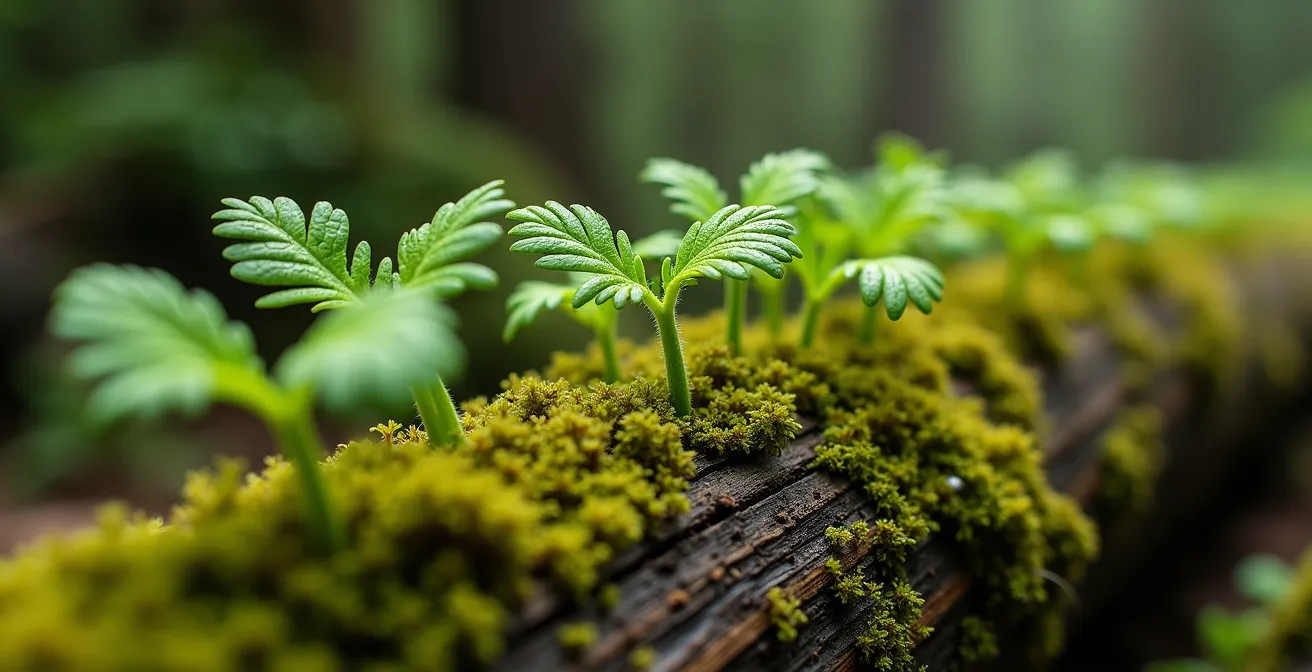
This is why leaving fallen trees undisturbed is paramount. They are not debris; they are cradles. They are monuments to the past and architects of the future, embodying the forest’s endless cycle of life, death, and renewal.
Accessible boardwalks or remote boat access: which rainforest trip fits your budget?
Experiencing British Columbia’s temperate rainforests can range from a free, 30-minute stroll to a multi-day wilderness expedition. Your choice depends on your budget, physical ability, and what you hope to gain from the experience. Places like Cathedral Grove are invaluable educational tools, but their accessibility comes at a cost: crowds. With over 300,000 visitors annually, the experience is often shared, and the ecosystem is under immense pressure.
Understanding your options allows you to make a choice that aligns with your values as an eco-tourist. Here’s a comparison of typical rainforest access options in British Columbia, using data from parks and tour operators:
| Access Type | Location | Cost | Infrastructure | Visitor Experience |
|---|---|---|---|---|
| Accessible Boardwalks | Cathedral Grove | Free (parking only) | Maintained trails, wheelchair accessible sections | Educational but crowded, 30-45 min visit |
| Remote Boat Access | Meares Island Big Tree Trail | $60-100 water taxi from Tofino | Basic trail markers only | Solitude, 3-4 hour immersion |
| Backcountry | Carmanah Walbran | $200+ guided tour | Minimal infrastructure | Multi-day wilderness experience |
There is no “best” option; they serve different purposes. The boardwalks of Cathedral Grove offer a crucial, accessible introduction for everyone. A trip by water taxi to Meares Island offers a deeper sense of solitude and a more rustic trail experience. A guided tour into the backcountry of Carmanah Walbran is a profound, immersive journey for the dedicated adventurer. By choosing a remote option, you not only find solitude but also distribute the economic benefits of tourism and ease the pressure on hyper-popular sites.
The camping mistake of pitching a tent under a dead branch in a storm
The awe-inspiring scale of an old-growth forest can lull us into a false sense of security. These giants feel permanent, immovable. But as a living system, the forest is in a constant state of change, and that includes decay and death. This process creates one of the most significant and often underestimated hazards for backcountry users: falling trees and branches. As BC Parks warns, the very nature of these ancient places requires heightened awareness.
Cathedral Grove in MacMillan Park is an old forest. Its large trees will continue to live for many more years, but root system disease will cause some trees and branches to die.
– BC Parks, MacMillan Park Official Information
Large, dead branches suspended in the canopy are known by a grimly descriptive name: “widowmakers.” In high winds or a storm, these can break free without warning. The most common and dangerous mistake a camper can make is choosing a tent site based solely on its beauty or flat ground, without first assessing the overhead risk. A majestic, towering Douglas Fir might seem like a poetic shelter, but if it has dead limbs, it’s a serious liability.
Before setting up any camp in a BC forest, you must perform a thorough safety check:
- Look Up: Scan the entire canopy above and around your proposed site. Look for dead branches, identifiable by their lack of needles or leaves and often a different, greyer colour.
- Choose Clearings: Whenever a storm is forecast, opt for a site in a clearing or among younger, healthier trees, far from the reach of any potential widowmakers.
- Assess the Whole Tree: Look at the base of large trees for signs of rot or fungal growth, which can indicate instability.
- Heed Park Warnings: Pay close attention to any storm damage warnings or area closures. BC Parks has experienced significant storm damage in recent years, and these closures are for your safety.
Your safety is intrinsically linked to understanding the forest’s natural processes. Recognizing the signs of decay is as important as recognizing the signs of life.
How to photograph the dark forest floor without a tripod?
Capturing the ethereal beauty of the rainforest floor—the vibrant green moss, the intricate ferns, the subtle textures of a nurse log—is a challenge. The dense canopy creates a low-light environment, and conventional wisdom dictates a tripod is necessary to avoid blurry images. However, for visitors to places like Cathedral Grove, where boardwalks can be narrow and crowded, or for hikers wanting to travel light, a tripod is often impractical. Fortunately, modern cameras and a few field techniques make it possible to get sharp, beautiful handheld shots.
Expert Insight: Ditching the Tripod
Professional macro photographer Emilie Talpin notes that massive improvements in in-camera image stabilization have largely made tripods obsolete for much of her forest work. She argues that being untethered allows for greater creativity and the ability to move constantly, finding better compositions and fleeting moments of light. Using lightweight cameras and lenses, she can spontaneously capture incredible detail on the forest floor, even in challenging conditions.
To follow this professional advice and leave your tripod at home, you need to become a master of stability and light. Here are some proven techniques for sharp, handheld forest photography:
- Find Natural Braces: Use the environment as your tripod. Brace your camera against a solid tree trunk, press your elbows against a boardwalk railing, or even use your backpack as a stable base on the ground.
- Master Your Settings: Don’t be afraid to increase your ISO to a range of 1600-3200 to achieve a sufficiently fast shutter speed (e.g., 1/125s or faster). Modern cameras handle high ISO much better than older models.
- Shoot in Bursts: Use your camera’s continuous shooting (burst) mode. Take 3-5 frames of the same composition. Invariably, one will be sharper than the others, as it was likely captured between breaths or micro-movements.
- Use Available Light: Look for shafts of light filtering through the canopy. Position yourself so this light illuminates your subject, creating natural highlights and contrast. Use spot metering to expose for the most important part of your scene, like a patch of bright green moss.
By combining body mechanics with smart camera settings, you can capture the soul of the forest without being burdened by extra gear, allowing for a more fluid and immersive experience.
How does a remote resort handle sewage without polluting the pristine lake?
As an eco-tourist, your choices extend beyond the trail. Where you stay has a direct impact on the health of the surrounding ecosystem, especially in remote, sensitive areas. A lakeside resort in the middle of a pristine watershed has a profound responsibility to manage its waste. The question of how it handles sewage is not a trivial detail; it is a critical indicator of its environmental commitment. A poorly managed system can leach nutrients and contaminants into the soil and water, devastating the very environment its guests have come to enjoy.
Responsible operators in British Columbia invest heavily in advanced wastewater treatment systems. These are not simple septic tanks but sophisticated, multi-stage processing plants designed to treat sewage to a high standard before the water is safely discharged back into the environment, often through a large dispersal field far from any water sources. These systems must comply with the stringent BC Sewerage System Regulation, often requiring a Type 2 or even Type 3 system for commercial operations in sensitive areas. They work alongside robust greywater management and composting programs to minimize the facility’s overall footprint.
As a conscious traveller, you have the power to support operators who take this responsibility seriously. Before booking a stay at a remote lodge or resort, you can perform a quick environmental audit.
Your 5-Step Audit for Choosing a Responsible Resort
- Identify Points of Contact: List potential resorts in your target area and locate their “Sustainability” or “Environment” page on their website. If none exists, note their general contact information.
- Collect Specific Claims: Inventory the concrete claims they make. Look for keywords like “Type 2 or 3 treatment system,” “greywater recycling,” “composting,” and specific certifications. Vague statements like “we are eco-friendly” are not enough.
- Verify with Standards: Confront their claims with recognized certifications. Do they mention holding a rating from Green Key Global or explicitly state their compliance with provincial regulations? A lack of verifiable detail is a red flag.
- Assess Transparency: Evaluate how this information is presented. Is it shared proudly and in detail, demonstrating a commitment to transparency? Or is it buried, vague, or absent altogether?
- Finalize Your Plan: Make your booking decision based not on price alone, but on which operator best demonstrates a verifiable, transparent, and comprehensive commitment to protecting the watershed.
By asking these questions, you are sending a powerful market signal: environmental stewardship matters. You are using your tourist dollars to actively support businesses that are partners in conservation.
Why do Douglas Firs grow distinct ecosystems in their upper branches?
The wonders of an old-growth forest are not confined to the ground. High above the forest floor, in the upper canopy of ancient Douglas Firs and Sitka Spruces, lies a hidden world—a “second forest” that few people ever see. Over hundreds of years, the broad, gnarled branches of these giants accumulate a thick mat of shed needles, airborne dust, and organic matter. This material slowly decomposes, forming a rich, suspended layer of canopy soil. This soil can be over a foot deep, creating a unique and vital habitat for a host of species, some of which may live their entire lives without ever touching the ground.
This elevated ecosystem is a testament to the sheer complexity of old-growth forests, which are powerhouses of biodiversity and carbon storage. In fact, old-growth coastal rainforests store two to three times more carbon per hectare than managed second-growth forests. Protecting one hectare is equivalent to taking over 100 cars off the road for a year.
Case Study: The Science of Canopy Soils
Canopy researchers in the Pacific Northwest have discovered an astonishing level of biodiversity in these crown humus mats. They have found fungi, lichens, insects, and even amphibians like the Wandering Salamander that are uniquely adapted to this arboreal environment. These canopy soils absorb and retain vast amounts of water and nutrients, which the tree can then access through adventitious roots that grow directly from its own branches down into the soil it has created. It is a self-sustaining ecosystem, a world within a world.
This hidden dimension is one of the most compelling reasons why old-growth trees are irreplaceable. You cannot “replant” a 500-year-old canopy ecosystem. It is a feature that develops only with immense time and stability. When you stand at the base of a giant, you are looking at the foundation of a structure that supports entire communities high above your head. It fundamentally changes your perspective, transforming the tree from a simple plant into a multi-story, living apartment complex.
Key Takeaways
- An ancient forest is a complex, multi-layered system, not just a collection of big trees. Its health depends on unseen connections.
- The cycle of death and rebirth, embodied by fallen nurse logs, is the foundation of the forest’s future and must be protected.
- True responsible tourism involves making conscious choices about where and how you visit, understanding that every decision has an impact.
How to hike the West Coast Trail without underestimating the mud and tides?
For the adventurous eco-tourist, the legendary West Coast Trail (WCT) represents the ultimate immersion in British Columbia’s coastal rainforest. This multi-day trek is a profound journey through the heart of the Pacific Rim National Park Reserve. But underestimating its two greatest challenges—mud and tides—can quickly turn an adventure into a dangerous ordeal. Successfully and responsibly hiking the WCT requires meticulous planning and a deep respect for the power of the natural world. It is the final exam in understanding the West Coast ecosystem.
The trail is infamous for its deep, unforgiving mud, which can be knee-deep even in summer. But the more critical, time-sensitive challenge is the tide. Large sections of the WCT are routed along coastal shelves that are beautiful and easy to walk at low tide but completely submerged and impassable at high tide. Being caught by a rising tide can be deadly. Proper preparation is not optional; it’s a matter of survival.
- Master the Tides: Before you go, download and print the Canadian Hydrographic Service tide tables for both Bamfield and Port Renfrew. Learn to read them and plan each day’s hike around the low tide windows.
- Know Your Limits: Understand that a tide height above 2.5 meters (8 feet) generally makes shelf sections impassable. Identify these critical sections on your map and time your arrival accordingly.
- Prepare for Mud: High-quality, waterproof hiking boots are essential, as are durable gaiters to keep mud and water out. Trekking poles are indispensable for stability and for probing mud depth.
- Respect Wildlife and Territory: You are a guest in both a wilderness habitat and the traditional territories of the Huu-ay-aht, Ditidaht, and Pacheedaht First Nations. Make noise to avoid surprising bears, carry bear spray and know how to use it, and always respect trail closures and Indigenous protocols.
As Parks Canada states, your path is chosen for you, and respecting that path is a form of respect for the entire ecosystem.
Use official trails only and leave the wild trails to wildlife. Respect closures and seasonal trail restrictions —they are in place for your safety and to give bears a chance to use critical habitat undisturbed.
– Parks Canada, Safe travel in bear country guidelines
The West Coast Trail is a synthesis of everything this guide covers: it demands an understanding of the environment, meticulous planning, and a humble respect for forces far greater than yourself. It is not just a hike; it is a lesson in stewardship.
By shifting your perspective from that of a spectator to that of an informed steward, you transform your visit. Every step you take—or choose not to take—becomes an act of conservation. Begin today to plan your next visit not just as a trip, but as a partnership with one of Earth’s most magnificent and fragile ecosystems.
Frequently Asked Questions about Cathedral Grove
How long does it take to walk through Cathedral Grove?
A typical visit to Cathedral Grove, covering the main boardwalk loops on both sides of the highway, takes between 30 and 45 minutes. This allows for a comfortable pace to observe the giant trees and read the interpretive signs.
Are there bears or other dangerous wildlife in Cathedral Grove?
While Cathedral Grove is in the heart of Vancouver Island’s black bear and cougar territory, the high volume of visitors makes sightings within the main boardwalk area very rare. However, it is always wise to be aware of your surroundings, never feed wildlife, and properly dispose of all food and garbage in designated bins.
Is Cathedral Grove accessible for wheelchairs or strollers?
Yes, sections of the trail system at Cathedral Grove are wheelchair and stroller accessible. The main boardwalks are relatively flat and well-maintained, offering an excellent opportunity for visitors of all mobility levels to experience the majesty of the old-growth forest.