

Fumbling with a whole lobster is a tourist’s game; eating it with confidence and getting every last morsel is the Maritime way.
- The secret to flavour isn’t just melted butter; it’s knowing the difference between a sweet “shedder” and a meaty hard-shell, and when to find them.
- Authentic preparation starts with the water, salted perfectly to match the ocean, and ends with a unique regional dipping sauce you won’t find anywhere else.
Recommendation: Master the simple, hands-on techniques for cracking the shell and savouring the meat, and you’ll transform a meal into an unforgettable cultural experience.
There’s a moment every visitor to the Maritimes faces: a bright red, whole lobster is placed before you, steaming and magnificent. Alongside it sits a little bowl of melted butter and a set of intimidating metal tools. The common advice is to twist, crack, and pick your way through, but this purely mechanical approach misses the entire point. It’s like being given the keys to a sports car but only being told how the ignition works.
Here on Prince Edward Island, eating lobster is a craft, a tradition passed down through generations of fishing families. It’s less about force and more about finesse. We know that the real flavour comes from understanding the animal itself—when it was caught, where it’s from, and how to honour it in the kitchen. The tools are secondary; the real secrets are in your hands, in the pot, and in the surprisingly simple sauce that defines an authentic lobster supper.
Forget the fear of making a mess. This guide isn’t about the tourist-trap bibs and crackers. It’s about the local knowledge that turns a complicated meal into a simple, delicious ritual. We’ll cover everything from the dockside purchase to the final, sweet bite, so you can tackle that lobster not just with confidence, but with the reverence of a true Islander.
To guide you through this culinary journey, we’ve broken down the essential knowledge every lobster lover should have. This article will walk you through the secrets of seasonality, the hands-on techniques for getting every piece of meat, and the cultural traditions that make the Maritime lobster experience unique.
Summary: Your Guide to the Authentic Maritime Lobster Experience
- Why is fresh lobster available in different zones at different times?
- How to extract meat from the legs using only your hands?
- More meat or sweeter taste: which lobster version is the better deal?
- The biological truth behind the sound when boiling
- How to salt the water to replicate the ocean taste perfectly?
- When to be at the dock to buy fresh seafood directly from the boat?
- Why is the sweet condensed milk sauce essential to the authentic experience?
- How to find authentic regional foods beyond poutine and maple syrup?
Why is fresh lobster available in different zones at different times?
The first secret to a great lobster is knowing that “fresh” has a calendar and a map. In the Canadian Maritimes, the lobster fishery is meticulously managed through a system of Lobster Fishing Areas (LFAs). Each LFA has a specific, staggered season to ensure sustainability and provide a near year-round supply. This is why you can find incredible lobster in Southwest Nova Scotia in the dead of winter, while PEI’s boats are docked until spring.
These seasons are not arbitrary. They are timed with the lobster’s natural life cycle, including migration and molting. The water temperature plays a massive role. For example, historically warm waters can disrupt these cycles, leading to unpredictable seasons. In 2024, the Northumberland Strait (LFA 25) saw a 30-40% decline in landings early on because the lobsters’ molt was delayed. Understanding this rhythm is key to tasting lobster at its absolute peak.
So, when you’re planning a culinary trip, think in terms of LFAs. A visit to PEI in May or June means you’re getting prime LFA 24 spring lobster. A trip to the Northumberland Strait in late summer gets you the coveted LFA 25 “shedders.” This regional timing is the difference between a good lobster and a perfect one. The table below, based on information from the Department of Fisheries and Oceans, breaks down the main seasons, as detailed in the official Canadian Lobster Fishing Areas (LFA) schedule.
| LFA Region | Areas | Season | Key Characteristics |
|---|---|---|---|
| Southwest Nova Scotia | LFA 33-38 | Nov-May | 40% of Canada’s annual catch, coldest water |
| Eastern Shore | LFA 27-32 | Variable by zone | Staggered seasons for year-round supply |
| Northumberland Strait | LFA 25 | Aug 7 – Oct 8 | Summer fishery, warmer waters |
| Prince Edward Island | LFA 24 | May-June | Spring season lobster |
How to extract meat from the legs using only your hands?
Now for the part where you can put the tools aside. A true Islander wastes nothing, and the sweetest, most tender meat is often hidden in the small walking legs. Tourists often discard them, but locals know this is a mistake. There’s a simple, satisfying technique to get this meat out using only your hands and mouth—no picks required.
First, twist each of the eight small legs off the body right at the joint. You’ll work with one leg at a time. The trick is to break the leg’s “seal” to create a tiny straw. This is the authentic, no-fuss Maritime method.
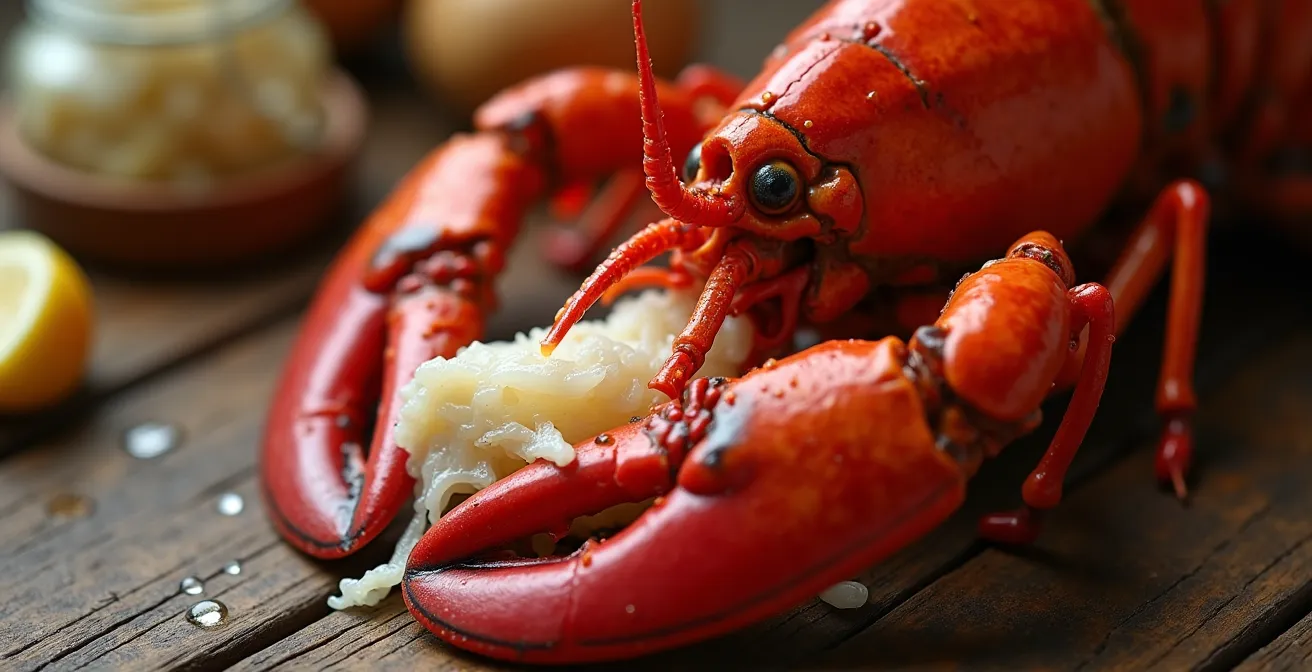
As the image above demonstrates, it’s a precise, hands-on process. Follow these steps to master the local technique and savour every last bit of that sweet leg meat.
Your Action Plan: The Maritime Fisherman’s Leg Extraction
- Twist and Pull: Firmly twist each walking leg from the lobster’s body where it connects at the knuckle. It should come off cleanly.
- Snap the Joints: Take a single leg and bend it backwards at each joint until you hear a small, satisfying crack. This breaks the cartilage inside that holds the meat.
- Create a Straw: Break off the very tip of the leg. This creates an opening at both ends.
- Suck Out the Meat: Put the wider, open end (where it connected to the body) to your mouth and suck sharply. The entire piece of leg meat will slide out directly into your mouth. It’s the most efficient—and enjoyable—way to do it.
- Alternative Press: If you’re more reserved, you can place the leg on a plate and use the handle of a knife or a rolling pin to gently press the meat out from the tip towards the base.
More meat or sweeter taste: which lobster version is the better deal?
Not all lobsters are created equal. The biggest debate at any Maritime lobster supper is the choice between hard-shell and soft-shell. A tourist might think a heavier lobster is always better, but a local knows the truth is more nuanced. The choice is a trade-off between meat yield and flavour profile. Your preference will define your perfect lobster experience.
Hard-shell lobsters, typically caught in the cold waters from late fall to spring, have shells that are full to bursting with firm, dense meat. They have a higher meat-to-shell ratio, giving you more bang for your buck in terms of sheer volume. Their flavour is rich and briny, a direct reflection of the cold Atlantic waters. On the other hand, soft-shell lobsters, also known as “shedders,” are caught in the warmer summer months right after they’ve molted into a new, larger shell. This new shell hasn’t fully hardened, so there’s more space and water inside. While they yield less meat per pound, that meat is incredibly tender, delicate, and noticeably sweeter.
Northumberland Strait’s 2024 Soft-Shell Challenge
The 2024 season in LFA 25 provided a perfect example of this trade-off. A delayed molt cycle due to warm waters meant fewer lobsters were caught, but those that were, were often premium “shedders.” These soft-shell lobsters, while containing less meat, were in high demand for their exceptionally sweet taste, commanding prices of $8.50/lb at the dock. It proved that for many connoisseurs, superior taste and tenderness are worth more than just weight.
So, what’s the better deal? If you want maximum meat and a robust, salty flavour, go for a hard-shell. If you prize a tender texture and a subtle, sweet taste—and don’t mind getting your hands a bit wet—the soft-shell shedder is the connoisseur’s choice. Breaking a soft-shell lobster can often be done entirely by hand, making it a more primal and rewarding experience.
| Characteristic | Hard-Shell | Soft-Shell (Shedder) |
|---|---|---|
| Season | November-May (cold water) | July-September (post-molt) |
| Meat Yield | More meat per pound | Less meat (30-40% water weight) |
| Meat Texture | Firmer, denser | More tender, delicate |
| Flavor | Rich, briney | Sweeter, more subtle |
| Price | Generally higher | Variable based on availability |
| Ease of Eating | Requires crackers/tools | Can break by hand |
The biological truth behind the sound when boiling
Let’s address the elephant in the room. Many first-timers are concerned by the high-pitched, whistle-like sound a lobster can make when it’s placed in boiling water. This has led to the persistent myth that the lobster is “screaming.” As a chef who handles hundreds of lobsters, let me put this to rest: lobsters cannot scream. They lack the biological structures, like vocal cords and complex lungs, necessary to produce sound.
The sound you hear is purely a physical reaction. A lobster’s shell has tiny fissures and gaps, especially around the joints. When the lobster is submerged in boiling water, the air and steam trapped inside the shell expand rapidly and escape through these openings. It’s the same principle as a tea kettle whistling when it boils. It is a release of pressure, not a cry of pain. Knowing this allows you to cook with a clear conscience, focusing on the culinary process rather than a mistaken belief.
Another key indicator of a properly cooked lobster is the tail. A lobster that was fresh and alive when it went into the pot will have a tightly curled tail after cooking. This is a natural reflex. If the tail is straight, it’s a sign the lobster was dead before it was cooked, which can affect both safety and quality. While traditional boiling is the standard at community suppers across the Maritimes, it’s worth noting that the industry is always evolving. Some Canadian processors are now exploring more modern methods, such as using a device called the Crustastun to electrically stun the lobster instantly before cooking, ensuring absolute inactivity.
How to salt the water to replicate the ocean taste perfectly?
The most common mistake people make when cooking lobster at home is under-salting the water. You are not just boiling the lobster; you are giving it one last, sweet, briny kiss of the ocean. The goal is to make your pot of water taste exactly like the Atlantic. At many coastal restaurants and church suppers in Nova Scotia, the “secret” is simple: they use filtered seawater straight from the source. This ensures the lobster meat is perfectly seasoned from the inside out.
If you’re not on the coast, you can easily replicate this at home. Forget measuring spoons and generic recipes. The old-time Maritime method is called “The Potato Test.” It’s beautifully simple: add coarse sea salt (never iodized table salt) to your pot of fresh water, stirring until it dissolves. Keep adding salt until a raw, scrubbed potato just begins to float off the bottom. That’s when you know the salinity is perfect. It’s a foolproof trick passed down from fishermen.
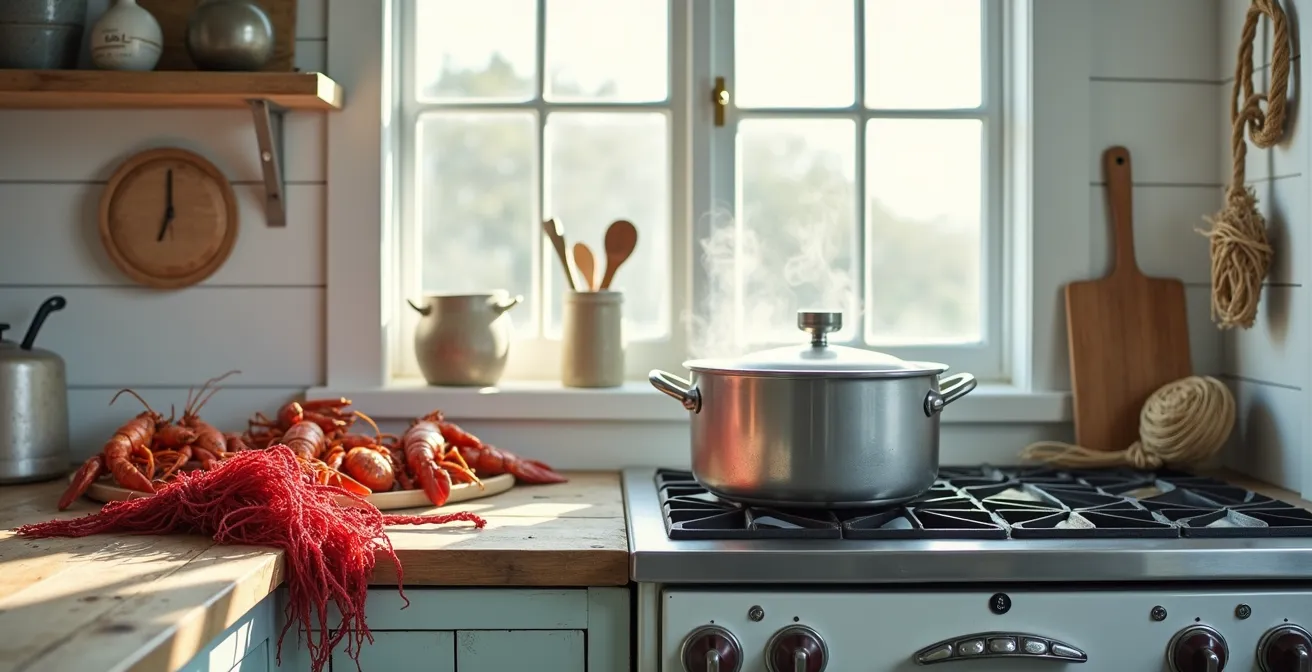
To add another layer of authentic Atlantic flavour, many local chefs will toss in a handful of fresh or dried seaweed, like dulse or kelp, along with a bay leaf. This infuses the water with a subtle umami that complements the lobster’s natural sweetness. Following these steps, as detailed in guides from organizations like the Nova Scotia Seafood Alliance, will elevate your home-cooked lobster to a professional level.
Action Plan: Replicating the Authentic Maritime Boil
- Source Your Water: If possible, start with clean, filtered seawater. If not, use fresh water and prepare for salting.
- Perform the Potato Test: Add coarse sea salt to your pot of fresh water, stirring to dissolve. Keep adding salt until a whole raw potato just begins to lift off the bottom. Remove the potato before boiling.
- Add Atlantic Aromatics: For true Maritime flavour, toss a handful of dulse or kelp seaweed, a bay leaf, and a few black peppercorns into the water.
- Bring to a Rolling Boil: Ensure the water is at a full, vigorous boil before you add the lobsters. This cooks them quickly and evenly.
- Time it Right: Boil for approximately 7-9 minutes for the first pound, and 3-4 minutes for each additional pound. A 1.5 lb shedder will cook faster than a 1.5 lb hard-shell.
When to be at the dock to buy fresh seafood directly from the boat?
To get a lobster any fresher, you’d have to go out on the boat yourself. Buying directly from fishermen at the wharf is a quintessential Maritime experience. It connects you to the source, supports the local economy, and guarantees unparalleled freshness. But it’s an informal market that runs on the rhythm of the tides and the fishing day, not a retail clock.
The golden window is generally between 1:00 PM and 3:00 PM. Fishing boats typically head out in the early morning and return with their haul in the early afternoon. In iconic fishing communities like Shediac, New Brunswick, or Summerside, Prince Edward Island, you’ll see locals gathering at the wharf during this time, cash in hand. The prices are often the best you’ll find, typically ranging from $6 to $12 per pound, depending on the season, size, and market conditions.
This tradition of “off-the-dock” sales has become so integral to the culture that it’s now being formalized. The Department of Fisheries and Oceans (DFO) Canada has implemented programs that officially designate wharves where licensed fishermen can sell their catch directly to the public. This ensures the practice continues in a safe and regulated way. When you buy at the dock, you’re not just getting dinner; you’re taking part in a living tradition and will likely get a friendly piece of advice from the fisherman who caught it.
Why is the sweet condensed milk sauce essential to the authentic experience?
While the rest of the world serves lobster with melted butter, many parts of the Maritimes, particularly in Acadian and Gaspésien communities, have a different tradition. It’s a simple, tangy, and sweet cold sauce that might sound unusual at first, but it’s a game-changer. This sauce is made from sweetened condensed milk, and it is absolutely essential to the authentic lobster supper experience here.
The origin of this sauce is rooted in practicality and history. In rural fishing communities, shelf-stable ingredients were a pantry staple. Sweetened condensed milk, with its long life and rich texture, was always on hand. The genius of the recipe is how the acid from white vinegar “cooks” or curdles the milk slightly, thickening it into a creamy, tangy dip. The sweetness of the milk perfectly balances the saltiness of the lobster meat, creating a flavour combination that is, quite simply, “dangerously addicting.” It cuts through the richness of the lobster in a way that plain butter cannot.
Serving lobster with this cold, sweet sauce is a hallmark of a true, old-fashioned community supper. It’s meant to be served at room temperature in small bowls for dipping the cold lobster meat. Here is the traditional recipe, which couldn’t be simpler.
Recipe: Traditional Gaspésien Sweet Lobster Sauce
- Mix 1 can (300ml) of sweetened condensed milk with 3 tablespoons of plain white vinegar.
- Add 1/2 teaspoon of salt and 1/4 teaspoon of white pepper.
- Whisk the mixture vigorously. You will notice it starts to thicken almost immediately as the vinegar reacts with the milk.
- Serve immediately in small dipping bowls. It is critical to never heat this sauce; its magic is in the cool, tangy contrast it provides to the lobster.
- For an Acadian twist, some families add a pinch of summer savory.
Key Takeaways
- Lobster seasonality is real: check the Lobster Fishing Area (LFA) schedule to taste the freshest catch for your travel dates.
- The best lobster experience is a trade-off: choose hard-shell for more, firmer meat, and soft-shell (shedders) for a sweeter, more tender taste.
- The “scream” from a boiling lobster is a myth; it’s simply steam escaping the shell. A curled tail is the true sign of a fresh cook.
How to find authentic regional foods beyond poutine and maple syrup?
Your journey into authentic Maritime cuisine begins with lobster, but it certainly doesn’t end there. Using the lobster experience as your gateway, you can discover a rich tapestry of local food traditions that go far beyond the stereotypical Canadian dishes of poutine and maple syrup. The key is to look for events and places where locals gather to eat.
The most vibrant expressions of this are the region’s legendary lobster festivals. These are not just tourist attractions; they are deeply ingrained community celebrations. The Shediac Lobster Festival in New Brunswick, for instance, has been running for over 75 years and is a full-blown party celebrating the town’s heritage as the “Lobster Capital of the World.” These festivals are where you’ll find everything from lobster-eating contests to culinary demonstrations of traditional recipes.
However, for the most authentic experience of all, you need to look smaller. Seek out the community lobster suppers, often held in church basements or community halls throughout the summer. These are no-frills affairs where the focus is entirely on the food, prepared the same way it has been for generations. Here, you’ll get a lobster, potato salad, coleslaw, a roll, and a slice of homemade pie for a set price. It’s here you’re most likely to find the authentic condensed milk sauce and other local delicacies. These suppers are the heart and soul of Maritime food culture.
The festival circuit provides a fantastic overview of the region’s passion for seafood, as shown in the table below based on information from sources like Tourism PEI.
| Festival | Location | Dates (2024) | Unique Features |
|---|---|---|---|
| Shediac Lobster Festival | Shediac, NB | July 9-14 | 75-year tradition, eating contests, concerts |
| Summerside Lobster Carnival | Summerside, PEI | July 11-13 | Harness racing, culinary demos, trap stacking competition |
| Nova Scotia Lobster Crawl | South Shore, NS | February | Winter festival, 150+ events, lobster beer tastings |
| Community Lobster Suppers | Various churches/halls | May-September | Most authentic experience, local preparation methods |
Frequently Asked Questions About Maritime Lobster
Why does a lobster make noise when boiled?
The sound is simply air and steam escaping from the shell through small gaps, not a scream. Lobsters lack vocal cords and the complex respiratory system needed to produce sounds. It’s a purely physical process, like a kettle whistling.
How can I tell if a lobster was fresh when cooked?
The most reliable sign is the tail. A lobster that was alive and healthy when cooked will have its tail curled tightly under its body. This is a result of a natural muscle reflex. A straight tail indicates the lobster likely died before being cooked, which can compromise its texture and flavour.
Are there more humane cooking methods being adopted?
Yes, the industry is exploring alternatives. Some Canadian seafood processors are adopting devices like the Crustastun, which uses an electric current to stun lobsters instantly before cooking. However, traditional boiling remains the standard and accepted method for most restaurants and community lobster suppers in the Maritimes.