
In summary:
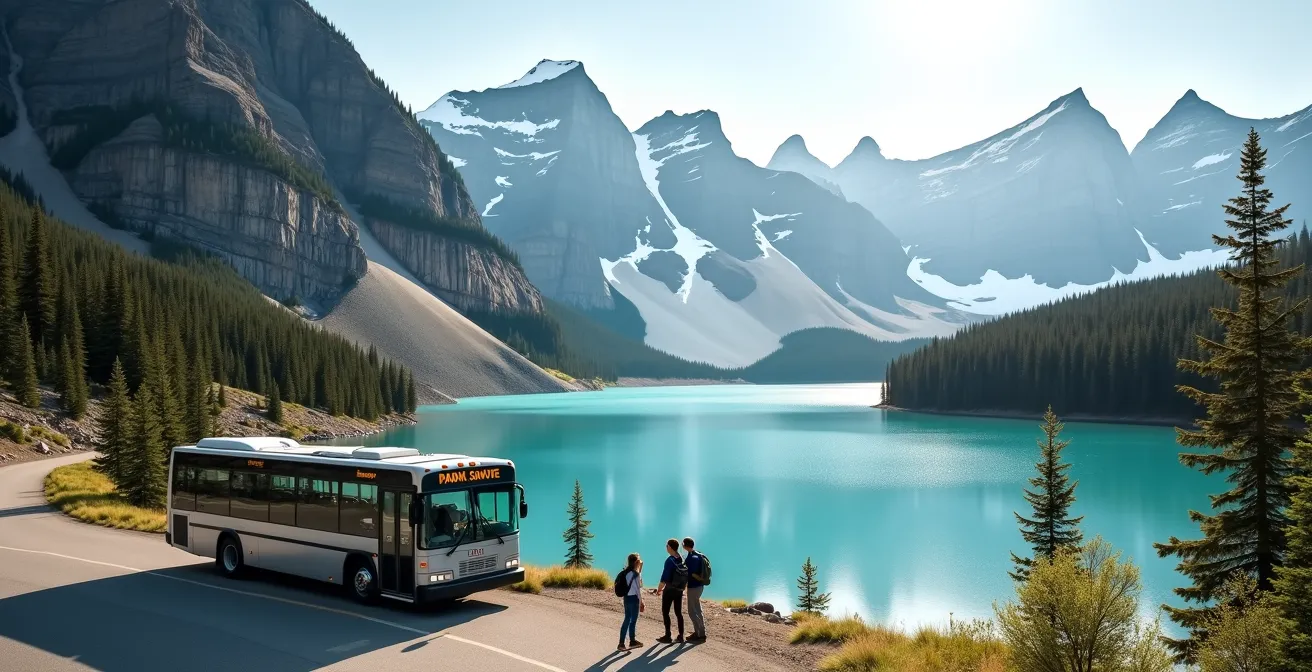
- Accessing Moraine Lake now requires booking a Parks Canada shuttle, a private tour, or using Roam Transit, as personal vehicles are banned.
- Success depends on strategy: book Parks Canada seats exactly at 8 AM MDT, 48 hours in advance, or secure a spot with a private operator for guaranteed access, especially for sunrise.
- Consider strategic alternatives like Peyto Lake, which offers similar stunning views but is managed for better crowd dispersal.
- Understand the local context, from trail difficulty ratings to cold water safety, to have a safer and more enjoyable trip.
If you’ve driven the scenic road towards Moraine Lake recently, you’ve likely been met with a disheartening sign: “Private Vehicle Access Closed.” That iconic view, once the prize for a pre-dawn drive, now seems locked away. The internet is full of basic advice: book a shuttle, go with a tour group, or try your luck with public transit. While correct, this information barely scratches the surface of the frustration and fails to offer a real strategy for navigating the new reality in the Canadian Rockies.
The restrictions aren’t there just to inconvenience you; they are a necessary response to overwhelming visitor numbers and a crucial step towards preserving the delicate ecological integrity of these world-class landscapes. But as a local, I know that simply giving up or feeling frustrated isn’t the answer. The key isn’t just knowing the options, but understanding the system, the timing, and the landscape itself. It’s about shifting your mindset from a simple destination-grab to a thoughtful exploration of the entire region.
This guide offers a different perspective. Instead of just listing what you *can’t* do, we’ll dive into the local’s playbook for what you *can*. We’ll cover the insider tricks for snagging those elusive shuttle seats, decode why a “moderate” hike here feels like a marathon elsewhere, and explore how to find that same sense of awe with fewer crowds. This is about working with the new rules, not against them, to build a smarter, more rewarding, and more respectful Rockies experience.
This article provides a comprehensive strategy for visiting the iconic lakes of the Canadian Rockies in the wake of new access regulations. Below, you will find a detailed breakdown of everything from the science behind the water’s colour to practical tips for securing reservations and maximizing your park pass.
Summary: A Local’s Guide to Navigating the Rockies’ Lake Access
- Why do rock flour deposits make the lakes turn that specific blue?
- How to secure a Parks Canada shuttle seat when they sell out in minutes?
- Lake Louise or Peyto Lake: which offers a better experience with fewer crowds?
- The swimming error that leads to cold water shock in July
- When to arrive at the lakeshore to capture the perfect mirror reflection?
- How to navigate the new reservation launch dates to get a spot in Jasper?
- Why is a “moderate” trail in the Rockies considered “hard” in Ontario?
- How to maximize your Parks Canada Discovery Pass value on a 2-week trip?
Why do rock flour deposits make the lakes turn that specific blue?
That almost-unreal, opaque turquoise colour of lakes like Moraine, Louise, and Peyto isn’t due to a filter or some trick of the light; it’s pure geology in action. The phenomenon is caused by “rock flour,” a fine, silt-like powder of rock ground up by the immense weight and movement of glaciers. As glaciers slowly grind their way over bedrock, they pulverize the stone into microscopic particles. This glacial flour is then carried into the lakes by summer meltwater.
Instead of sinking, these fine particles remain suspended in the water column. When sunlight hits the lake, the water absorbs most colours in the light spectrum, but the rock flour particles scatter the blue and green wavelengths back to our eyes. According to University of Alberta researchers who documented this process, the result is the hypnotic, milky turquoise hue that makes these lakes famous. The specific shade can change depending on the time of year and the amount of meltwater, but the science remains the same.

However, this spectacular display is under threat. As climate change accelerates, the glaciers that produce this rock flour are receding at an alarming rate. With projections showing that as much as 70% of Western Canada’s glaciers could vanish by 2100, the source of the lakes’ iconic colour is diminishing. Over time, as less rock flour enters the water, the lakes may become clearer and shift towards a more common, translucent deep blue. Seeing them now is witnessing a geological process that is, unfortunately, fading.
How to secure a Parks Canada shuttle seat when they sell out in minutes?
The biggest source of frustration for visitors is the “booking pressure” surrounding the Parks Canada shuttle system. Seats are released, and within minutes, they’re gone. Success isn’t about luck; it’s about a precise, prepared strategy. The main release happens 48 hours in advance, to the minute. You must be logged in and ready to click at exactly 8:00 AM Mountain Daylight Time (MDT).
Here’s the local’s approach: First, create your Parks Canada account weeks before your trip. Pre-populate all your details and save your credit card information to avoid any glitches during the high-traffic rush. Remember that while a portion of seats are released in the spring, an updated strategy confirmed that 60% of seats are now released on this 48-hour rolling window, so you still have a strong chance. When booking, it doesn’t matter if you choose the Moraine Lake or Lake Louise shuttle first; your ticket includes free access to the Lake Connector shuttle that runs between both lakes, so just focus on securing a spot on either one.
But what if you fail? Don’t despair. This is where your backup plan comes in. Several excellent private operators offer guaranteed access, often with perks that Parks Canada doesn’t. They might cost more, but they eliminate the stress. The key is choosing the one that fits your itinerary.
This table compares some of the top-rated local shuttle companies, giving you a clear overview of your “Plan B” options.
| Operator | Departure Points | Special Features | Best For |
|---|---|---|---|
| Moraine Lake Bus Company | Lake Louise Village | Sunrise shuttles at 4am/5am | Photography enthusiasts |
| Fairview Limousine | Lake Louise | Pet-friendly with extra fee | Travelers with pets |
| Ten Peaks Shuttles | Banff, Bow Valley Parkway | Multiple pickup locations | Bow Valley accommodations |
| Mountain Park Transportation | Banff town | Stops at both lakes | Banff-based visitors |
Lake Louise or Peyto Lake: which offers a better experience with fewer crowds?
With access to Moraine Lake now so tightly controlled, many visitors wonder where to find a similar “wow” factor without the logistical headache. The choice often comes down to two titans: the world-famous Lake Louise and the wolf-shaped Peyto Lake, located further up the Icefields Parkway. While both are stunningly beautiful, they offer fundamentally different experiences due to Parks Canada’s strategic approach to visitor dispersion.
Lake Louise is all about accessibility and amenities. The shuttle drops you right at the shoreline, where a flat, stroller-friendly path leads along the lake towards the Fairmont Chateau. This makes it an excellent choice for families with young children or those with mobility concerns. However, this ease of access concentrates crowds in a very small area. The shoreline can feel more like a city square than a natural wonder during peak hours.
Peyto Lake, on the other hand, is managed to spread people out. Accessing its famous viewpoint requires a moderate 10-15 minute uphill walk from the parking lot to the Bow Summit lookout. This small effort barrier is enough to deter some, and the recently expanded, multi-level viewing platform ensures that even when busy, you can find a spot for an unobstructed photo. For photographers and those seeking a more panoramic, wilder feeling, Peyto Lake offers a better effort-to-reward ratio for avoiding concentrated crowds while still getting a jaw-dropping view of its distinctively vibrant turquoise water.
This difference in management is a conscious choice. As outlined in a crowd management strategy review by Parks Canada, different approaches are used to balance visitor experience with ecological protection. Lake Louise uses concentrated shuttle access, while Peyto Lake uses a larger viewing area to handle the flow of visitors more organically. Choosing between them depends on your priority: convenience and amenities, or a more expansive view with fewer people elbowing for the same shot.
The swimming error that leads to cold water shock in July
On a hot July day, the glistening turquoise water of a glacial lake looks incredibly inviting. For many visitors, the temptation to jump in for a quick swim is overwhelming. This is a critical, and potentially fatal, mistake. The single biggest swimming error is underestimating the extreme cold. Even when the air temperature is 30°C, the water in these lakes, fed continuously by melting glaciers, hovers just a few degrees above freezing. Jumping in without acclimatization can trigger involuntary cold water shock.
This is a physiological response where the sudden cold causes an involuntary gasp for air, followed by hyperventilation. If your head is underwater, that gasp can fill your lungs with water, leading to drowning in seconds. It’s a silent and swift danger that has contributed to many of the more than 460 preventable water-related fatalities that occur annually in Canada. The danger is not just hypothermia, which takes longer to set in, but the immediate, uncontrollable shock to your system.
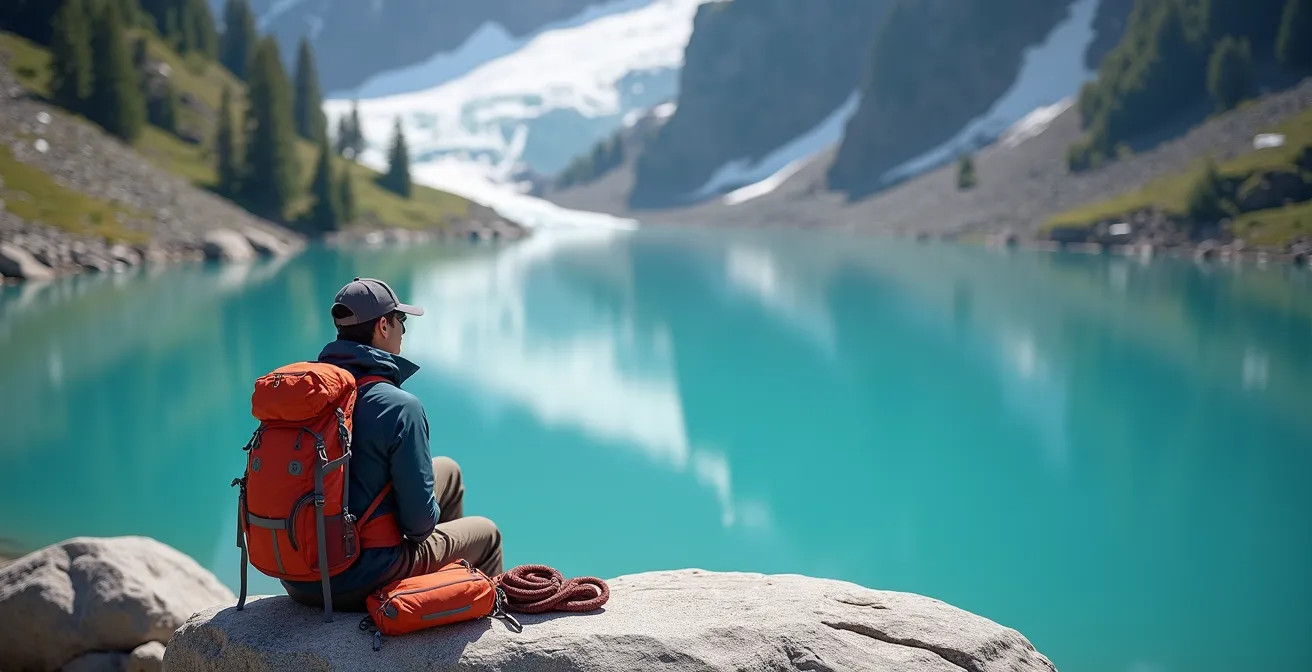
As locals who respect the power of these mountains, we treat these waters with extreme caution. If you are determined to take a dip, never jump in, never go alone, and always wear a life jacket. A life jacket not only provides buoyancy but also crucial insulation for your core. Protecting the environment is also paramount; please avoid wearing sunscreen or insect repellent if you enter the water, as these chemicals contaminate the pristine alpine ecosystem.
Action plan: Surviving cold water immersion
- Master the 1-10-1 principle: You have 1 minute to get your breathing under control, 10 minutes of meaningful movement before muscles fail, and 1 hour before you lose consciousness due to hypothermia.
- Wear a life jacket: In water 21°C or colder, a life jacket is your best defense against both the initial shock and eventual hypothermia.
- Never go alone: A significant portion of drownings occur when people are alone. A buddy can provide immediate assistance or call for help.
- Acclimatize slowly: Never jump or dive in. Enter the water gradually to allow your body to adjust to the extreme temperature change.
- Protect the water: Respect the fragile ecosystem by not introducing chemicals like sunscreen or bug spray into these pure alpine lakes.
When to arrive at the lakeshore to capture the perfect mirror reflection?
For photographers, the ultimate prize at Moraine Lake is the “money shot”: a perfect mirror reflection of the Valley of the Ten Peaks on the water’s calm surface, bathed in the soft morning light of alpenglow. This requires near-windless conditions, which are most common around sunrise. In the past, this meant a competitive, and often chaotic, 3 AM drive to snag a parking spot. That era is over.
As one local photography guide bluntly puts it in a workshop guideline, the old strategy is dead. This perspective is crucial for setting realistic expectations:
The old strategy of driving at 4 AM is dead. Now, the only way to capture the classic, calm dawn reflection is to secure a spot on the very first Parks Canada or tour operator shuttle.
– Local photography guide, Banff Photography Workshop Guidelines
The new strategy is entirely dependent on shuttle schedules. To capture that perfect reflection, you need to be on the lakeshore at least 30 to 60 minutes *before* sunrise to set up and catch the pre-dawn blue hour and the first light hitting the peaks. This means booking one of the earliest possible shuttles. For example, the Moraine Lake Bus Company offers dedicated sunrise shuttles that depart as early as 4:00 AM, getting you to the lake by 4:30 AM. This is your new target. Booking these specialized private shuttles is often the most reliable way to guarantee you’ll be there for the golden hour.
If you’re using the Parks Canada shuttle, you still need to aim for the very first departure of the day. Check their schedule religiously and book the moment it becomes available. The key takeaway is that spontaneity is no longer an option for serious sunrise photography at Moraine Lake. It requires precise planning and booking far in advance or having a lightning-fast trigger finger for the 48-hour release window.
How to navigate the new reservation launch dates to get a spot in Jasper?
The booking pressure experienced in Banff is just as intense for high-demand locations in Jasper National Park. Whether you’re vying for a spot at the iconic Wapiti campground or a permit for the world-renowned Skyline Trail, the strategy is the same: be prepared. Parks Canada uses a centralized reservation system, so the account you created for the Banff shuttles is the same one you’ll use here.
The most critical date to have circled on your calendar is the main launch for summer reservations. For the 2025 season, for example, this is scheduled for April 16, 2025, at 8:00 AM MDT. On this day, a massive inventory of frontcountry camping and other experiences becomes available. Success hinges on being logged in, with your payment information pre-saved, before the system opens. The website will be flooded, and any delay during checkout can cost you your spot.
A smart strategy involves having a primary goal and several backups. If you’re aiming for a coveted Skyline Trail permit, also research less competitive but still beautiful backcountry options. If Wapiti campground is full, have alternatives like Kerkeslin or Snaring campgrounds ready to book in the same session. Understand that different types of reservations, like frontcountry camping versus backcountry permits, can sometimes have slightly different booking windows or processes, so read the Parks Canada website carefully for your specific interest well in advance of the launch day.
Your action plan should be simple: create your account, set a calendar reminder (or three), research primary and backup options, and be ready to execute the moment reservations go live. It’s a competitive environment, but with preparation, you can significantly increase your chances of securing a spot for your Jasper adventure.
Why is a “moderate” trail in the Rockies considered “hard” in Ontario?
One of the most common pitfalls for visitors from other parts of Canada, particularly Ontario, is misinterpreting trail difficulty ratings. A “moderate” 10 km hike in the Rockies is a fundamentally different beast than a “moderate” 10 km hike on the Bruce Trail. The discrepancy comes down to two factors that are often underestimated: sustained elevation gain and altitude.
As the Parks Canada Trail Assessment Team points out, the sense of scale is completely different:
A ‘moderate’ Rockies trail like Plain of Six Glaciers has ~500m of sustained elevation gain, which is more than the entire elevation of many Ontario ‘hard’ trails.
– Parks Canada Trail Assessment Team, Canadian Rockies Trail Standards Guide
This means you are climbing, consistently, for a significant portion of the hike. A trail that gains 500 meters (1,640 feet) requires a level of cardiovascular fitness that isn’t tested on the rolling hills of Southern Ontario or the Maritimes. Furthermore, most of these trails start at an altitude above 1,500 meters, where the air is thinner. This can lead to shortness of breath and fatigue much faster than you would experience at sea level, even for very fit individuals. Other factors include more rugged terrain and the necessity of being prepared for sudden weather changes and potential wildlife encounters.
To help visitors calibrate their expectations, it’s useful to think of it as a translation. If your reference point for a “hard” hike is a challenging section of a trail in Eastern or Central Canada, you should start with trails rated as “easy” in the Rockies to acclimatize and safely gauge your abilities.
This quick guide helps translate your hiking experience to the Rockies’ scale.
| Your ‘Hard’ Trail Reference | Rockies Equivalent Rating | Key Difference |
|---|---|---|
| Bruce Trail sections (Ontario) | Start with ‘Easy’ rated trails | 500m+ sustained elevation gain in Rockies |
| Cup and Saucer (Manitoulin) | Choose ‘Easy’ to begin | Altitude effects above 2000m |
| Cape Breton Highlands | Try ‘Easy-Moderate’ trails | Wildlife safety requirements |
| Fundy Coastal trails | Consider ‘Moderate’ carefully | Longer distances between exits |
Key takeaways
- The iconic turquoise colour of Rockies lakes is a fragile phenomenon caused by glacial rock flour, which is diminishing as glaciers recede.
- Accessing Moraine Lake requires a strategic booking approach for shuttles; have a private operator as a reliable and stress-free backup plan.
- Trail difficulty ratings in the Rockies are on a different scale; factor in major elevation gain and altitude when choosing a hike.
How to maximize your Parks Canada Discovery Pass value on a 2-week trip?
For any trip to a Canadian national park lasting more than a few days, the Parks Canada Discovery Pass is a topic of discussion. Is it worth it? For a typical two-week trip spanning multiple parks in the Rockies, the answer is an unequivocal yes. The math is simple: a daily admission fee per vehicle can add up quickly. While prices vary, the annual Discovery Pass often pays for itself by the seventh day of your trip when compared to buying individual daily passes.
But the true value of the Discovery Pass extends far beyond simple break-even calculations. Its greatest benefit is the freedom it provides. With the pass, you are encouraged to explore beyond the main attractions. You can enter and exit parks multiple times a day without a second thought, visit the Cave and Basin National Historic Site in Banff, or take a detour through Kootenay National Park on a whim. This flexibility transforms your trip from a checklist of destinations into a genuine exploration.
Moreover, the pass is valid for a full year at all national parks and national historic sites across Canada. This turns a single vacation purchase into a year-long invitation to explore. Many visitors driving to the Rockies from Vancouver, for example, can use the pass to visit Mount Revelstoke and Glacier national parks along the Trans-Canada Highway. It encourages future domestic travel, inspiring trips to see the towering fjords of Gros Morne in Newfoundland or the wild coastlines of Pacific Rim National Park Reserve on Vancouver Island. It’s not just a ticket for one trip; it’s an investment in a year of Canadian discovery.
Ultimately, navigating the Rockies today is about more than logistics; it’s about adopting a mindset of respect, preparation, and adaptability. By embracing the strategies and understanding the context behind the rules, you can unlock an experience that is just as profound, and perhaps even more rewarding, than in the days of open roads. Plan ahead, travel thoughtfully, and the mountains will share their magic with you.