
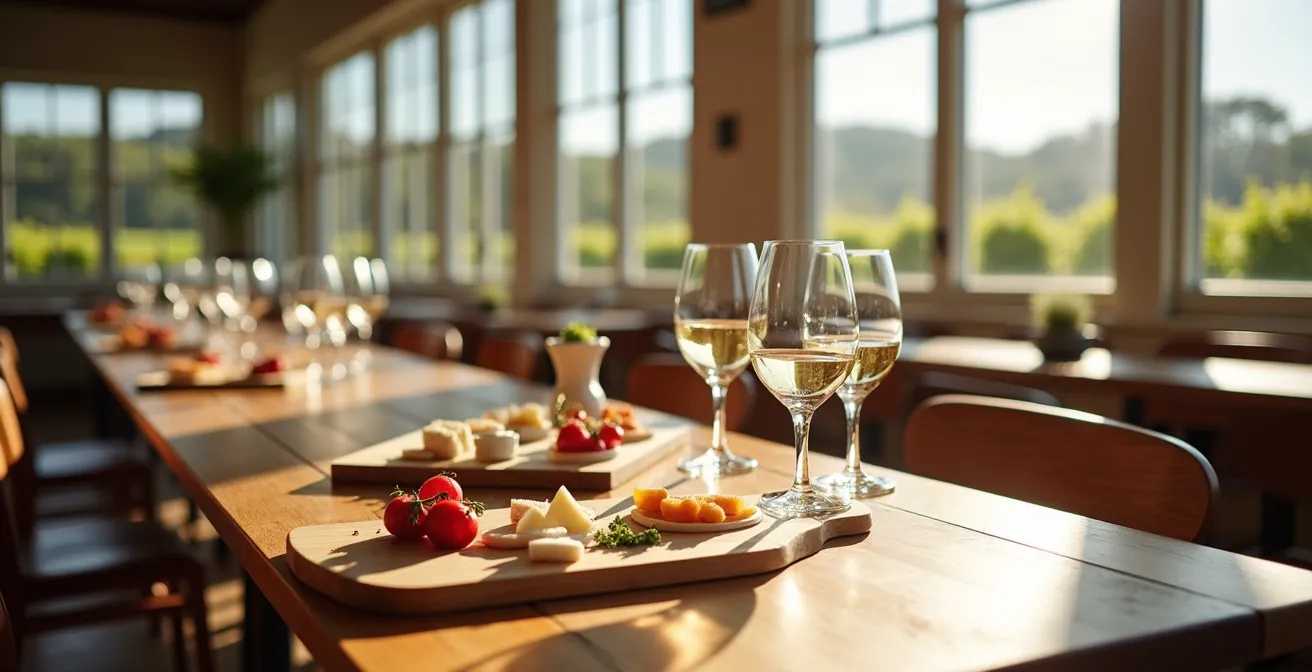
A successful food and wine pairing workshop transforms you from a follower of rules into an architect of flavour.
- It focuses on the scientific interaction between core components like acid, fat, and tannin, not just matching flavours.
- The best experiences are structured, sommelier-led seminars that prioritize deep learning over casual dining.
Recommendation: Seek workshops in Canadian wine regions like the Okanagan or Niagara that emphasize ‘component tasting’ to truly develop your palate literacy.
Imagine this: you’ve planned the perfect romantic dinner, complete with a beautiful piece of fatty fish, but the red wine you chose makes every bite taste metallic and unpleasant. Or you’ve brought a celebrated local cheese to a picnic, only to find the wine pairing you thought was a sure thing falls completely flat. For many couples exploring the world of wine, these moments of culinary dissonance are all too common. It’s a frustrating experience that can make the art of pairing feel like an arcane set of unbreakable, and often inexplicable, rules.
Most advice centres on tired platitudes: “red wine with red meat, white wine with white meat.” While a decent starting point, this approach barely scratches the surface and robs you of the joy of discovery. But what if the key wasn’t about memorizing a list of matches, but about understanding the very structure of taste itself? What if you could learn to build a pairing from the ground up, based on the scientific and sensory principles that govern how food and wine interact? This is the promise of a truly educational winery workshop.
This guide is designed for couples in Canada looking for a sophisticated and engaging date activity. We will move beyond the basics to explore the core of what makes a pairing workshop a transformative experience. We will delve into the chemistry of taste, compare learning formats, and provide you with the tools to not only select the right workshop but to maximize its value. It’s time to develop your shared palate literacy and begin crafting your own perfect pairings with confidence.
In the following sections, we will deconstruct the science behind classic pairings, explore the unique terroir of Canadian wine regions, and offer a practical roadmap for your educational journey. This article is your guide to becoming the architect of your own culinary experiences.
Summary: Your Journey into the World of Food and Wine Pairing
- Why does crisp white wine pair better with fatty fish than red wine?
- How to pair Okanagan goat cheese with local Gewürztraminer?
- Sommelier-led seminar or patio lunch: which offers deeper learning?
- The tasting mistake of trying too many bold reds before the whites
- How to enjoy a pairing class responsibly without driving impaired?
- In what order should you drink a tasting flight to not ruin your palate?
- How to salt the water to replicate the ocean taste perfectly?
- Why is authentic Icewine so expensive compared to table wine?
Why does crisp white wine pair better with fatty fish than red wine?
The classic rule of “white wine with fish” is not an arbitrary tradition; it’s a guideline rooted in the fundamental chemistry of taste. The success of this pairing hinges on the interaction between three key components: the acidity in the wine, the fat in the fish, and the tannins in the wine. Understanding this interplay is the first step toward developing true palate literacy and moving beyond rote memorization.
A crisp white wine, like a Sauvignon Blanc or an unoaked Chardonnay, is characterized by high acidity. This acidity acts as a palate cleanser, cutting through the richness and oiliness of fatty fish such as salmon or mackerel. Think of it like a squeeze of lemon over a piece of grilled fish—it brightens the flavours and prevents the dish from feeling heavy. The wine’s acidity lifts the food, creating a pairing that feels balanced and refreshing rather than cloying.
Conversely, red wines present a significant challenge. As a general rule, red wines contain significantly more tannins, which are phenolic compounds from grape skins and seeds that create a sensation of bitterness and astringency. When these tannins interact with the oils in fatty fish, they can produce a distinct and often unpleasant metallic aftertaste. This clash is a prime example of why, as experts from the San Francisco Wine School note, pairing success has more to do with the specific chemistries of the components than simply matching their overarching flavours. The science is clear: the high acidity of white wine complements fat, while the high tannins of red wine conflict with it.
Therefore, choosing a crisp white wine for your fatty fish isn’t just following a rule; it’s a deliberate act of sensory architecture. You are using the wine’s acidic structure to build a better, more harmonious culinary experience. This principle is a cornerstone of any effective food and wine pairing workshop.
How to pair Okanagan goat cheese with local Gewürztraminer?
Pairing a specific regional product like an Okanagan goat cheese with a local wine is where your journey into food and wine pairing truly comes alive. It becomes a terroir dialogue—a conversation between the land, the food, and the wine. The pungent, tangy, and creamy profile of goat cheese finds a spectacular partner in the aromatic and slightly sweet character of a British Columbian Gewürztraminer. This isn’t a coincidence; it’s a masterclass in complementary and contrasting pairings.
The key to this pairing lies in a principle called “intensity matching.” A delicate food requires a delicate wine, while a powerfully flavoured food demands a wine that can stand up to it. Okanagan goat cheese is anything but shy; it has a pronounced tangy flavour and a rich, creamy texture. A light, simple wine would be completely overwhelmed. A Gewürztraminer, however, is a full-bodied white wine known for its intense aromatics of lychee, rose petals, and ginger, along with a textural richness that matches the creaminess of the cheese. It has the confidence to meet the cheese on its own terms.
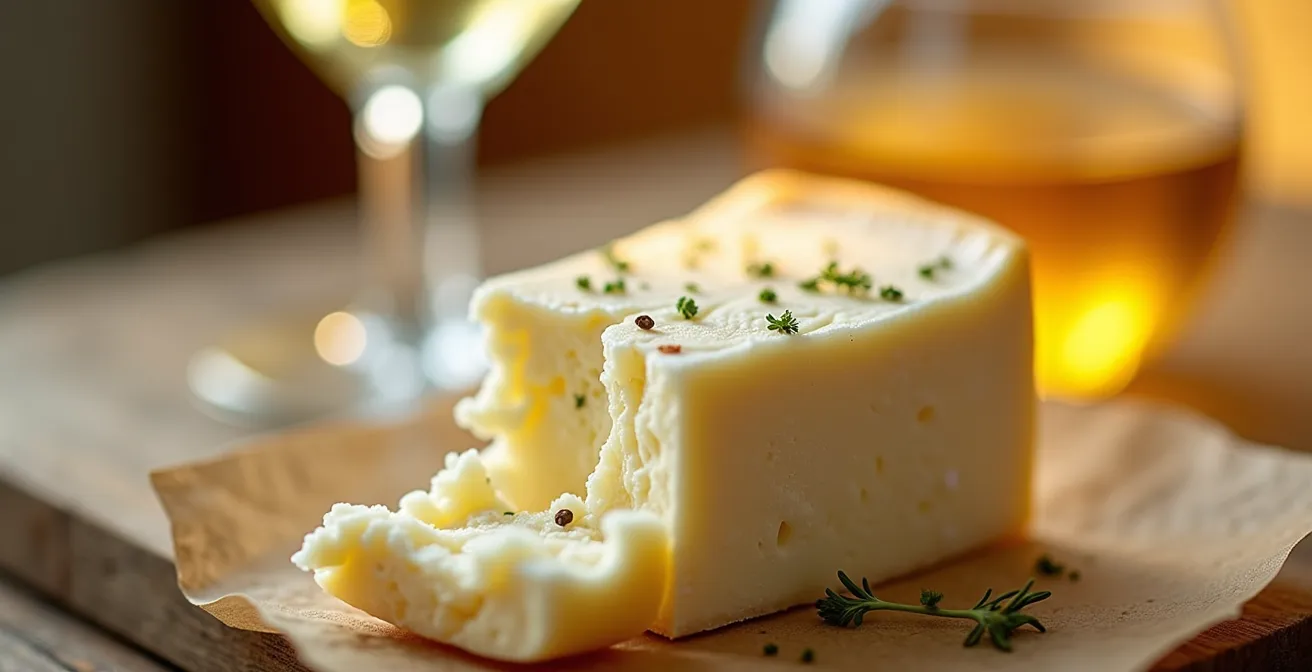
Furthermore, many Okanagan Gewürztraminers have a hint of residual sugar, creating an off-dry style. This subtle sweetness provides a beautiful contrast to the salty tang of the goat cheese, with each component enhancing the other. The wine’s sweetness tames the cheese’s sharp edge, while the cheese’s saltiness makes the wine’s fruit flavours seem even more vibrant. This dynamic interplay is the essence of a successful pairing, where the combination is greater than the sum of its parts. The following table illustrates how matching wine body to food intensity is crucial for success.
| Wine Body | Food Intensity | Pairing Success |
|---|---|---|
| Light-bodied white | Delicate fish, salads | Perfect match |
| Full-bodied white (Gewürztraminer) | Rich cheeses, spiced dishes | Perfect match |
| Light red | Grilled vegetables, light meats | Good match |
| Full-bodied red | Hearty stews, red meats | Perfect match |
Sommelier-led seminar or patio lunch: which offers deeper learning?
When planning your educational date, you’ll often face a choice: the structured, sommelier-led seminar or the more casual winery-restaurant patio lunch with suggested pairings. While both can be enjoyable, they serve fundamentally different purposes. For couples genuinely seeking to develop their palate literacy and understand the “why” behind pairings, the sommelier-led seminar is unequivocally the superior choice for deep, lasting learning.
A patio lunch, even at a top winery, is primarily a dining experience. The pairings are pre-selected for you, and while a server might briefly explain the choice, the focus is on enjoyment, not education. You are a passive recipient of a finished product. In contrast, a seminar is an active learning environment. It’s a workshop designed to deconstruct the experience. As demonstrated by programs like the one at George Brown College, a great workshop often involves both a chef and a sommelier, allowing you to engage in component tasting—tasting the wine, then the food element (like a piece of cheese or a salted cracker), and then the two together to analyze the interaction.
The value of a sommelier cannot be overstated. These are professionals with deep experience who can guide you through the nuances of a tasting. Take, for example, an expert with a profile like Joey Krueger’s, who has served as Head Sommelier at one of Canada’s most iconic wineries. According to her professional background, her extensive experience provides a layer of insight that a restaurant server simply cannot match.
Joey Krueger is a hospitality and wine industry professional with over 20 years of international experience across a broad spectrum of the food and beverage world. Her experience ranges from boutique wineries to luxury brands… Moving to the Okanagan valley in 2015, Joey joined Mission Hill Family Estate as Head Sommelier.
– Algonquin College, Food & Wine Pairing Workshop Description
A seminar provides a controlled setting to ask questions, compare different pairings side-by-side, and receive immediate, expert feedback. This structured approach accelerates your understanding far more effectively than a casual lunch ever could. You leave not just having had a great meal, but with a mental framework you can apply to all future culinary decisions.
Your Action Plan: Vetting a High-Value Pairing Workshop
- Curriculum Check: Does the workshop description mention ‘component tasting’, ‘acidity’, ‘tannin’, or the ‘science of pairing’? Look for a focus on principles, not just pre-set matches.
- Instructor Credentials: Is it led by a certified sommelier or a winemaker? Research their background and experience in wine education.
- Format and Structure: Is it a sit-down, guided seminar with dedicated time for Q&A, or is it a walk-around tasting? A structured format offers deeper learning.
- Group Size: Smaller group sizes generally allow for more personalized attention and interaction with the instructor. Inquire about the maximum number of participants.
- Take-Home Materials: Do they provide tasting notes, pairing charts, or summary sheets? These resources are invaluable for reinforcing what you’ve learned.
The tasting mistake of trying too many bold reds before the whites
One of the most common and detrimental mistakes made during a tasting workshop is approaching the wines in the wrong order. It might seem trivial, but tasting a big, bold Cabernet Sauvignon before a delicate Riesling is the sensory equivalent of shouting in a library before trying to hear a whisper. You have effectively overwhelmed your palate, making it impossible to appreciate the subtlety and complexity of the lighter wines that follow. This is a critical lesson in any educational tasting: order dictates perception.
The reason for this lies in the concentration of flavour compounds, particularly tannins. Bold red wines are packed with powerful tannins that coat your mouth and linger on the palate. Trying to taste a crisp, light-bodied white wine afterward is a futile effort; its delicate notes of citrus, green apple, or minerality will be completely bulldozed by the residual astringency and dark fruit flavours of the red. Your palate becomes fatigued and desensitized, a phenomenon known as palate fatigue.
A properly structured workshop will always guide you through a flight of wines in a specific progression, a visual and sensory journey from light to heavy. This allows your palate to gradually adjust and appreciate the unique characteristics of each wine without interference from the one before.
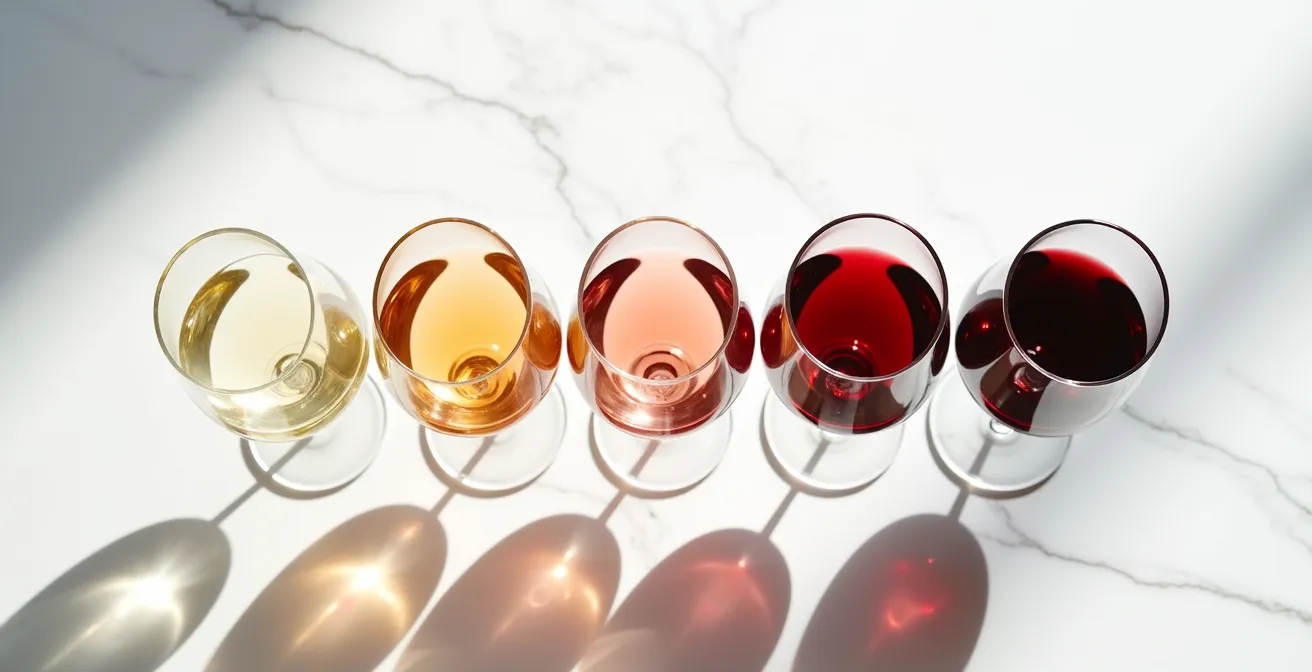
The correct tasting order is a cornerstone of professional wine evaluation and is essential for any educational experience. It ensures that each wine is given a fair chance to express itself. By following this sequence, you are not just tasting wines; you are conducting a controlled experiment, isolating the variables of each glass to build a clear sensory map. Ignoring this order is the fastest way to waste a learning opportunity.
How to enjoy a pairing class responsibly without driving impaired?
A sophisticated winery workshop is an immersive experience, but it comes with a critical responsibility: ensuring you and your partner get home safely. The concept of responsible indulgence is paramount in Canadian wine culture, especially given the strict laws regarding impaired driving. Planning your transportation is not an afterthought; it is an integral part of the workshop experience itself, allowing you to fully engage with the tasting without anxiety or risk.
In major Canadian wine regions, wineries and local businesses have developed a robust infrastructure to support safe wine tourism. Before you even book your workshop, your first step should be to arrange your transportation. In sprawling areas like the Okanagan Valley or the Niagara-on-the-Lake region, dedicated wine tour bus services are an excellent option. They offer hop-on, hop-off services or curated routes, removing all transportation-related stress. For a more intimate and flexible experience, hiring a private driver for the day is a perfect choice for a couple, allowing you to set your own schedule. In flatter regions like Prince Edward County, bicycle tours offer a charming and active alternative.
During the workshop, remember the sommelier’s most-used tool: the spittoon. Using a spittoon is not rude; it is the mark of a serious taster. It allows you to experience the full flavour profile of a wine—its aroma, taste, and texture—without consuming the alcohol. This is how professionals taste dozens of wines a day and remain sharp. Remember that even small sips add up, and in provinces like Ontario and British Columbia, the legal blood alcohol concentration (BAC) warning range starts as low as 0.05. The safest approach is always to have a zero-alcohol plan for the designated driver. The ultimate solution, of course, is to eliminate driving entirely by booking on-site accommodation at a winery guesthouse or a nearby inn, turning your educational day trip into a truly relaxing romantic getaway.
In what order should you drink a tasting flight to not ruin your palate?
While the progression from light to bold wines is the foundational rule of tasting order, a truly advanced workshop introduces another dimension: age. Tasting the same wine from different vintages—known as a vertical tasting—is one of the most profound educational experiences a winery can offer. It moves beyond simple flavour identification to explore how a wine evolves, matures, and develops complexity over time. This structured approach prevents palate fatigue while adding a rich layer of understanding.
The standard professional tasting order is as follows:
- Sparkling Wines: Their high acidity and bubbles act as a perfect palate primer.
- Light-bodied, Dry White Wines: Think Pinot Grigio, Sauvignon Blanc.
- Full-bodied White Wines: Such as oaked Chardonnay or Viognier.
- Rosé Wines.
- Light-bodied Red Wines: For example, Pinot Noir or Gamay.
- Full-bodied Red Wines: Like Cabernet Sauvignon or Syrah.
- Sweet/Dessert Wines: Their high sugar content would overwhelm anything that came after.
Educational events, such as the ‘Then and Now’ VQA tasting hosted by Brock University’s CCOVI, offer a rare opportunity to see this principle in action with an added layer of complexity. At this event, participants evaluated VQA wines from the same winemaker that were at least five years apart. This structure allows tasters to directly compare the vibrant primary fruit notes of a young wine against the nuanced, earthy, and integrated secondary and tertiary notes of its mature counterpart.
As noted by wine experts who attended, the experience often reveals the profound beauty of aged wines. As one Niagara College professor observed after the tasting, the mature wine was almost always the most “beguiling and attractive.”
I don’t need to be convinced that aging good wines is necessary to bring out their most beautiful, balanced, expressive, and complex side but yesterday’s…Experts Tasting at Brock University further reinforced the fact…In all other cases…the mature wine was the most beguiling and attractive.
– Peter Rod, Niagara College Wine Professor
When tasting a vertical flight, the typical order is to proceed from youngest to oldest. This allows you to first establish a baseline with the wine’s youthful expression before appreciating the subtleties that emerge with age. Following a deliberate order is not restrictive; it is liberating, as it unlocks a deeper, more sophisticated level of wine appreciation.
How to salt the water to replicate the ocean taste perfectly?
The question of how to perfectly salt water to mimic the ocean is a fascinating metaphor for the power of a single element in transforming an entire sensory experience. In the world of food and wine pairing, that element is often salt. It is arguably the most wine-friendly ingredient in a chef’s arsenal, possessing an almost magical ability to improve and soften a wine, making it taste fruitier, fuller, and less acidic.
Understanding the five pillars of taste—salt, sweet, sour (acid), bitter, and umami—is fundamental to mastering food and wine pairing. A great workshop will dedicate time to exploring how each of these components in food interacts with the primary characteristics of wine (acid, alcohol, tannin, and sweetness). Salt has a particularly profound effect. When you take a bite of a well-salted food and then a sip of a high-acid wine, the salt on your palate diminishes your perception of the wine’s acidity. This makes the wine feel rounder and brings its fruit characteristics to the forefront.
This is the science behind why salty foods like prosciutto, parmesan cheese, or even simple salted nuts pair so beautifully with a wide range of wines. The salt acts as a buffer, smoothing out the wine’s rougher edges. In contrast, other elements can be more challenging. For instance:
- Sweetness in food can make a dry wine taste thin and overly acidic. The rule of thumb is that the wine should always be sweeter than the food.
- Bitterness (e.g., in radicchio or kale) and umami (e.g., in mushrooms or soy sauce) can amplify the perception of tannins in red wine, making it taste harsh and more bitter.
So, while perfectly replicating the ocean’s salinity might be a culinary challenge, understanding the role of salt in a pairing is a straightforward lesson with a huge payoff. It demonstrates that you don’t always need to match flavour to flavour. Sometimes, the secret is using one structural component in the food to fundamentally change the perception of the wine, creating a more harmonious partnership.
Key takeaways
- Pairing is a science of component interaction (acid, fat, tannin), not just a matter of matching flavours.
- The most valuable learning comes from structured, sommelier-led seminars that focus on ‘component tasting’.
- Tasting order is critical: progressing from light-bodied whites to full-bodied reds prevents palate fatigue and allows for true appreciation of each wine.
Why is authentic Icewine so expensive compared to table wine?
Authentic Canadian Icewine is one of the world’s great dessert wines, a luscious, concentrated nectar that commands a high price. This cost is not a matter of marketing; it is a direct reflection of a high-risk, labour-intensive, and low-yield production process that makes it a true liquid luxury. The “authentic” designation is also critical, as it is protected by the VQA (Vintners Quality Alliance) system, guaranteeing its origin and quality.
The primary reason for Icewine’s expense is the harvest. To be legally called Icewine in Canada, the grapes (typically Riesling, Vidal Blanc, or Cabernet Franc) must be harvested and pressed while naturally frozen on the vine at a temperature of -8°C or colder. This often requires a crew of workers to head into the vineyards in the dead of night in the middle of winter. The risk is enormous; if the temperature doesn’t drop sufficiently, the entire crop can be lost to rot or eaten by animals.
When the frozen grapes are pressed, the water content remains behind as ice crystals, while only a tiny amount of highly concentrated, super-sweet juice is extracted. The yield is incredibly low—the juice from a single vine might produce just one bottle of Icewine, compared to the 6-8 bottles of table wine the same vine could produce from a normal harvest. This combination of high risk and minuscule yield is the main driver of its cost.
The “authentic” part of the question is answered by the VQA designation. As the Ontario Wine Appellation Authority emphasizes, the VQA seal on a bottle is a consumer’s guarantee of 100% Ontario origin and adherence to strict production standards. This system protects the integrity of true Canadian Icewine from cheaper, artificially produced alternatives where grapes are commercially frozen. Understanding the story behind Icewine—the risk, the labour, and the protected authenticity—transforms your appreciation of what is in the glass. It’s not just a sweet wine; it’s a testament to the winemaker’s courage and a symbol of Canada’s unique position in the global wine world.
Now that you are equipped with a deeper understanding of the principles behind food and wine pairing, your next step is to put this knowledge into practice. The most rewarding way to begin this journey is by selecting and booking an educational workshop at a Canadian winery that aligns with these learning-focused principles.