

Facing the chaos of a massive Canadian festival like the Calgary Stampede feels overwhelming, but the key isn’t just to endure it—it’s to outsmart it. This guide reframes the challenge from one of cost and crowds to one of strategy. By treating the festival as a system of logistical levers—timing, location, and transportation—you can manipulate the rules to your advantage, crafting a premium experience while saving significant money and stress. It’s about thinking like a veteran, not a tourist.
The first time you plan a trip to a massive Canadian event like the Calgary Stampede or the Toronto International Film Festival (TIFF), you experience a special kind of sticker shock. Hotel prices seem to defy gravity, the thought of downtown traffic is paralyzing, and the sheer scale of the event feels impossible to navigate. The usual advice feels hollow: “book early” doesn’t help when prices are already inflated a year in advance, and “wear comfortable shoes” doesn’t solve the two-hour lineup for a single concert.
Most guides focus on what to see, but they miss the most critical element: the operational strategy. They treat you like a tourist destined to be swept away by the current of a million other people. But what if the real secret wasn’t just to survive the chaos, but to actively game the system? The veteran’s approach isn’t about enduring the festival; it’s about making the festival’s own logistics work for you. It’s about understanding the principles of what I call logistical arbitrage—exploiting the predictable patterns of crowds and costs.
This isn’t just a list of tips. This is a playbook for transforming your experience from stressful and expensive to strategic and rewarding. We will deconstruct the common pain points of Canada’s biggest festivals and provide a clear, actionable framework for navigating them. We’ll explore how to find accommodation others overlook, leverage free entertainment, avoid the gridlock that traps thousands, and master the art of timing to feel like a VIP without the price tag.
Summary: How to survive the Calgary Stampede crowds and costs without losing your mind?
- Why do hotel prices triple during Stampede and how to find alternatives?
- How to enjoy the Montreal Jazz Festival without buying a single ticket?
- Celebrity spotting or comedy clubs: which festival offers better fan interaction?
- The parking mistake that traps you in downtown gridlock for hours
- Where to find the free Stampede breakfasts to save on food costs?
- When to visit Montreal to catch the Jazz Festival and avoiding sold-out hotels
- When to visit to experience the peak of Quebec national pride?
- How to celebrate Caribbean culture at Toronto’s Caribana with kids?
Why do hotel prices triple during Stampede and how to find alternatives?
The first rule of festival economics is that demand is a blunt instrument. When you have over 1 million visitors descending on a city, hotel operators don’t need to be nuanced; they can charge a premium, and they will. The mistake is thinking you have to play their game. A veteran doesn’t fight for an overpriced downtown room; they practice logistical arbitrage by looking where others don’t.
The real value lies in a simple trade-off: a slightly longer commute for a drastically lower cost. Calgary’s C-Train system is the key. It’s efficient, runs 24-hour service during the festival, and has a station right at the Stampede grounds. This opens up a world of smart, affordable accommodation options that most first-timers completely ignore. Instead of paying a fortune to be within walking distance, you pay a few dollars for a train ticket and save hundreds on your room.
This strategy hinges on leveraging infrastructure that already exists. University residences, empty for the summer, offer modern, clean rooms directly on transit lines. Commuter towns just outside the city offer hotel rates that are 50-70% cheaper than their downtown counterparts, often with free parking at a Park & Ride station. It’s not about finding a “deal” downtown; it’s about changing your definition of a good location.

As you can see, choosing an alternative like a university residence places you right on the C-Train line, turning a 20-minute train ride into a massive cost-saving maneuver. Your accommodation options include:
- University Residences: Book rooms at the University of Calgary or SAIT, both of which are available from May to August and offer direct C-Train access.
- Commuter Towns: Stay in places like Airdrie or Cochrane. The savings on your room will far outweigh the cost and time of a short commute via a Park & Ride station.
- RV Parks & Camping: If you’re equipped for it, nearby sites like Calaway Park are only about 30 minutes from downtown and often provide shuttle services.
How to enjoy the Montreal Jazz Festival without buying a single ticket?
The second-biggest mistake festival-goers make is equating “the event” with “the expensive, ticketed shows.” This mindset is a trap. The playbook for enjoying a world-class event like the Montreal Jazz Festival for free is identical to the one for the Stampede: understand that the ticketed events are only a fraction of the total experience. The real magic, and the best value, is often found on the free stages and in the streets.
Major Canadian festivals are masters of creating a vibrant, free-to-access ecosystem around their core programming. They need to generate an atmosphere that draws people in, and they do it with a staggering amount of free entertainment. Your mission is to leverage this. A veteran doesn’t blow their budget on one headliner; they practice value stacking by building a full day of top-tier entertainment for the cost of park admission—or sometimes, for nothing at all.
The Calgary Stampede is a perfect case study. The Coca-Cola Stage is famous for hosting free concerts with park admission, featuring major artists from alt-rock to hip hop. For ten straight days, it’s a music festival within a festival, and it costs nothing beyond the gate price. This principle applies directly to the Montreal Jazz Festival’s legendary outdoor stages, which are the heart and soul of the event for many locals. You get to soak in the atmosphere and discover new artists without spending a dime on tickets.
This table, based on the Stampede model, illustrates the principle of separating free experiences from paid ones—a mindset you can apply to any major festival.
| Free with Admission | Requires Separate Ticket | Best Value Strategy |
|---|---|---|
| Outdoor concert stages | Rodeo events ($45+) | Value Days with free admission windows |
| Cultural demonstrations | Evening Grandstand Show | Two-Day Thrill Package |
| Agricultural showcases | Major headliner concerts | SuperPass for multiple days ($50) |
| Street performers | Chuckwagon races | Free pancake breakfasts citywide |
Celebrity spotting or comedy clubs: which festival offers better fan interaction?
Many first-timers are drawn to massive festivals by the allure of big names. Whether it’s spotting a movie star at TIFF or seeing a music legend on the main stage, the focus is often on proximity to celebrity. But a veteran knows that true fan interaction rarely happens at a distance. The most memorable moments often come from smaller, more intimate settings that are built for engagement. This is the strategy of experience curation.
Instead of craning your neck in a crowd of thousands, you actively seek out the venues where you can have a genuine connection with the performers. The Calgary Stampede, for example, has leaned into this by creating unique, smaller-scale entertainment options. Their investment in a dedicated comedy show is a prime example of this principle in action. It offers a completely different, and often more satisfying, type of fan experience than a massive concert.
Case Study: The Calgary Stampede Stand-Up Show
The Calgary Stampede Stand-Up Show exemplifies how to find intimate fan interaction. By featuring established Canadian comedians like Erica Sigurdson and Pete Zedlacher in a smaller venue with options for VIP tables, the festival creates an environment for direct audience engagement. According to the official Stampede comedy programming, it’s a chance to see top-tier talent in a personal setting that’s impossible to replicate in a giant arena, offering a more memorable interaction for comedy fans.
This is a strategic choice. While others are chasing a fleeting glimpse of a celebrity from 100 yards away, you’re enjoying a world-class performance in a setting where the artist can actually see and react to the audience. As the festival itself describes the unique atmosphere:
For one night only, the Stage of Wonders becomes a licensed 18+ Comedy Club featuring Canada’s funniest comedians mining laughs from every corner of life.
– Calgary Stampede, Official Calgary Stampede Comedy Programming
This philosophy applies to any large festival. Look for the film Q&As at TIFF, the small club shows during the Montreal Jazz Festival, or the author panels at a literary festival. These are the events where real connection happens.
The parking mistake that traps you in downtown gridlock for hours
Nothing sours a festival experience faster than being trapped in your car. The single biggest logistical mistake you can make is trying to drive directly to the event and park nearby. It’s a rookie move that guarantees frustration, expense, and wasted time. The lots close to the grounds are not only exorbitantly priced—with official on-site parking costing $30 per day or more—but they also create a bottleneck that leads to hours of post-event gridlock.
The veteran strategy is simple and ruthless: never drive to the main gate. This is where you practice “crowd judo,” using the predictable flow of the masses to your advantage by moving in the opposite direction. While thousands are inching their way towards expensive central parking, you are calmly parking for free at a suburban C-Train station and enjoying a stress-free ride directly to the gate.
This isn’t just about saving money on parking; it’s about reclaiming your time and sanity. The C-Train’s 24-hour Stampede service is your ultimate escape route. It bypasses all traffic and delivers you to the entrance. When the fireworks end and the mass exodus begins, you won’t be one of the thousands trying to exit the same few parking lots. You’ll be on a train, moving freely while others are still in park.
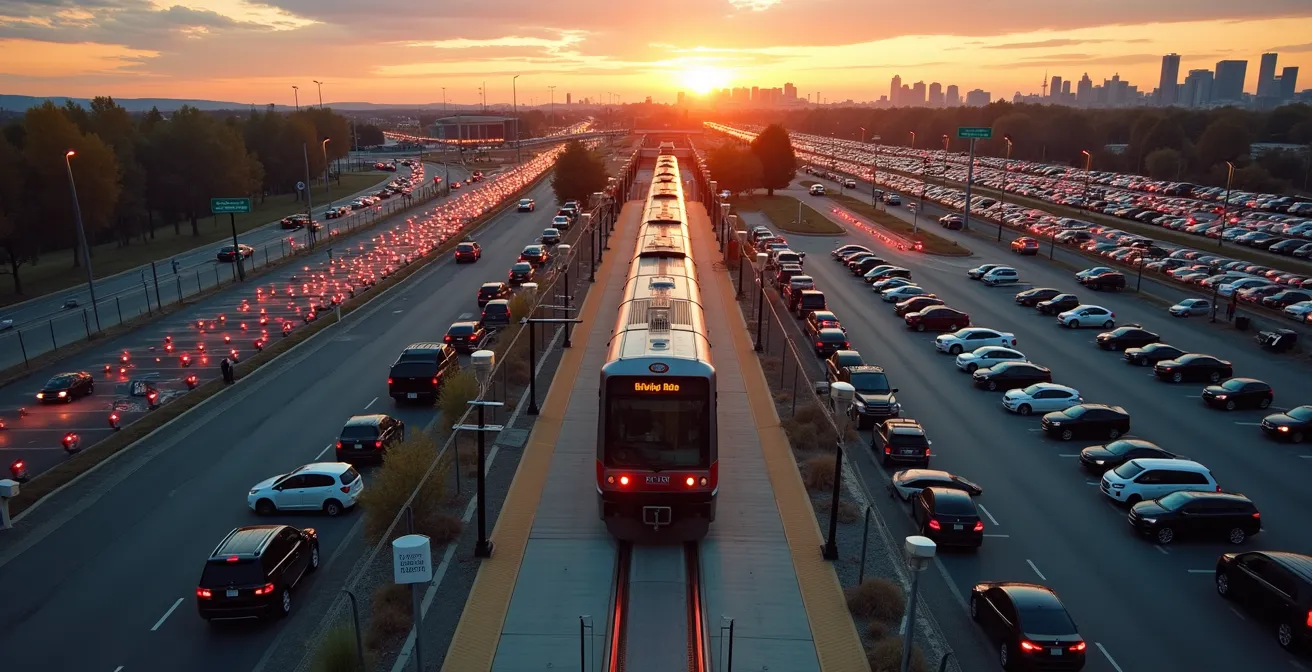
The image above tells the whole story: an empty, peaceful Park & Ride lot at dusk, with a train ready to go, while the distant downtown glows with the red river of brake lights. It’s the visual representation of a smart choice versus a painful one. The key is to have an exit strategy before you even arrive.
Your Action Plan: The Gridlock Avoidance Audit
- Identify Entry Points: Ditch the main gates. Plan your entry through quieter access points like the Stampede Trail or MacDonald Avenue entrances.
- Leverage Transit: Fully commit to the C-Train. Identify your nearest Park & Ride station and make it your base of operations. Forget your car exists once you’re on the train.
- Master the Early Exit: The mass exodus begins the second the fireworks finale ends. Leave 15 minutes before the show concludes to beat 90% of the crowd to the train platform.
- Use Re-Entry Privileges: Get a hand stamp. If the grounds become too crowded in the afternoon, leave for a few hours. Have a quiet dinner off-site and return later in the evening when the crowds have thinned.
- Time Your Visit: Avoid arriving at peak times (like right after the parade). A slightly later arrival can mean the difference between walking right in and waiting in a long queue.
Where to find the free Stampede breakfasts to save on food costs?
Festival food is part of the fun, but buying three meals a day on the grounds is a quick way to drain your wallet. The most uniquely Calgarian “system hack” for this problem is the legendary tradition of free pancake breakfasts. This isn’t just a quirky local custom; it’s a cornerstone of a veteran’s budget strategy. For ten days, the entire city becomes a source of free, hearty meals, allowing you to save your food budget for the iconic midway treats you actually want to try.
This is another form of value stacking. By starting your day with a free breakfast, you’re not just getting a meal; you’re participating in a core part of the community spirit. There are over 100 free breakfasts hosted by businesses, community groups, and politicians across the city. With a little planning, you can genuinely eat for free every single morning of the Stampede.
Case Study: Fluor Rope Square, The Breakfast Epicenter
Fluor Rope Square in downtown Calgary is more than just a breakfast spot; it’s the central hub of this city-wide tradition. As highlighted by guides from Travel Alberta, this venue serves thousands of free pancakes daily, accompanied by live music, First Nations performers, and street entertainers. It perfectly demonstrates how these breakfasts are not just about food, but are cultural gathering spaces that offer a full morning of entertainment before you even set foot on the Stampede grounds.
To master the pancake trail, you need a plan. Showing up randomly might work, but a strategic approach guarantees success and minimizes wait times. The key is to treat it like any other part of your festival itinerary.
- Get the App: Download one of the free Stampede breakfast tracker apps. They provide a real-time map and schedule of all official and unofficial breakfasts.
- Go Early: For the most popular spots like Fluor Rope Square or the Chinook Centre mall, arrive about 30 minutes before the advertised start time to be at the front of the line.
- Think Corporately: On weekdays, breakfasts hosted by large corporations often have shorter lines and are very efficiently run.
- Explore the Neighbourhoods: For a more local and less crowded experience, venture out to a community-run breakfast in a residential neighbourhood.
When to visit Montreal to catch the Jazz Festival and avoiding sold-out hotels
The question of “when” to visit a festival is just as important as “where” to stay. Most people aim for opening weekend, assuming it’s the “best” time. A veteran knows it’s often the most crowded, most expensive, and most stressful time. Mastering the art of timing is a crucial “system hack” that can fundamentally change your experience, whether you’re in Montreal for the Jazz Festival or Calgary for the Stampede.
The key is to understand that a festival’s 10-day or two-week run is not monolithic. It has peaks and valleys of attendance. Your goal is to aim for the valleys. The opening day parade at the Stampede, for example, is an incredible spectacle that draws an estimated 350,000 parade-goers downtown. This creates a massive surge onto the grounds immediately after. A strategic visitor watches the parade, then goes for a leisurely (and free) pancake breakfast somewhere else, waiting for the initial wave to subside before heading to the park.
This principle of avoiding “peak surge” applies universally. For the Montreal Jazz Festival, arriving a day or two after the opening night can mean better hotel availability and less frantic crowds at the outdoor stages. Look for the festival’s own value propositions, which are often scheduled on traditionally slower days to boost attendance. These “Value Days” are a gift to the strategic festival-goer.
The following table, using the Stampede’s schedule as a model, shows how to analyze a festival’s timeline for strategic opportunities. You can apply this same logic to the Montreal Jazz Festival schedule.
| Time Period | Crowd Level | Hotel Availability | Cost Savings Opportunity |
|---|---|---|---|
| Sneak-A-Peek (Day before parade) | Moderate | Better availability | 50% off admission (5pm-midnight) |
| Opening Weekend | Maximum crowds | Sold out | Free parade-to-park window |
| Mid-week (Tuesday-Thursday) | Lighter crowds | Some availability | BMO Kids Day free for children |
| Final Weekend | Heavy crowds | Limited | Championship Sunday excitement |
When to visit to experience the peak of Quebec national pride?
To truly “get” a festival, you have to look beyond the rides and concerts and understand its soul. Whether it’s the Fête Nationale in Quebec, celebrating a distinct cultural identity, or the Calgary Stampede, celebrating western heritage, the most rewarding experiences come from tapping into this core spirit. A veteran doesn’t just attend; they seek to understand the “why” behind the celebration.
This means looking for the cultural anchors of the event. While the midway and rodeo are the commercial face of the Stampede, its heart can be found in places that showcase its heritage. The organization’s mission is clear, and it’s not just about entertainment. As the official mission statement says:
The Calgary Stampede is a not-for-profit community organization that preserves and celebrates our western heritage, culture and community spirit.
– Calgary Stampede Organization, Official Calgary Stampede Mission Statement
The key words are “preserves and celebrates.” Your job as a visitor is to find where that preservation is happening. In Quebec, it might be at a traditional music performance on the Plains of Abraham. In Calgary, a prime example is the Elbow River Camp.
Case Study: The Elbow River Camp and Treaty 7 Culture
The Elbow River Camp (formerly the Indian Village) has been part of the Stampede since its inception in 1912. It is a living exhibition of the cultures of the Treaty 7 First Nations: the Kainai, Piikani, Siksika, Tsuut’ina, and Stoney Nakoda. As detailed by travel guides like HI Hostels Canada, visitors can explore 26 tipis, watch traditional dancing, and speak with artisans. It’s an immersive and educational experience that provides a deep, authentic connection to the history of the land, offering a profound counterpoint to the commercial energy of the midway.
Experiencing the peak of a region’s pride means seeking out these authentic expressions of culture. Don’t just watch the parade; ask about its history. Don’t just eat the food; find out where the traditions come from. This is how you transform from a mere spectator into a knowledgeable participant.
Key Takeaways
- Treat accommodation and timing as strategic levers; stay outside the core on a transit line to save significantly.
- Master “value stacking” by building full days of entertainment from the vast array of free concerts, events, and meals that festivals offer.
- Abandon your car. Use public transit and Park & Ride systems as your primary tool for avoiding traffic gridlock and high parking costs.
How to celebrate Caribbean culture at Toronto’s Caribana with kids?
Taking kids to a massive, high-energy festival like Toronto’s Caribana (now the Toronto Caribbean Carnival) can feel daunting. The crowds, the noise, the scale—it can all seem like a recipe for a meltdown. But the strategies for a successful family festival trip are the same as any other: planning, pacing, and finding the kid-friendly havens within the larger event.
The core principle is to see the festival through their eyes. A full day on a packed parade route might be too much, but a few hours followed by a retreat to a calmer space can be perfect. Again, the Calgary Stampede provides an excellent model for how large events can build a family-friendly ecosystem. Smart parents learn to identify and leverage these zones to create a balanced day for everyone.
Model for Family Fun: The Calgary Stampede Dog Bowl
The Dog Bowl at the Stampede is a perfect example of dedicated family programming. It’s a high-energy canine showcase that is inherently engaging for all ages, providing thrilling entertainment without the overwhelming sensory input of the main midway. This, combined with agricultural showcases and educational zones about ranch life, shows how a festival can balance adult-oriented entertainment with meaningful, lower-intensity activities for children. It’s a template you can look for at any festival: find the dedicated, all-ages shows.
When planning for Caribana with kids, apply this logic. Look for the “Junior Carnival” or family-day events, which are specifically designed for a younger audience. Your strategic toolkit should include:
- Designated Quiet Zones: Before you go, identify spots on the festival map that are likely to be calmer. At the Stampede, this might be the Western Oasis or a quiet garden. At Caribana, it could be a park adjacent to the main parade route.
- Dedicated Kids’ Days: Many festivals have a day with free admission for children. The Stampede’s BMO Kids’ Day is a huge money-saver. Check the Caribana schedule for similar promotions.
- Animal & Agricultural Exhibits: Almost every large fair or festival has an agricultural component. These areas are often less crowded and provide a welcome change of pace for children.
- Plan for Sensory Breaks: Don’t try to be a hero. Plan to take breaks away from the main action every couple of hours. A quiet retreat can reset everyone’s energy levels.
Now that you have the complete playbook, the next step is to apply this strategic mindset to your own festival planning. Start by deconstructing the event schedule, identifying your logistical advantages, and building an itinerary that prioritizes value and experience over convenience and cost.