
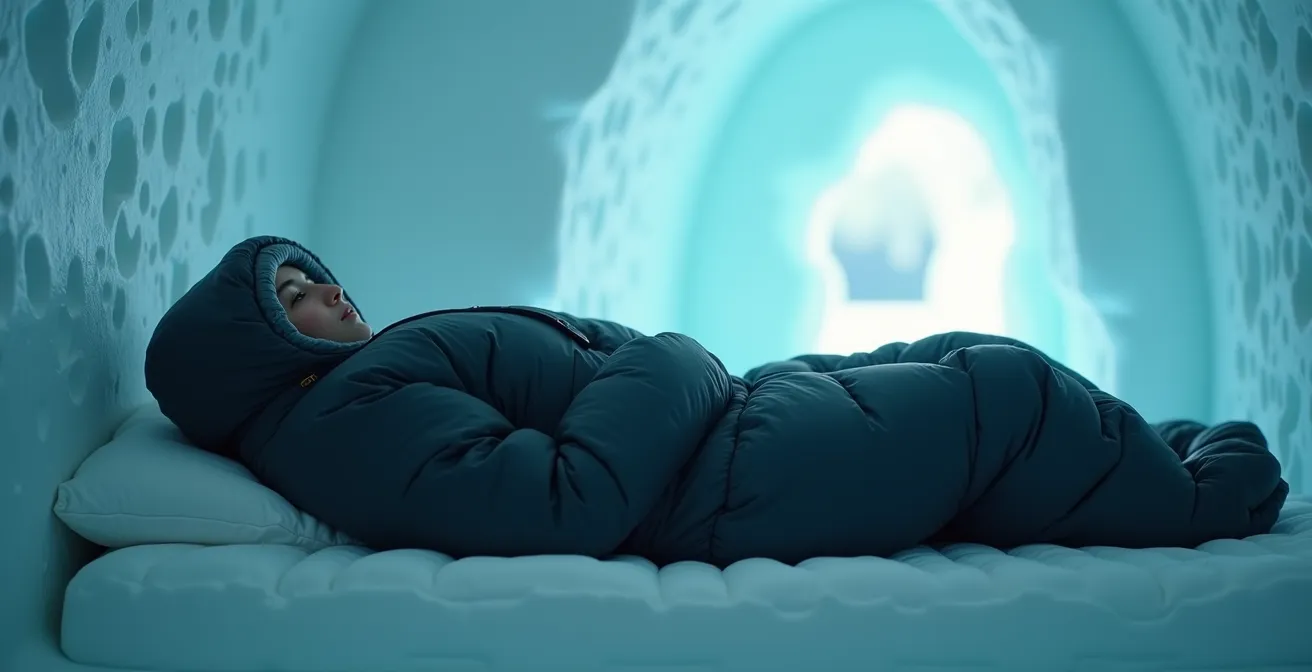
The secret to a warm, comfortable night at the Hôtel de Glace is not piling on clothes, but mastering moisture and pre-heating your body.
- Your warmth comes from the sleeping bag’s ability to trap your dry body heat, not from layers that make you sweat.
- Using the Nordic spa’s hot-cold cycles before bed is a critical step to “prime” your core temperature for the night.
Recommendation: Follow the hotel’s official preparation briefing exactly. Arrive at your sleeping bag warm from the spa, completely dry, and wearing only a thin, fresh base layer.
The idea is captivating: spending a romantic night surrounded by the ethereal glow of ice sculptures in Quebec’s famous Hôtel de Glace. But for many, that magical image is quickly followed by a chilling anxiety: how can you possibly sleep comfortably when the room is a constant -5°C (23°F)? The fear of a miserable, sleepless night spent shivering in the dark is real. Many people assume the solution is to wear every sweater they own to bed, a common mistake that actually makes you colder.
The truth is, enjoying this unique Canadian experience has little to do with toughing it out. It’s about understanding a little bit of thermal science. Your comfort depends entirely on a complete thermal system: your body as the furnace, the high-tech sleeping bag as the insulation, and a crucial set of pre-sleep rituals designed to eliminate the true enemy of warmth: moisture. Forget piling on layers; the key is managing humidity and priming your core body temperature. This guide isn’t just a list of tips; it’s an explanation of the principles that will allow you to relax, stay toasty warm, and fully immerse yourself in the magic of a night on ice.
For those who prefer a visual summary, the following documentary offers a full tour and captures the stunning scale of Canada’s one-of-a-kind ice hotel, complementing the practical advice in this guide.
In this article, we’ll deconstruct the science of staying warm. We’ll explore everything from the function of your sleeping bag and the pre-sleep spa ritual to common mistakes to avoid and how the hotel’s very structure contributes to your comfort. By understanding these elements, you’ll be fully prepared for an unforgettable night.
Summary: Your Guide to a Warm Night at the Hôtel de Glace
- Why does a mummy bag keep you warm even if you sleep naked?
- How to use the sauna/spa cycle to raise body core temperature before bed?
- Why is one night in the ice room usually enough for most people?
- The error of burying your face in the sleeping bag that freezes the zipper
- When to photograph the ice sculptures to capture the light through the snow walls?
- The “sweat and freeze” error beginners make with heavy jackets
- Why is spiraled snow construction superior to a modern tent in extreme wind?
- How to wax your skis for the fluctuating temperatures of a Canadian winter?
Why does a mummy bag keep you warm even if you sleep naked?
The most common misconception about sleeping in the cold is that you need to bundle up inside your sleeping bag. The reality is the opposite. A high-quality mummy bag, like the ones provided at the Hôtel de Glace, works by creating a layer of static, unmoving air around your body. It is this trapped air, heated by your own body, that insulates you from the -5°C room. Your body is the furnace; the bag is the insulation. If you wear multiple layers, you risk two problems: first, you might overheat and sweat, introducing moisture that will later chill you. Second, bulky clothing can compress the bag’s loft (its fluffiness), eliminating the air pockets and reducing its insulating power.
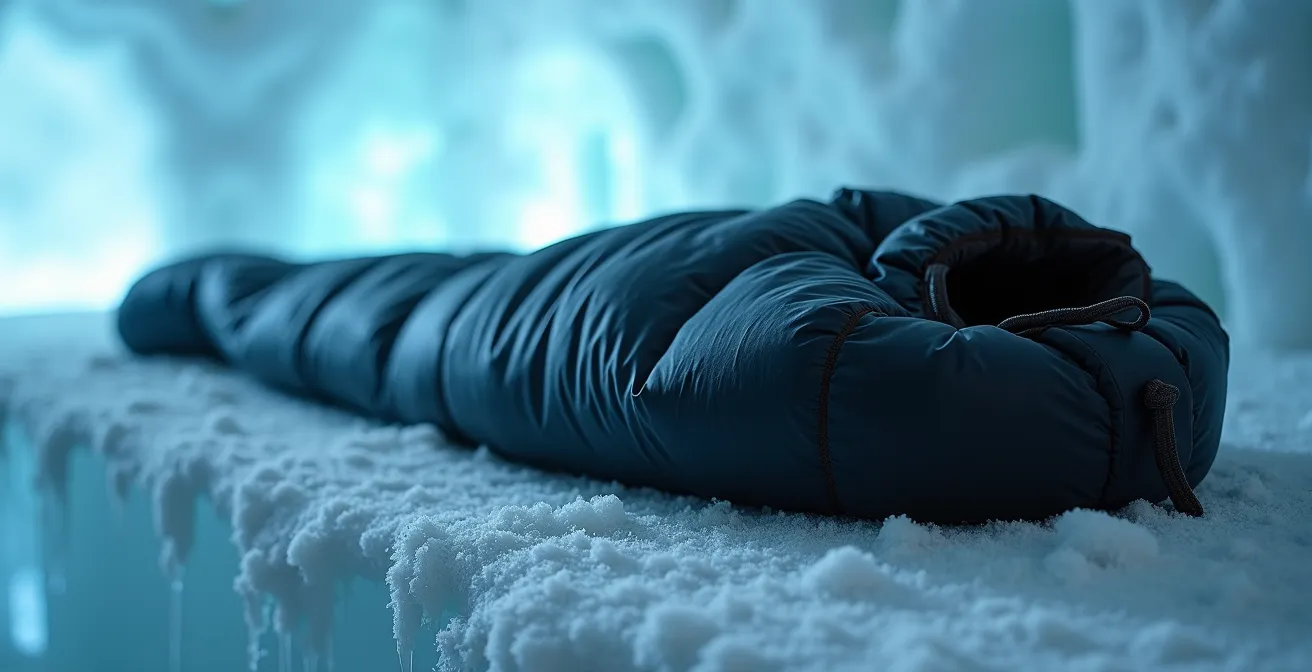
The single most important rule is to enter the bag completely dry. This is why the mandatory briefing advises changing into a fresh, dry base layer of merino wool or a technical synthetic fabric just before bed. These materials wick moisture away from your skin, keeping you dry even if you perspire slightly. As one travel writer noted in a first-hand account, the provided Nordic sleeping bags are so effective that the only cold moment was the 30 seconds spent getting out of day clothes and into the bag. Once zipped up and dry, they were perfectly warm all night, proving that proper use, not extra clothing, is the key to comfort.
How to use the sauna/spa cycle to raise body core temperature before bed?
The Hôtel de Glace experience includes access to the outdoor Nordic Area, with its hot tubs and saunas under the stars. This isn’t just a luxurious perk; it is a critical part of your pre-sleep preparation. The goal is to engage in a “thermal cycle” to deliberately raise your core body temperature, ensuring you get into your sleeping bag as warm as possible. This process, often called core temperature priming, turns your body into a well-stoked furnace that will heat your sleeping bag’s micro-environment for hours.
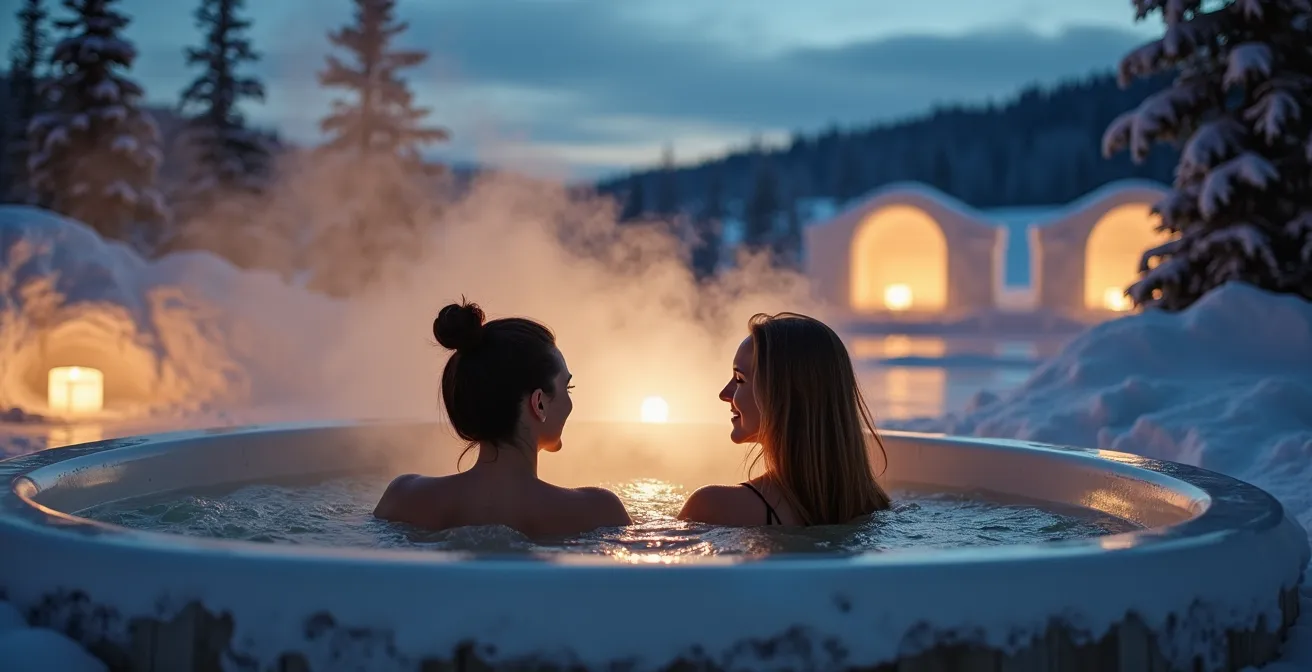
The official hotel guide strongly recommends this ritual, which is available to guests from 9 p.m. The cycle is a well-established Nordic tradition. You start with 10-20 minutes in a sauna or hot tub to store deep heat in your core and muscles. This is followed by a brief, seconds-long plunge into cold water to cool the skin and boost circulation. Finally, a 15-minute relaxation period allows your system to stabilize. Repeating this hot-cold-relax cycle two or three times amplifies the benefits, reduces the shock of later cold exposure, and leaves you pleasantly drowsy. The final, crucial step is to dry off completely after your last cycle before heading to your ice room, warm, relaxed, and ready for a comfortable night.
Why is one night in the ice room usually enough for most people?
A night at the Hôtel de Glace is designed as a unique, high-impact adventure, not a multi-day endurance test. This philosophy is built directly into the booking. Every reservation for an ice room automatically includes a standard, heated room at the adjoining Hôtel Valcartier for the same night. This “backup room” is your home base; it’s where you store your luggage, take a hot shower, and use the bathroom. It also provides a crucial psychological safety net: if, for any reason, you decide the ice room isn’t for you, you can retreat to a conventional warm bed at any time.
This structure reframes the experience. It’s not about surviving the wilderness; it’s about enjoying a focused, several-hour-long novelty within the comfort of a full-service resort. The official timeline for a “Nordic Night” reflects this: guests check in late afternoon, attend a mandatory information session, enjoy the ice bar and Nordic spa in the evening, and then have exclusive access to their ice room from about 9 p.m. until the next morning. After waking up, you simply walk back to your heated hotel room to start your day. This package turns a single, intense night into a memorable highlight of an otherwise comfortable trip, which aligns well with modern travel habits. In fact, a recent study confirmed that for domestic Canadian holidays, the average overnight trip lasts about 1.0 night, making this a perfectly typical duration for a leisure experience.
The error of burying your face in the sleeping bag that freezes the zipper
When the air is cold, the instinct is to burrow down completely inside your sleeping bag, pulling the opening tight around your face. This is a critical mistake. The moisture in your breath is significant, and as you exhale, that warm, damp air will hit the cold fabric and zipper of your bag. It will quickly condense and freeze, creating a rime of ice right next to your face. This can make the zipper difficult to operate and, more importantly, introduces moisture directly into the “condensation zone” of your bag’s insulation, compromising its ability to keep you warm.
The solution is to keep your mouth and nose outside the bag. Wear a warm tuque (beanie) or a thin balaclava to keep your head and neck warm, and use the bag’s drawcords to cinch the hood snugly around your face, creating a small breathing hole. This allows your breath to escape into the room instead of into your sleep system. This principle of ventilation is well-understood in winter camping, as explained by the experts at MSR:
“While it may seem counterintuitive, airflow in your tent is important during the winter… opening the vents helps prevent you from waking up entombed in frost.”
– MSR Team, 9 Tips for Staying Warm While Winter Camping, The Summit Register – Cascade Designs
While you are in a room, not a tent, the principle is the same: managing moisture is paramount. You must actively work to keep your sleep system dry, both from external sources and from your own body and breath. This means swapping out any damp socks or base layers before bed and ensuring your face remains outside the bag’s main opening throughout the night.
When to photograph the ice sculptures to capture the light through the snow walls?
The Hôtel de Glace is a photographer’s dream, but capturing its true magic depends heavily on timing and light. The character of the hotel changes dramatically throughout the day and night. During daytime hours, the sunlight is bright and crisp, reflecting off the ice and snow. This light is great for capturing sharp details in the sculptures but can feel harsh and wash out the subtle colours within the ice.
The most magical time for photography is undoubtedly the “blue hour”—the period of twilight just after sunset or just before sunrise. During this window, the ambient light outside is a deep, soft blue, while the hotel’s internal, concealed LED lights have been turned on. This combination creates a spectacular effect where the thick snow walls begin to glow from within, and light passes through the ice sculptures, revealing their depth and texture. The contrast between the warm interior lights and the cool external twilight provides a rich, jewel-box atmosphere that is impossible to capture in the full light of day or the complete darkness of night.
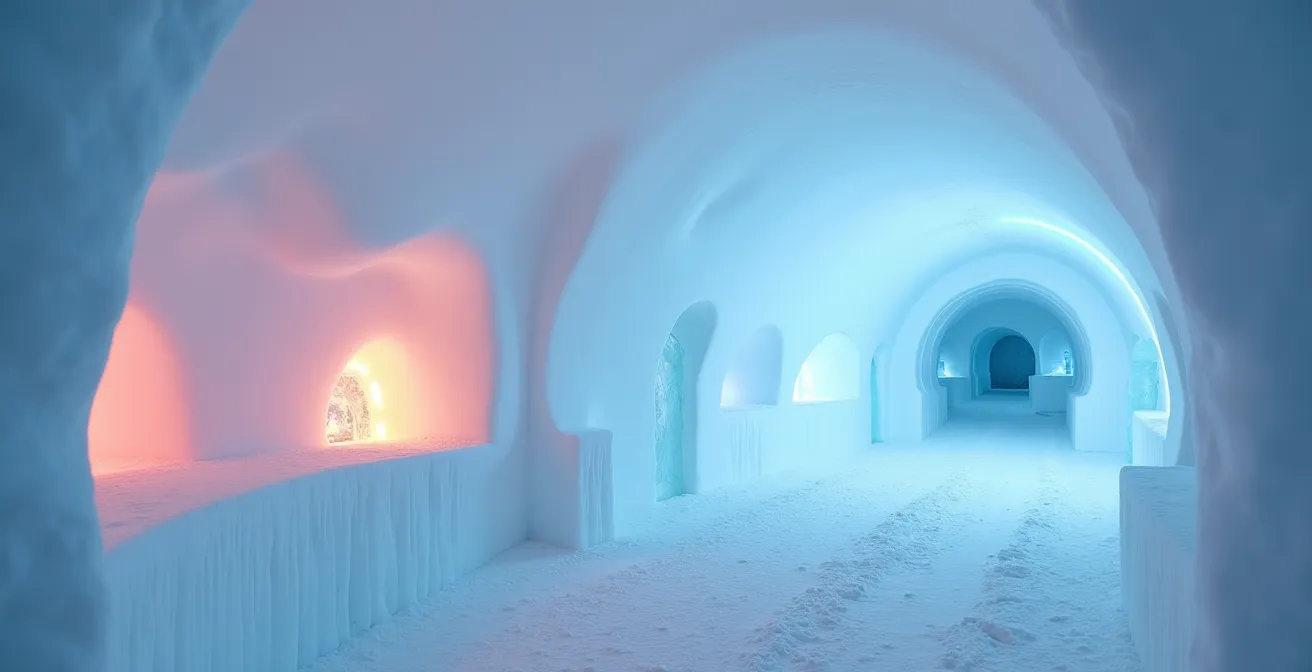
Once night fully falls, the experience is different again. The corridors and rooms are lit only by the artificial lights, creating a more dramatic, high-contrast look. While beautiful, this can be challenging to photograph without getting hotspots or losing the delicate translucency of the ice. For that truly ethereal, glowing shot that defines the Hôtel de Glace experience, aim for that brief but brilliant blue hour.
The “sweat and freeze” error beginners make with heavy jackets
The same principle of moisture management that governs your night’s sleep also applies to your daytime comfort while exploring the Valcartier resort or dancing at the ice bar. A common beginner’s mistake is to wear a single, extremely heavy winter parka. While it feels warm when you’re standing still, you will quickly overheat the moment you become active. This leads to sweating, and as soon as you stop moving, that dampness trapped in your clothes will rapidly cool, leaving you chilled and miserable. This is the classic “sweat and freeze” cycle.
The solution is the proven three-layer system, which allows you to constantly adjust your insulation to match your activity level and the fluctuating Canadian temperatures. By adding or removing the middle layer, you can avoid overheating and stay dry and comfortable all day long.
Your Action Plan: Three-layer dressing rule for active winter days in Québec City
- Base layer – wear a warm, moisture‑wicking layer directly against your skin (merino wool or technical synthetic) and pack an extra dry base layer to change into after you sweat.
- Middle layer – add an insulating fleece or softshell that traps heat but still breathes, removing it when you’re very active (walking fast, dancing at the ice bar, or tubing) so you don’t overheat.
- Outer layer – use a wind‑ and waterproof shell or parka appropriate to your activity: a longer, warmer coat for standing around festivities, and a lighter, breathable shell for active sports.
- Accessorize smartly with tuque, mitts, snow pants and waterproof boots that have good grip; avoid cotton pieces that stay wet and make you cold once you stop moving.
- Adjust layers often as temperatures in Québec can swing from around -20°C up to 0°C in a few days; delayer slightly when you’re working hard to avoid the sweat‑and‑freeze effect later.
This layering advice, officially recommended for visitors to Québec City, is the key to enjoying all the outdoor winter activities the region has to offer without ever feeling the damp chill of sweat.
Why is spiraled snow construction superior to a modern tent in extreme wind?
Part of the comfort you feel inside the Hôtel de Glace comes from its profound silence and stillness, a stark contrast to the flapping and shuddering of a tent in the wind. This stability is a direct result of its brilliant architecture. The hotel is not built with flat walls and right angles; it is constructed as a series of massive snow arches, domes, and curved corridors. This design, inspired by ancient igloo-building techniques, allows wind to flow smoothly over the structure rather than pushing against it. A flat tent wall catches the wind like a sail, but a curved snow wall deflects it.
The sheer scale and mass of the construction add to this inherent stability. An updated guide on the hotel’s construction highlights how this design allows for vast interior spaces, like a 60-seat ice restaurant, that a fabric tent could never support. The structural integrity comes from snow under compression. Furthermore, the walls themselves are incredibly thick. According to details on its construction, the hotel is rebuilt each winter using approximately 30,000 tonnes of snow and 500 tonnes of ice, with walls reaching up to 1.2 metres (4 feet) in thickness. This incredible thermal mass not only provides structural strength and wind resistance but also acts as a phenomenal sound and temperature insulator, keeping the interior at a calm, stable -3°C to -5°C, regardless of the howling gales or deep freezes outside.
Key Takeaways
- Your primary goal is moisture management; stay dry to stay warm, both day and night.
- The provided mummy sleeping bag is highly effective, but only when used correctly with a single, dry base layer.
- The pre-sleep spa ritual is not just a luxury but a vital step in “priming” your body’s core temperature for the night.
How to wax your skis for the fluctuating temperatures of a Canadian winter?
Once you’ve mastered the science of sleeping comfortably in the cold, you may feel inspired to embrace other Canadian winter challenges. Cross-country skiing is a perfect next step, but just like sleeping on ice, success depends on understanding some technical principles. One of the biggest challenges in a Canadian winter is dealing with fluctuating temperatures, which can swing from deep-freeze to near-thawing in a single day, drastically changing snow conditions and how your skis perform.
Expert skiers manage this by using a system of waxes. The base of a classic cross-country ski is divided into a “glide zone” at the tip and tail and a “grip zone” (or “kick zone”) underfoot. The glide zone is treated with a glide wax to reduce friction, while the grip zone is treated with a stickier kick wax that allows you to push off the snow. According to experts at Swix Canada, the key is choosing the right kick wax for the temperature. Waxes are colour-coded, with “harder” waxes (like blue) used for colder, drier snow and “softer” waxes (like red) for warmer, wetter conditions near 0°C. Applying several thin, smooth layers is crucial for performance. This careful attention to conditions and equipment is the same philosophy that ensures a warm night at the Hôtel de Glace: success comes from applying the right technique, not from brute force.
By applying these principles of moisture management and thermal regulation, your night at the Hôtel de Glace can be transformed from a source of anxiety into a deeply comfortable and magical experience. Now that you’re equipped with this knowledge, the next logical step is to explore the booking options and plan your own unforgettable winter adventure.