
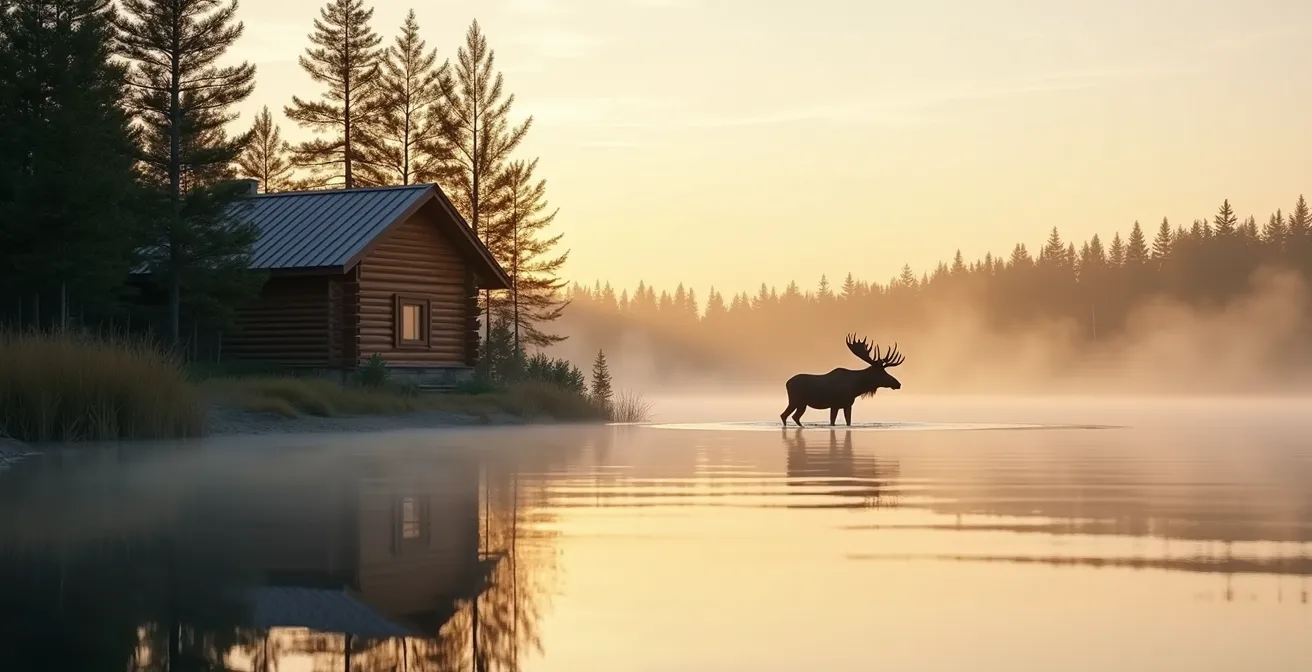
Securing a coveted boreal forest cabin during moose season is less about luck and more about adopting an outfitter’s mindset.
- The booking frenzy for public parks is intense; a strategic approach focusing on shoulder seasons or private inns offers a better path.
- Success in the wild hinges on logistical mastery—from packing calorie-dense food to understanding the nuances of “off-grid” living and wood stove safety.
- The most rewarding experiences come from aligning with the forest’s rhythm, where silence becomes a tool and your location an economic support for remote communities.
Recommendation: Shift your focus from competing for the most popular park cabins to building relationships with rural innkeepers who hold the keys to local knowledge and less-travelled territories.
You’ve seen the photos: a majestic bull moose, antlers draped in velvet, emerging from the morning mist of a northern lake. You’ve dreamed of the profound silence of the boreal forest, broken only by the call of a loon. And you’ve experienced the crushing reality: logging onto the provincial park booking site at 7:00 AM, only to find every single backcountry cabin for the September-October rut has vanished in minutes. The common advice—”book a year in advance”— feels hollow when you’re competing with thousands for a handful of spots.
The frustration is understandable, as is the competition. According to Northern Ontario tourism data, Ontario Parks’ backcountry cabins receive an average of 47 booking attempts within the first three minutes of the reservation window opening. This leaves many passionate nature lovers feeling that these profound wilderness experiences are inaccessible. But what if the secret to securing your boreal refuge wasn’t about faster clicking, but about a fundamental shift in strategy? What if the key was to stop thinking like a tourist and start thinking like a seasoned outfitter?
This guide moves beyond the obvious. It’s an insider’s look into the logistics and mindset required to not only book a stay but to truly inhabit the Canadian wilderness. We’ll explore why the forest’s silence is a strategic tool, how to master the art of off-grid living, and how your choice of lodging can become a vital part of a fragile local economy. This is about aligning yourself with the rhythm of the forest to create an opportunity that booking portals can’t offer.
To help you navigate this journey, this article breaks down the essential strategies. From the philosophy of silence to the practicalities of heating your cabin, each section is designed to equip you with the insider knowledge needed to transform your dream of a boreal retreat into a reality.
Summary: An Insider’s Guide to Securing a Boreal Forest Refuge in Canada
- Why is the silence of the boreal forest essential for mental reset?
- How to pack food for a 7-day stay in a fly-in outpost camp?
- Rustic cabin or luxury lodge: what to expect when the brochure says “off-grid”?
- The fire safety mistake that endangers wooden cabins in winter
- How to heat a wilderness cabin efficiently with a wood stove overnight?
- How to build a survival kit for a 3-day hike in the Yukon?
- How to position your stay to see Northern Lights from your doorstep?
- Why does staying in rural inns keep small Canadian villages alive?
Why is the silence of the boreal forest essential for mental reset?
In our hyper-connected world, we often seek silence as an escape. But in the boreal forest, especially during moose season, silence is not a passive state; it’s an active practice. It’s the essential tool for both mental reset and wildlife viewing success. The constant low-grade hum of urban life numbs our senses. The profound quiet of the northern woods recalibrates them. Initially, this absolute silence can feel unnerving, but it’s the gateway to a deeper level of awareness. You begin to notice the subtle language of the forest: the snap of a twig, the rustle of leaves, the distinct calls of different birds. This is not just relaxing; it is a form of deep listening that rewires your brain away from distraction and towards focus.
For the purpose of seeing moose, this sensory recalibration is paramount. A moose’s hearing is exponentially more sensitive than a human’s. The sound of a zipper, a cough, or a synthetic jacket brushing against a branch can travel hundreds of metres and signal your presence long before you see them. Practicing silence is therefore a form of respect and a strategic advantage. By minimizing your own acoustic footprint, you cease to be an intruder and can begin to observe the forest as it truly is. This is the foundation of a successful and meaningful encounter, transforming the experience from a lucky sighting into a hard-earned reward.
Adopting a deliberate silence protocol allows you to map the soundscape around your cabin. You’ll identify the quietest times of day (typically dawn and dusk) and the most hidden spots, or “acoustic zones,” from which to observe. This meditative practice quiets the internal noise as much as the external, achieving the mental reset so many seek in the wilderness. It’s in that shared silence that the forest finally reveals itself, and the chances of a moose silently emerging from the treeline increase dramatically.
Your Action Plan: 7-Day Silence Protocol for Moose Viewing
- Days 1-2: Practice 30-minute silence periods during dawn walks to train your hearing for subtle forest sounds.
- Days 3-4: Extend silence periods to 2 hours, focusing on identifying natural sound patterns versus human-made disturbances.
- Day 5: Map ‘acoustic zones’ around your cabin—identify the quietest spots for optimal moose approach routes.
- Day 6: Implement a full-day silence protocol, communicating only through gestures or written notes.
- Day 7: Position yourself at pre-dawn in identified silent zones, maintaining complete stillness for maximum moose encounters.
How to pack food for a 7-day stay in a fly-in outpost camp?
When your transport is a float plane with strict weight limits, food packing transforms from a simple chore into a strategic challenge. For a 7-day stay in a remote Canadian outpost camp, every gram counts. The guiding principle is maximizing caloric density—the highest number of calories for the lowest possible weight and volume. Forget fresh vegetables and bulky packaging; your sustenance must be efficient, non-perishable, and above all, wildlife-proof.
Your packing list should be built around dehydrated meals, high-energy fats, and compact carbohydrates. Items like bannock mix, powdered milk, jerky, nuts, and hard cheeses are staples. One of the most overlooked but valuable items is hard maple sugar; it’s a uniquely Canadian, lightweight, and potent energy source. The goal is to plan each meal meticulously, calculating the required calories per person per day (factoring in strenuous activity like hiking or canoeing) and packing accordingly. Repackage everything from its commercial containers into vacuum-sealed bags or durable zip-locks to remove air, reduce bulk, and critically, minimize odours that attract bears and other wildlife.
The most crucial aspect of your food strategy is not what you pack, but how you store it. A remote cabin is not a fortress. Proper food storage is non-negotiable for your safety and the well-being of the animals whose territory you are visiting. All food, cooking utensils, and scented items (like toothpaste) must be stored in a certified bear-proof container or a properly executed food hang, at least 100 metres away from your sleeping area. Many fly-in outfitters will provide a bear-proof barrel or a dedicated storage locker; confirm this before you go. Assuming your cabin’s walls will protect you is a dangerous mistake.
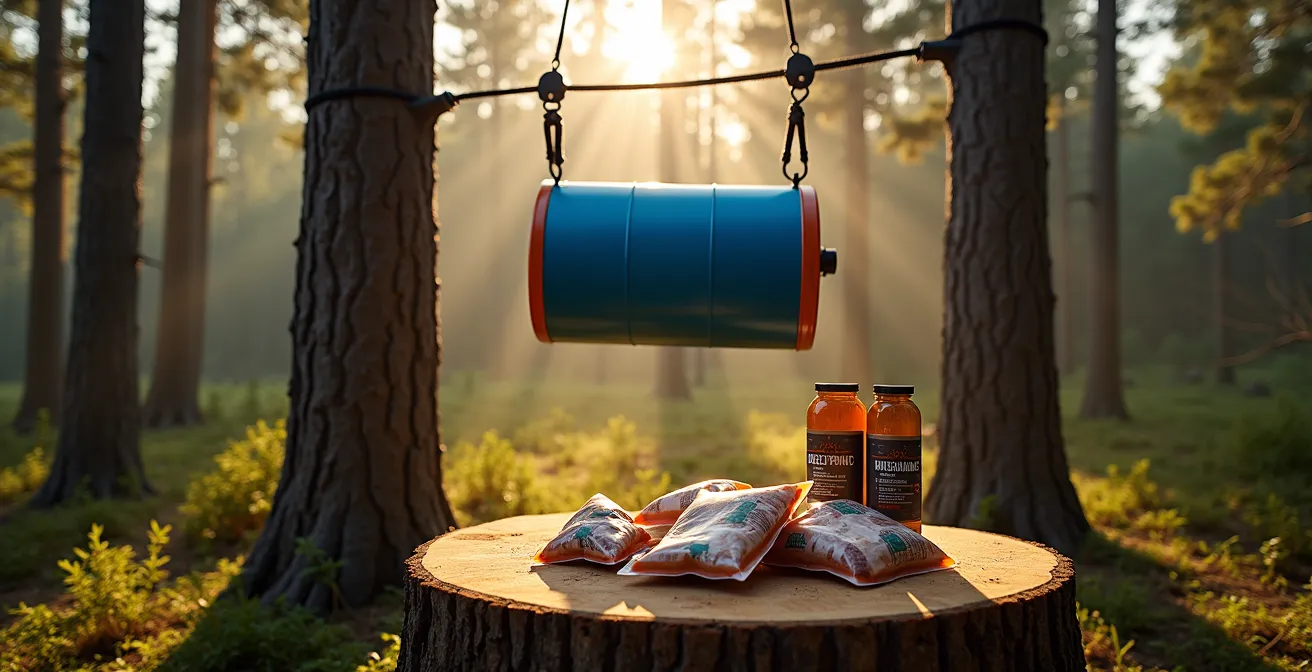
As the image demonstrates, a sophisticated bear hang or a dedicated barrel system is not optional—it’s an integral part of coexisting safely in the wild. The comparison below highlights foods that offer the best return on weight, but remember that even a low-scent item like bannock mix becomes a powerful attractant once it leaves its sealed container.
This table compares food options based on their efficiency and safety profile. Pay close attention to the Cal/g ratio and the Bear-Safe rating when making your final selections.
| Food Item | Weight (g) | Calories | Cal/g Ratio | Bear-Safe Rating |
|---|---|---|---|---|
| Bannock Mix | 500 | 2200 | 4.4 | Medium (dry mix) |
| Hard Maple Sugar | 200 | 760 | 3.8 | High (sealed) |
| Alberta Jerky | 300 | 900 | 3.0 | Low (strong scent) |
| Vacuum-Sealed Smoked Fish | 400 | 800 | 2.0 | High (vacuum sealed) |
| Dehydrated Meals | 150 | 600 | 4.0 | High (sealed pouch) |
Rustic cabin or luxury lodge: what to expect when the brochure says “off-grid”?
The term “off-grid” is one of the most romanticized—and misunderstood—in wilderness travel. In Canada, it can describe anything from a bare-bones plywood shack to a high-end lodge with a private chef. The key to a successful trip is deciphering this marketing language and aligning your expectations with reality. When a brochure promises an “off-grid” experience, you must ask critical questions: Off which grid? Electricity? Water? Internet? Road access? The answers define your entire stay.
At one end of the spectrum is the true rustic refuge, like those found in Quebec’s SEPAQ network or many provincial park systems. Here, “off-grid” is absolute. You should expect to arrive by canoe or on foot. Your shelter will be basic, providing bunks, a wood stove, and an outhouse. There will be no running water, meaning you’ll be hauling it from a lake or pump and purifying it yourself. You must bring all your own bedding, cookware, light sources (headlamps are essential), and food. This is a deeply rewarding, self-sufficient style of travel that offers unparalleled solitude but demands significant preparation and comfort with rugged conditions.
At the other end is the luxury wilderness lodge, often found in prime territories like the Yukon or remote parts of British Columbia. These establishments are also technically “off-grid,” accessible only by float plane, but the experience is entirely different. Power is supplied by a generator that runs for several hours a day, there might be satellite internet, and meals are prepared by a professional chef. As one case study on Yukon lodges notes, they maintain wilderness authenticity through strategic location in prime moose habitat, where naturally low densities make it difficult to spot them from highways. This option removes the logistical burdens of self-sufficiency, allowing you to focus purely on the nature experience, but it comes at a premium price and offers a more curated, less raw form of solitude.
Case Study: SEPAQ Refuge vs. Yukon Luxury Lodge Comparison
A comparative analysis of Quebec’s SEPAQ refuge system versus Yukon’s high-end lodges reveals stark contrasts in ‘off-grid’ experiences. SEPAQ refuges, accessible only by canoe or hiking, provide bunks and wood stoves but require guests to bring all bedding, cookware, and water purification. Meanwhile, Yukon luxury lodges, like those in the Yukon rivers and lakes area, offer generator power, professional chefs, and satellite internet while maintaining wilderness authenticity through strategic location in prime moose habitat.
The fire safety mistake that endangers wooden cabins in winter
In a remote wooden cabin, the wood stove is the heart of your shelter. It’s your source of heat, your means of drying wet gear, and a psychological comfort against the vast northern cold. However, it is also the single greatest fire risk, and a simple mistake in its use can have catastrophic consequences. The most common and dangerous error is not a dramatic flare-up, but the slow, silent buildup of creosote in the stove pipe. This black, tar-like substance is a byproduct of burning wood, especially if the wood is unseasoned (wet) or if the fire is consistently burned at a low temperature, causing incomplete combustion.

As the cross-section above starkly illustrates, creosote is not just soot; it’s a highly flammable fuel. When it accumulates to a significant thickness, a hot ember or a sudden increase in fire temperature can ignite it, leading to a violent chimney fire. The roar can sound like a freight train, and temperatures can exceed 1000°C, easily igniting the surrounding wooden structure. This is not a rare occurrence; based on recent conservation area incident reports, over 30% of wilderness cabin fires in Canada’s boreal forest regions are caused by creosote buildup from burning unseasoned wood. The responsibility for preventing this rests squarely on you, the cabin user.
Preventing creosote buildup involves two key practices. First, burn only dry, seasoned hardwood whenever possible. Second, ensure you have at least one hot, brisk fire each day to burn off the minor deposits from slower, overnight burns. You must also know how to inspect the chimney. A flashlight shined up the flue can reveal the extent of the buildup. If the deposits are thick, flaky, or glossy, the risk is high. Many cabins are equipped with cleaning tools, and it’s your duty to know how to use them or to report the hazard. Ignoring the silent threat of creosote is betting your safety against a simple, preventable chemical reaction.
Your Checklist: Critical Cabin Fire Safety Protocol
- Monitor weather forecasts for sudden temperature swings, which can affect stove draft.
- Reduce stove load by half when temperatures rise, to avoid overheating and creosote ignition.
- Check the stove pipe for visible creosote buildup every 48 hours using a flashlight.
- Maintain a minimum distance of 30 feet from any wooden structure for ash disposal, using a metal container.
- Know where the chimney cleaning rod is and be prepared to perform a sweep if black deposits exceed 3mm in thickness.
How to heat a wilderness cabin efficiently with a wood stove overnight?
Keeping a cabin warm through a sub-zero Canadian night without waking every two hours to stoke the fire is a skill. It’s a delicate balance of fuel, airflow, and thermodynamics. The secret lies not in stuffing the stove with as much wood as possible, but in building a fire designed for a long, slow, and efficient burn. This requires understanding the concept of thermal inertia and employing a specific fire-building technique known as the top-down burn, or the “Canadian method.”
A conventional fire is lit from the bottom, causing a rapid, hot burn that consumes fuel quickly. The top-down method inverts this process to create a slower, more controlled release of energy. You start by placing your largest, densest hardwood logs (like maple or birch) at the bottom of the firebox. You then stack progressively smaller pieces of wood on top, finishing with kindling and tinder at the very peak. When you light the fire from the top, the flames slowly burn downwards, igniting the layer below in a controlled sequence. This prevents the entire fuel load from combusting at once, extending the burn time for hours.
Damper control is the other half of the equation. Once the top layer is well-lit and the chimney is drawing properly (about 20-30 minutes), you must reduce the air intake via the damper. This slows the rate of combustion, allowing the logs to smolder and release their heat steadily overnight. Finding the sweet spot—enough air to keep the fire from going out, but not so much that it burns too fast—is an art learned with practice. Before leaving any cabin, you must also be aware of the invisible risks. Provincial safety inspection data from 2023 showed that 23% of remote Canadian cabins inspected had non-functional or missing Carbon Monoxide (CO) detectors, an essential safeguard against incomplete combustion. Always bring your own portable detector.
Your Action Plan: The Canadian Top-Down Fire Method for All-Night Burns
- Layer 1 (Bottom): Place 3-4 large hardwood logs (birch/maple) parallel, leaving 1-inch gaps for airflow.
- Layer 2: Add medium-sized hardwood logs perpendicular to the bottom layer to create air channels.
- Layer 3: Place kindling and small softwood pieces (pine/spruce) on top of the medium logs.
- Layer 4 (Top): Add tinder like paper or birch bark at the very top and light the fire from here.
- Damper Management: Leave the damper fully open for 20 minutes to establish a hot fire, then reduce it to about 25% for a slow, overnight burn.
- Morning Protocol: In the morning, add a couple of small softwood pieces to the hot coals to quickly revive the fire without a full rebuild.
How to build a survival kit for a 3-day hike in the Yukon?
Embarking on a multi-day hike in a territory as vast and unforgiving as the Yukon requires a shift in mindset. You are not merely packing for a walk; you are preparing for self-reliance in an environment where help is not readily available. Building a survival kit here is not about generic “ten essentials” lists; it’s about addressing the specific, high-stakes challenges of the northern wilderness: sudden, extreme weather changes, formidable wildlife, and the near-total absence of communication infrastructure. According to Yukon search and rescue statistics, the average emergency evacuation time in the backcountry is 8-12 hours, and 65% of the territory has zero cellular coverage.
Your kit must be layered and function-specific. The first layer is what you wear: merino wool thermals are non-negotiable, even in summer, as is a reliable rain shell. The second layer is your immediate defense and navigation. This includes two cans of bear spray—one on your hip holster, one as a backup in your pack. For navigation, a GPS is a useful tool, but it’s secondary to a waterproof topographic map and a compass, skills you must know how to use. Flagging tape is an underrated but crucial item for marking your trail or a water source if you become disoriented.
The third layer is your 72-hour emergency system. This assumes you are stranded and awaiting rescue. A satellite communication device, like an InReach or SPOT, is the most important piece of gear you can carry. Before your trip, your plan should be registered with a service like AdventureSmart, and preset messages should be configured on your device. Your emergency shelter (a bivy sack, not just an emergency blanket) and a foolproof fire-starting kit (with waterproof matches and a ferro rod) are your lifelines for surviving the cold nights. Finally, a length of lightweight rope and carabiners are essential, not for climbing, but for safely navigating the fast, frigid, glacier-fed creeks that can suddenly become impassable.
Your Checklist: Yukon-Specific 72-Hour Survival Kit Essentials
- Layer 1 (Base): A -30°C rated merino wool thermal set, plus a complete backup set stored in a dry bag.
- Bear Defense: Two cans of bear spray (purchased locally in Whitehorse), one in an accessible holster and a backup.
- Navigation: Waterproof topographic maps, a reliable compass, and a GPS unit, supplemented with flagging tape for trail marking.
- Communication: An InReach Mini or similar satellite device with preset Yukon RCMP coordinates and a trip plan shared via AdventureSmart.
- Water Crossing: A 30-metre lightweight rope and carabiners for safely navigating fast-moving, glacier-melt creeks.
- Emergency Shelter: A bivy sack, an emergency blanket, and a fire starter kit containing waterproof matches.
How to position your stay to see Northern Lights from your doorstep?
Witnessing the aurora borealis is a bucket-list experience, but seeing it from the warmth of your own cabin is the ultimate northern dream. This doesn’t happen by chance. It requires a strategic choice of location that optimizes three factors: magnetic latitude, darkness, and a clear northern view. While many places in Canada offer a chance to see the lights, certain locations are fundamentally superior, transforming a possibility into a high probability.
The first factor is choosing a location within the auroral oval, the zone where aurora activity is most concentrated. This includes the northern parts of most provinces and all three territories. However, the most critical factor you can control is the level of light pollution. You must seek out an official Dark Sky Preserve. These are areas where artificial light is strictly regulated, allowing for unparalleled night sky visibility. The difference between viewing the aurora from a town versus a Class 1 preserve on the Bortle Scale (a measure of sky darkness) is profound. Faint auroral bands that are completely invisible near a town can dance vividly across the sky in a true dark-sky zone.
Finally, the specific siting of your cabin is key. You need an unobstructed view to the north. When booking, ask the outfitter or owner about the cabin’s orientation and what lies to the north—is it a dense forest or an open lake? A cabin on the southern shore of a large lake is ideal, as it provides a perfect, dark horizon. As a case study from Parks Canada highlights, cabins in Wood Buffalo National Park, the world’s largest Dark Sky Preserve, report sightings on 78% of clear nights in September and October, a period which perfectly overlaps with the moose mating season. This synergy of peak seasons for both moose and aurora viewing makes for an unforgettable trip.
| Dark Sky Preserve | Light Pollution (Bortle Scale) | North View Quality | Moose Density | Peak Season Overlap |
|---|---|---|---|---|
| Wood Buffalo, AB/NT | Class 1 | Excellent | High | Sept-Oct |
| Jasper, AB | Class 2 | Very Good | Moderate | Sept-Oct |
| Mont-Mégantic, QC | Class 2 | Good | Low | Sept |
| Grasslands, SK | Class 1 | Excellent | Very Low | Sept-Oct |
Key Takeaways
- Adopt an outfitter’s mindset: Success is about strategy, local knowledge, and flexibility, not just booking speed.
- Master wilderness logistics: Your trip’s success depends on meticulous planning, from calorie-dense food packing to understanding wood stove mechanics.
- Embrace silence as a tool: True quiet is not just for relaxation; it’s a strategic practice for deeper connection and better wildlife encounters.
- Deconstruct “off-grid”: Always clarify what the term means for a specific lodging to align expectations with reality, from rustic self-sufficiency to catered luxury.
Why does staying in rural inns keep small Canadian villages alive?
While the allure of a secluded park cabin is powerful, the insider’s secret to a successful moose-viewing trip often lies in an alternative strategy: the rural inn. These small, often family-run establishments in gateway communities like Huntsville near Algonquin Park or Ucluelet on Vancouver Island are more than just a place to sleep. They are the living hubs of a local knowledge ecosystem. Choosing to stay in one is not a compromise; it’s a strategic decision that offers unique advantages while directly supporting the economies of the small Canadian villages that make wilderness access possible.
Unlike a centralized park system, an innkeeper is a real-time source of invaluable, hyperlocal information. As wildlife tourist Sarah Mitchell noted in a travel survey, “The innkeeper told us the moose had been spotted at kilometre 34 on the logging road that morning – information we’d never have found online.” This is the crucial edge that online portals can’t provide. These innkeepers are connected to a network of local guides, hunters, and residents, and they can direct you to active wildlife areas that aren’t on any official map, helping you escape the crowds along main corridors.
Furthermore, your spending has a profound and direct impact. This is known as the hub-and-spoke economic model. A dollar spent at a chain hotel on a highway often leaves the community, whereas a dollar spent at a local inn multiplies. One study in Ucluelet, BC, found that each dollar spent at a local inn generated $3.40 for the community, flowing to local restaurants, First Nations art galleries, and independent guide services. By staying at a rural inn, you are not just a tourist; you are a temporary participant in a local economy, funding the very infrastructure and community that preserves the wild spaces you came to see. This symbiotic relationship ensures these small villages can continue to serve as authentic gateways to the Canadian wilderness for years to come.
The innkeeper told us the moose had been spotted at kilometre 34 on the logging road that morning – information we’d never have found online.
– Sarah Mitchell, Wildlife Tourist, Northern Ontario Travel Survey 2024
Instead of battling the booking portals for a remote cabin, your next step could be to explore these vital community hubs. Consider contacting an innkeeper in your target region; they are not just renting a room, but offering a gateway to an authentic boreal experience, complete with the local knowledge you can’t find anywhere else.