
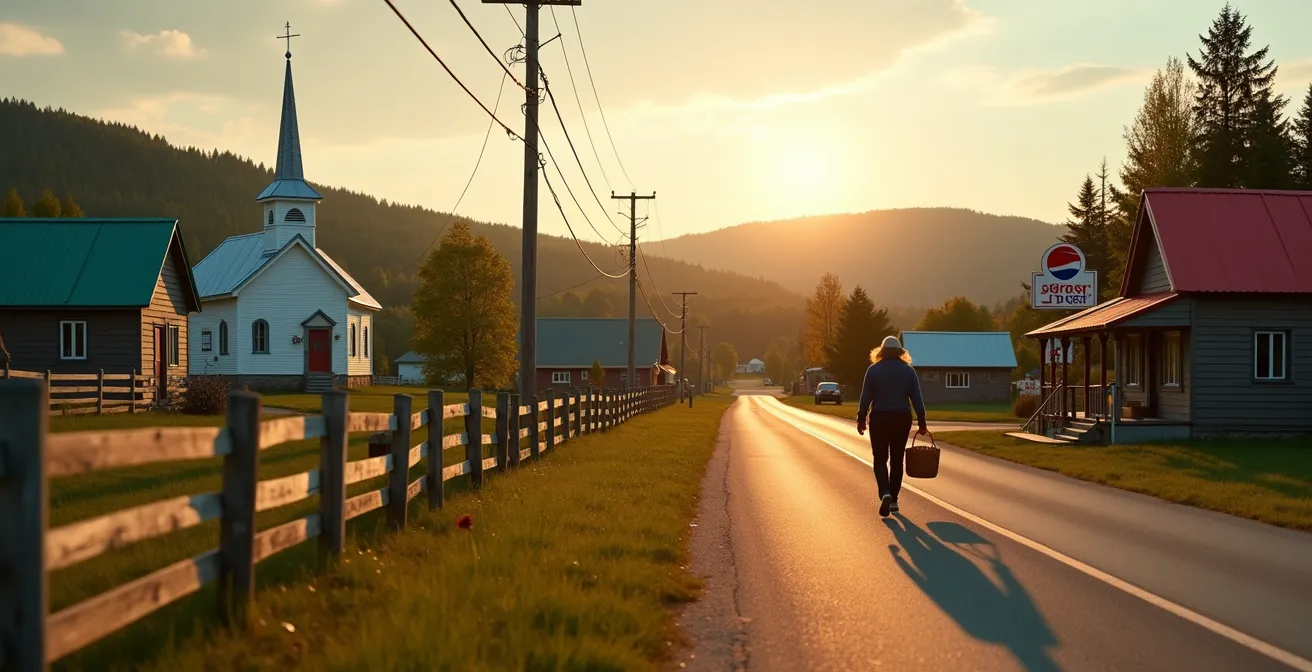
Feeling anxious about visiting rural Quebec without speaking French? The solution isn’t just to memorize phrases, but to shift your perspective. This guide shows you how to see the language barrier not as an obstacle, but as a doorway to authentic cultural connection. By understanding the mindset behind the language, even the smallest effort becomes a powerful act of respect that transforms your travel experience from transactional to truly memorable.
The thought of navigating the charming, but staunchly francophone, regions of Quebec like Charlevoix or Gaspésie can be intimidating for an English speaker. The fear is common: getting lost, being unable to order a meal, or causing an unintentional offense. Your mind might jump to practical-but-impersonal solutions like translation apps or sticking to a few memorized words. These are helpful, but they miss the real heart of the matter.
Many guides will give you a list of phrases, and you should absolutely learn “Bonjour,” “Merci,” and “S’il vous plaît.” But what they often fail to explain is the profound cultural context that gives these words their power. The goal isn’t just to communicate a need; it’s to show respect for a culture that has passionately protected its linguistic identity for centuries. This isn’t about achieving fluency overnight.
But what if the true key to unlocking Quebec wasn’t perfect pronunciation, but a genuine and respectful curiosity? This article reframes the challenge. We’ll move beyond simple vocabulary to explore the cultural mindset behind the language. We’ll uncover how a few well-placed words, a bit of historical understanding, and the right attitude can turn a moment of potential frustration into one of authentic human connection.
This guide will walk you through the nuances of Quebec’s unique French, its customs, and its history. By understanding the “why” behind the language, you’ll be equipped not just to survive, but to thrive, creating a richer and more meaningful journey through one of Canada’s most distinct cultural landscapes.
Summary: How to Embrace Quebec’s Language Landscape
- Why is “Joual” different from Parisian French?
- How to order and tip in a Quebec brasserie to show respect?
- Old World charm or modern bilingualism: which city offers the experience you want?
- The navigation mistake that leaves tourists stranded in unilingual areas
- When to visit to experience the peak of Quebec national pride?
- Why do events in Canada start with acknowledging traditional territory?
- Why does Quebec produce raw milk cheeses that are illegal in the US?
- How to walk the Quebec City walls to understand the strategic defense of New France?
Why is “Joual” Different From Parisian French?
The first thing to understand is that Québécois French is not simply Parisian French with a different accent; it’s a distinct dialect with its own history, vocabulary, and rhythm. At the heart of its most informal, working-class version is “Joual,” a term that was once derogatory but has since been reclaimed with pride. The key difference lies in its unique evolution. When colonists from France settled in North America in the 17th and 18th centuries, they brought their regional dialects with them. Cut off from France after the British conquest, their language evolved in isolation.
This isolation meant that Québécois French retained features that disappeared in Europe while also absorbing new influences. The result is a vibrant linguistic tapestry. As The Canadian Encyclopedia notes, Joual incorporates various archaisms, French dialectalisms, anglicisms, and Aboriginal words, making it one of the most unique French dialects in the world. You might hear older, more poetic terms alongside anglicisms for modern concepts, creating a sound that is both historic and contemporary.
The cultural significance of Joual was cemented during Quebec’s Quiet Revolution in the 1960s. It became a powerful symbol of a distinct Québécois identity, separate from both English Canada and Metropolitan France. This was famously demonstrated in 1968 with Michel Tremblay’s groundbreaking play, Les Belles-sœurs. Written entirely in Joual, it shocked the establishment but resonated deeply with the public. When it toured Paris, critics found it nearly incomprehensible, but Tremblay’s point was made: Quebec had its own voice. Recognizing this history is the first step toward linguistic respect.
You don’t need to understand Joual, but knowing it exists helps you appreciate the deep-seated pride Quebecers have in their language. Every “Bonjour” you offer is an acknowledgement of this unique heritage.
How to Order and Tip in a Quebec Brasserie to Show Respect?
A classic Quebec brasserie or bistro is the perfect place to practice your newfound cultural appreciation. The experience is about more than just food; it’s a social ritual. The most important rule is to always begin every interaction with “Bonjour.” This simple greeting is not just a pleasantry; it’s a sign of respect that signals your acknowledgement of being in a French-speaking environment. It immediately sets a positive and friendly tone, and you will find it opens doors, both literally and figuratively.
When it comes to ordering, don’t be afraid to try. A translation app on your phone is perfectly acceptable for looking up unfamiliar menu items like cretons (a pork spread) or tarte au sucre (sugar pie). Pointing at the menu and using “s’il vous plaît” (please) is universally understood and appreciated. When the meal is over, “L’addition, s’il vous plaît” will get you the bill. Complimenting the food with a simple “C’était délicieux” (It was delicious) is a wonderful touch that shows gratitude.
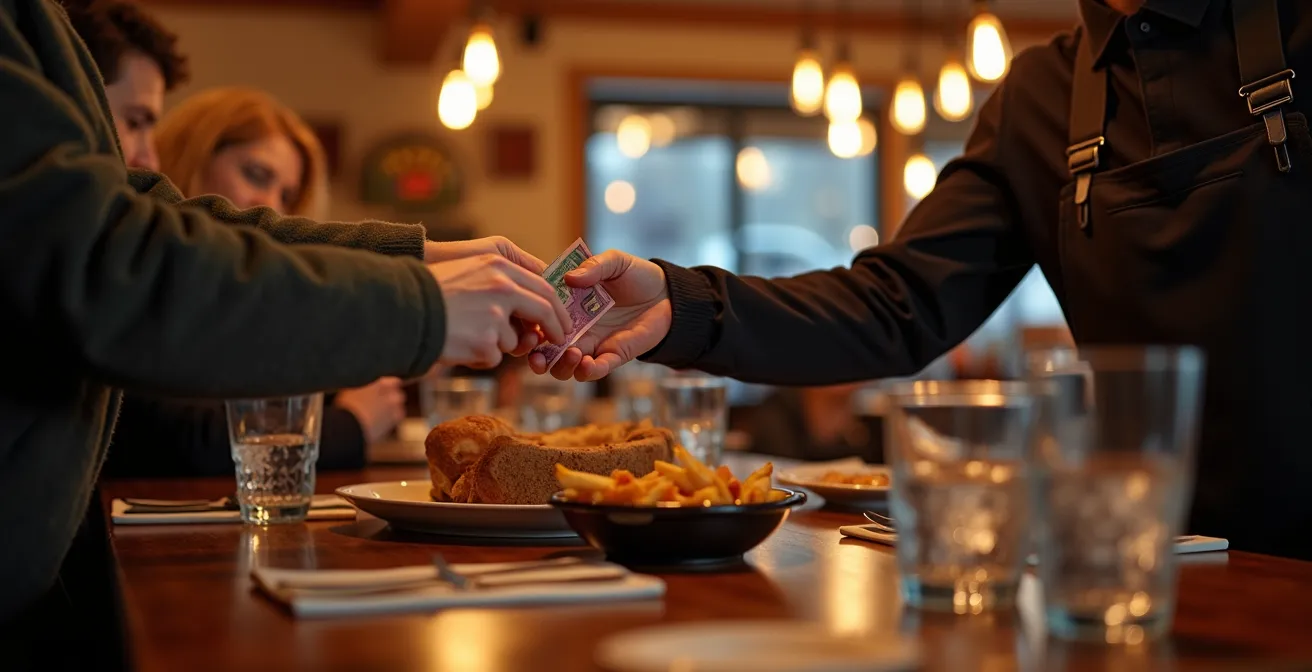
Finally, tipping is an important part of dining culture in Quebec, as it is throughout Canada. The expectation is similar to the rest of North America. According to a travel guide on tipping in Canada, it’s customary to leave a standard rate of 15-20% on the pre-tax bill for good service. This gesture of appreciation is a crucial part of showing respect for the service staff and the establishment. It completes the circle of a positive and respectful dining experience.
By combining a few key phrases with standard North American customs, you demonstrate that you’re an engaged and considerate visitor, not just a tourist passing through.
Old World Charm or Modern Bilingualism: Which City Offers The Experience You Want?
Quebec’s two largest cities, Montreal and Quebec City, offer vastly different linguistic and cultural experiences for an Anglophone visitor. Choosing between them depends entirely on what you’re looking for. Montreal is a dynamic, multicultural metropolis. It’s a laboratory of modern bilingualism where French and English coexist, often in the same conversation. Thanks to a large anglophone population and institutions like McGill University, it’s entirely possible to navigate Montreal using only English, though making an effort in French is always appreciated.
Quebec City, on the other hand, is a living museum. As the cradle of New France, its identity is inextricably linked to the preservation of French heritage. While staff in the highly touristed areas of Old Quebec are bilingual, the moment you step outside this zone, French becomes far more essential. This makes Quebec City a much more immersive environment for anyone wanting an authentic French experience. As travel writer Pamela MacNaughtan notes in the Quebec Maritime Travel Guide:
In tourist centres, hotels and attractions, there will be staff who can speak English. Often in shops, restaurants and bars too. However, English education has grown in the province over the last 30 years.
– Pamela MacNaughtan, Quebec Maritime Travel Guide
This choice between a bilingual hub and a historic fortress is a core part of planning your trip. The following table breaks down the key differences to help you decide which city aligns with your travel goals. An analysis by Babbel on speaking French in Quebec provides helpful context for this comparison.
| Aspect | Montreal | Quebec City |
|---|---|---|
| English Accessibility | High – McGill University creates English ‘bubbles’, many bilingual services | Moderate – Tourist areas bilingual, outside areas primarily French |
| Cultural Experience | Modern multicultural laboratory, dynamic and evolving | Living museum of New France, historical immersion |
| French Requirement | Optional for tourists, helpful for residents | More essential outside tourist zones |
| Language Learning Opportunity | Less immersive due to easy English access | More immersive, authentic French environment |
Ultimately, your choice depends on your comfort level and goals: do you want the safety net of English in a vibrant, mixed city, or the challenge and reward of deeper immersion in a historical setting?
The Navigation Mistake That Leaves Tourists Stranded in Unilingual Areas
The single biggest navigation mistake visitors make in rural Quebec isn’t a wrong turn on a highway—it’s relying solely on technology and assuming everything will be in English. Road signs, town names, and local directions are almost exclusively in French. An over-reliance on GPS without a basic understanding of key vocabulary can lead to confusion and, in some cases, humorous mishaps. One traveler in the remote Lac-Saint-Jean region shared a story of following a sign for a tourism office and confidently walking into what turned out to be someone’s private home, much to the bewilderment of the homeowner.
This is where navigational empathy comes into play. The goal isn’t to become a map-reading expert, but to prepare for moments of uncertainty with the right tools and attitude. The traveler who walked into the kitchen found that his clumsy attempts to explain in broken French with a translation app resulted in laughter and goodwill, not frustration. This is the heart of the rural Quebec experience: effort is rewarded with kindness.
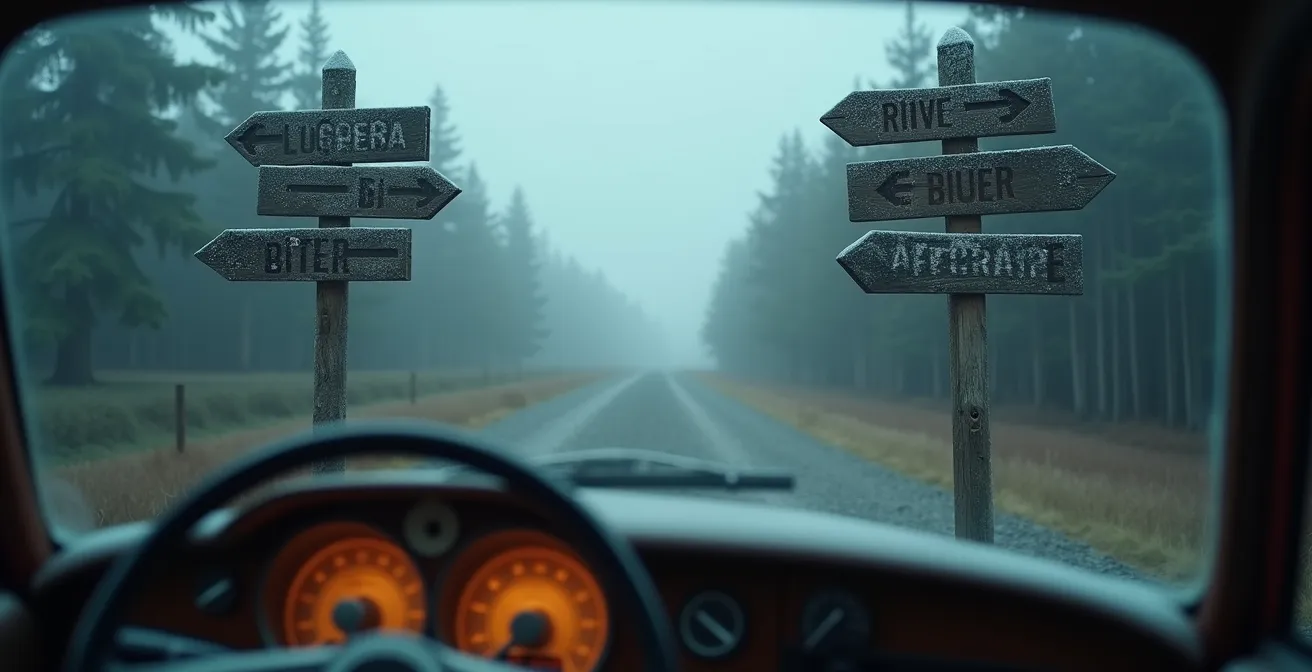
The most practical step you can take is to prepare for areas with spotty cell service and French-only signage. This means downloading offline maps for your destination and familiarizing yourself with a handful of essential navigation words before you go. Having these terms handy can be the difference between a stressful ordeal and a confident adventure.
Your Quebec Navigation Checklist
- Memorize key directional words: nord (north), sud (south), est (east), ouest (west).
- Learn critical road terms: sortie (exit), pont (bridge), autoroute (highway), and rue (street).
- Download offline Google Maps for your entire travel area before you leave Wi-Fi coverage.
- Keep a pre-written note in French: “Excusez-moi, je suis perdu(e). Pouvez-vous m’aider à trouver [your destination]?” (Excuse me, I’m lost. Can you help me find…?).
- Charge a portable power bank. Your phone is your lifeline for maps and translation, so ensure it stays powered.
By taking these simple preparatory steps, you turn a potential point of anxiety into an opportunity to interact with locals and experience the authentic helpfulness of rural communities.
When to Visit to Experience the Peak of Quebec National Pride?
To truly understand the depth of Quebec’s cultural identity, plan your visit to coincide with its national holiday, Saint-Jean-Baptiste Day, on June 24th. While Canada Day on July 1st is celebrated, for many Quebecers, “La Saint-Jean” is the true national celebration. This is the moment when the province’s pride in its language, history, and culture is at its most visible and vibrant. Originally a religious holiday honoring John the Baptist, it was transformed during the Quiet Revolution into a patriotic event celebrating the Québécois nation.
The celebrations are province-wide, with massive concerts, parades, and bonfires. The epicenter of the festivities is often Quebec City, where huge crowds gather on the historic Plains of Abraham for a massive free concert featuring the province’s biggest musical stars, all performing in French. The fleur-de-lis flag is everywhere, and the atmosphere is electric with a powerful sense of shared identity.
As a visitor, participating in Saint-Jean-Baptiste Day is an incredible immersion into the cultural mindset of Quebec. It’s an opportunity to witness firsthand the passion that has fueled the preservation of French in North America. While the holiday has a strong nationalistic component, particularly for those who support Quebec sovereignty, it is ultimately a joyous celebration that brings together Quebecers from all walks of life. Attending a local parade or concert, even if you don’t understand all the lyrics, allows you to feel the collective spirit in a way that no museum visit can replicate.
For an anglophone visitor, it’s a powerful lesson in what it means to be Québécois, offering a festive and profound context for the French language you hear all around you.
Why do Events in Canada Start With Acknowledging Traditional Territory?
When you attend a public event in Quebec, or anywhere in Canada, you’ll likely hear a statement at the beginning called a land acknowledgement. This practice recognizes the Indigenous peoples who have lived on this land since time immemorial, acknowledging that the event is taking place on their traditional and unceded territory. This is a formal act of respect and a crucial step in the ongoing process of reconciliation between settler and Indigenous peoples in Canada. It serves as a reminder of the deep, pre-colonial history of the land we now call Canada.
In Quebec, this history is woven directly into the landscape and language. It’s a powerful reminder that before the arrival of the French, this land was home to numerous First Nations and Inuit peoples. Their languages and knowledge shaped the very geography we navigate today. In fact, Quebec’s deep Indigenous heritage is reflected in the fact that close to 10% of Quebec’s official toponymy derives from Indigenous languages. Over 12,000 place names are inspired by their rich, descriptive imagery.
You see this heritage everywhere if you know where to look. As the official Bonjour Quebec tourism site explains, the name “Quebec” itself comes from the Algonquin word kebec, meaning “where the river narrows,” describing the dramatic landscape at Quebec City. The majestic Saguenay Fjord gets its name from an Innu term meaning “outflowing water.” Recognizing these origins adds another layer to your travels. It connects the French culture you’re exploring to an even older, foundational history. The land acknowledgement isn’t just a formality; it’s an invitation to see the land with deeper historical awareness and respect.
It’s an essential piece of the cultural puzzle, acknowledging that the story of Quebec did not begin with the arrival of European settlers, but is part of a much longer, continuous narrative.
Why Does Quebec Produce Raw Milk Cheeses That Are Illegal in the US?
Exploring Quebec’s culinary landscape, particularly its cheeses, reveals another facet of its fierce cultural independence. You’ll find an astonishing variety of world-class artisanal cheeses, many of which are made from raw (unpasteurized) milk. These cheeses are celebrated for their complex flavours, which are a direct expression of the local terroir—the unique combination of soil, climate, and pasture that gives agricultural products their distinct character. For a Quebec cheesemaker, using raw milk is not a risk; it’s an essential technique for creating a product with depth, personality, and a connection to the land.
This practice stands in stark contrast to regulations in the United States, where the FDA heavily restricts the sale of raw milk cheeses, requiring them to be aged for at least 60 days. This difference in food policy highlights a fundamental divergence in cultural philosophy. While the American approach prioritizes standardized safety, Quebec’s regulations place a high value on artisanal tradition and culinary heritage. This is seen as a form of food sovereignty—the right of a people to define their own food and agriculture systems.
By embracing raw milk cheesemaking, Quebec aligns itself more with traditional European practices, particularly those of France, than with the rest of North America. When you sample a raw milk Bleu d’Élizabeth or Pied-de-Vent, you are tasting more than just cheese. You are experiencing a delicious act of cultural preservation. It’s a statement that some traditions are worth protecting, even if they don’t fit the continent’s dominant industrial food model. Asking a fromager for a “fromage au lait cru” is a way to directly engage with this proud and delicious aspect of Quebec’s identity.
It demonstrates a commitment to preserving flavour and tradition, offering a tangible taste of the province’s unique place in North America.
Key Takeaways
- Approaching Quebec’s language with curiosity and respect is more important than achieving fluency.
- Cultural context is key: understanding the history of Joual, tipping customs, and national holidays transforms your interactions.
- Preparation is practical: downloading offline maps and learning a few key navigational terms prevents stress in rural areas.
How to Walk the Quebec City Walls to Understand the Strategic Defense of New France?
The fortifications of Quebec City are the only remaining fortified city walls in North America north of Mexico and are a UNESCO World Heritage site. Walking their 4.6-kilometre circuit offers more than just stunning views; it’s a journey through the military and strategic history that shaped the continent. A walk along these walls is a physical way to understand why the preservation of French culture here was possible: this rock was a nearly impregnable fortress.
A great place to start your walk is at the Saint-Louis Gate. From here, head south along the wall atop the Citadelle. You’re walking on the highest point of Cap Diamant, and looking down at the St. Lawrence River, you can immediately grasp Quebec’s strategic importance. This vantage point controlled all shipping traffic, effectively holding the key to the entire continent. The cannons you see are not just decorations; they are a stark reminder of the battles fought to defend New France.
Continue towards the Saint-Jean Gate. This section of the wall cuts through the vibrant Saint-Jean-Baptiste neighbourhood. As you walk, you’re tracing the line between the protected Upper Town and the bustling lower districts. Imagine soldiers patrolling this very path, watching for any threat from the west. Finally, descend towards the Artillery Park near the Palais station, where you can see barracks and military engineering facilities. This area was the industrial heart of the defense, where cannons were made and munitions stored. The entire walk is a narrative of defense, strategy, and survival, telling the story of how a small French colony held out against overwhelming odds for so long, cementing its cultural footprint forever.
Now that you have this deep cultural and historical context, start planning your trip not with apprehension, but with excitement for the authentic connections that await.