
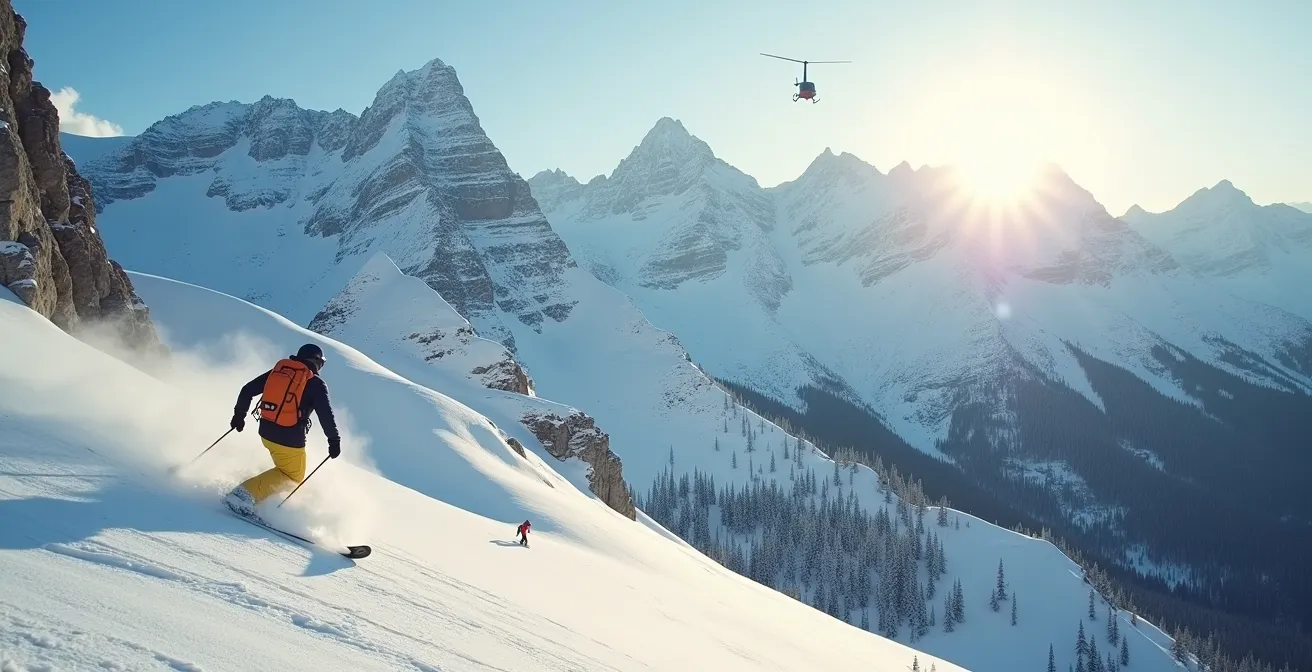
Your standard travel policy or credit card insurance almost certainly provides zero financial protection for heli-skiing or high-risk rafting in Canada.
- Policy exclusions for backcountry and high-risk activities are based on a quantifiable lack of professional oversight and infrastructure, not just the activity’s name.
- A signed liability waiver does not provide insurance; it legally transfers the assumption of risk to you, potentially even making you liable for the operator’s legal fees.
Recommendation: Never assume coverage. You must purchase a specific “adventure” or “sports” rider and get written confirmation from the insurer for the exact activity and location before your trip.
For many adventure travelers heading to Canada, the belief that their credit card benefits or standard travel insurance plan will cover them is a pervasive and dangerous assumption. You envision the thrill of dropping from a helicopter into British Columbia’s pristine powder or navigating the churning rapids of the Ottawa River, confident that you are “covered.” From an underwriter’s perspective, this confidence is misplaced. It stems from a fundamental misunderstanding of what a travel insurance policy is: not a blanket safety net, but a conditional financial contract.
The standard policy is designed to cover foreseeable, manageable risks—a lost bag, a flight cancellation, a broken leg from a fall on a hotel staircase. It is not priced or structured to cover activities where risk is not just present but is the core component of the product being sold. The fine print isn’t a formality; it is the operating manual of your financial liability. This guide will deconstruct the specific clauses, common errors, and financial realities that govern adventure sports coverage in Canada. The critical takeaway is not that these activities are uninsurable, but that your own assumptions, omissions, and misinterpretations are the primary liabilities that will lead to a claim denial, leaving you with catastrophic financial exposure.
This analysis will dissect the precise contractual reasons behind coverage exclusions, the legal implications of the waivers you sign, and the critical steps required to secure a policy that will actually respond in a worst-case scenario. We will examine the specific financial mechanisms and application pitfalls that every adventure traveler must understand before undertaking high-risk activities in Canada.
Summary: Does standard travel insurance cover heli-skiing or whitewater rafting in Canada?
- Why is resort skiing covered but backcountry skiing excluded in most policies?
- Why does standard travel insurance exclude backcountry skiing and climbing?
- What rights do you sign away when you initial that digital waiver at the rafting center?
- Heli-rescue vs. Ambulance: understanding the $10,000 difference if you get hurt remotely
- The application mistake that voids your coverage if you have a bad knee
- How to buy “adventure packs” to top up your standard insurance?
- Class III vs. Class IV rapids on the Ottawa River: which is right for a beginner?
- The panic mistake to avoid if you fall out of the raft in a rapid
Why Is Resort Skiing Covered but Backcountry Skiing Excluded in Most Policies?
From a risk assessment standpoint, the distinction between resort skiing and backcountry skiing is not a matter of semantics; it is a fundamental difference in an insurer’s ability to quantify and mitigate liability. A standard policy covers resort skiing because the environment is a controlled, managed system with predictable risk parameters. This system includes several key infrastructure elements that drastically reduce financial exposure for an insurer.
In a managed resort environment, you benefit from:
- Professional Ski Patrol: Resorts employ professional teams with response times often under 10 minutes, equipped for immediate triage and transport.
- On-site Medical Facilities: Most resorts have on-site clinics and defined, streamlined evacuation procedures to local hospitals.
- Systematic Avalanche Control: Resorts run extensive avalanche control programs using daily assessments and explosives to mitigate the single largest mountain risk.
The backcountry, by definition, has none of these. Risk is managed solely by the individual or a small group. Evacuation is not a streamlined process but a complex, multi-agency operation that often requires activating volunteer Search and Rescue (SAR) teams via the RCMP. Most critically, the cost of this evacuation is not part of a resort’s operational budget. A private helicopter rescue can cost, upwards of $2,500 per hour in B.C.’s mountains, a liability that standard policies are explicitly designed to exclude. The exclusion is not about punishing adventurers; it is a direct financial calculation based on the absence of a controlled, risk-mitigated environment.
Why Does Standard Travel Insurance Exclude Backcountry Skiing and Climbing?
Beyond the logistical challenges of rescue, the exclusion of backcountry skiing and climbing is rooted in the actuarial principle of unpredictable and unmanaged risk. An underwriter prices a policy based on vast pools of historical data. The data for incidents within a ski resort is plentiful and predictable. The data for backcountry incidents is sparse, highly variable, and subject to factors an insurer cannot control or model effectively, such as individual decision-making, weather volatility in remote areas, and the skill level of the party.
The core of the issue is the transfer of risk management from a professional entity (the resort) to an amateur (the policyholder). When you are climbing a remote peak or skiing an unpatrolled couloir, you are the sole party responsible for risk assessment, route-finding, and self-rescue. This introduces a level of moral hazard that standard policies are not designed to absorb. Your policy is a contract based on a certain level of predictable behaviour and environmental control; the backcountry invalidates these baseline assumptions.
However, this exclusion is not always absolute. The key for an underwriter is the re-introduction of professional oversight. This is why many adventure riders will cover high-risk activities under one critical condition: you must be with a licensed and certified guide. For instance, Heli and Cat Skiing are often covered if you are with a licensed tour operator. The guide, in this context, functions as a proxy for the ski patrol and avalanche control team at a resort. Their certification, experience, and operational protocols re-introduce a layer of professional risk management that allows an underwriter to quantify the liability and price the coverage accordingly. Without that professional oversight, you represent an unknown and unacceptable level of financial risk.
What Rights Do You Sign Away When You Initial That Digital Waiver at the Rafting Center?
A critical point of confusion for travelers is the distinction between a liability waiver and an insurance policy. They are not related; in fact, they serve opposing functions. As TuGo Travel Insurance bluntly states, “Don’t confuse the rafting company’s waiver with insurance! If you’ve signed a form, it’s likely not about insurance coverage. Signing a liability waiver will release the company of any responsibility, but won’t protect you.” The waiver is a legal instrument designed to protect the operator from you, not the other way around.
When you initial that waiver, you are participating in a legal concept known as “assumption of risk.” You are contractually acknowledging that the activity has inherent dangers and that you voluntarily accept the risk of injury or death, waiving your right to sue the operator for incidents arising from these inherent risks. However, the enforceability of these waivers can vary. In British Columbia, the Occupiers Liability Act makes waivers extremely powerful and they are frequently upheld by the courts. Conversely, Quebec’s Civil Code often voids clauses that waive a person’s rights in cases of bodily injury, offering significantly more consumer protection.
Most alarmingly, many waivers include an “indemnity clause.” This clause goes a step further than simply waiving your right to sue. It states that if your actions lead to someone else getting injured and that person sues the operator, you agree to cover the operator’s legal costs. This means you could be financially responsible for their lawyer’s fees, even if you were injured in the same incident. The waiver is a document that transfers legal and financial liability directly onto you, making personal insurance coverage not just advisable, but essential.
Heli-rescue vs. Ambulance: Understanding the $10,000 Difference if You Get Hurt Remotely
The financial consequences of an incident in a remote Canadian location are often orders of magnitude greater than in an urban or front-country setting. A traveler’s assumption that “rescue is covered” fails to differentiate between the types of emergency services and who bears the cost. A standard road ambulance trip in most provinces is heavily subsidized by provincial health plans, often resulting in a nominal fee for the patient. A helicopter rescue is an entirely different financial ecosystem.
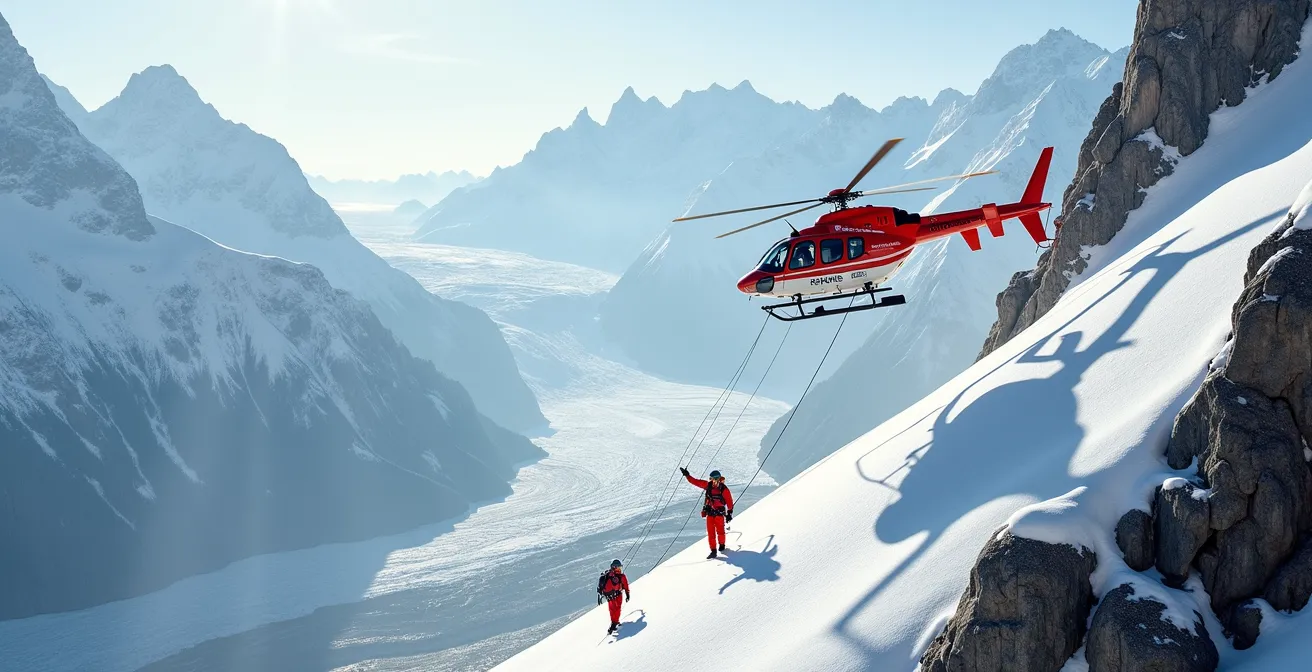
Private helicopter rescue, the most likely method of evacuation from a heli-skiing incident in areas like the Purcell Mountains, is not a government service. It is a private charter that bills by the hour, from the moment it lifts off to the moment it returns. These costs are not covered by provincial health insurance. While government-funded Search and Rescue (SAR) teams exist, they are a resource of last resort, activated by the RCMP only for life-threatening situations, and their availability is never guaranteed. You cannot simply call for a SAR helicopter. If you have an injury that is serious but not immediately life-threatening (e.g., a broken femur), the heli-ski operator will initiate a private rescue, and the bill will be directed to you.
This table illustrates the stark financial difference. As an analysis of remote evacuation costs shows, the financial gap between a provincially covered service and a private remote rescue is substantial. A basic insurance plan is built for the former, while only a specific adventure policy is structured to handle the latter.
| Service Type | Coverage by Provincial Health/Basic Insurance | Typical Cost | Who Pays |
|---|---|---|---|
| B.C. Road Ambulance | Yes (mostly covered) | $80 flat fee + mileage | Provincial insurance |
| Private Heli-Rescue (Purcell Mountains) | No | $2,500-$5,000+/hour | You (without adventure coverage) |
| Volunteer SAR (when available) | Government-funded | No direct bill | Government (life-threatening only) |
The Application Mistake That Voids Your Coverage if You Have a Bad Knee
One of the most common reasons for a denied claim has nothing to do with the incident itself, but with errors made on the insurance application. The legal principle at play is “material misrepresentation.” When you apply for a policy, you have a duty to disclose all “material facts” that could influence the insurer’s decision to offer you coverage or determine the premium. A pre-existing medical condition, such as a “bad knee” from an old sports injury, is a classic example.
Many policies have a “stability clause” for pre-existing conditions, requiring that the condition has been stable for a set period (e.g., 90, 180, or 365 days) before your trip. “Stable” is a precisely defined contractual term. If you have had changes in medication, seen a specialist, experienced new symptoms, or even had a physiotherapist appointment for that knee within the stability period, it may be deemed “unstable.” Failing to disclose this, even if it seems minor to you, can be grounds for the insurer to void the entire policy from inception. This means not only will they not cover the knee injury, they will not cover anything else—your lost luggage, your cancelled flights—because you breached the terms of the contract.
It is not the insurer’s job to investigate your health; it is your legal obligation to disclose it fully. Before you even apply, you must conduct a rigorous self-audit of your medical history against the policy’s specific definitions.
Action Plan: Pre-Application Medical Disclosure Audit
- Condition History: Have I seen a doctor or physiotherapist for this condition in the last 6-12 months as defined by the policy’s stability period?
- Medication Changes: Has my medication type or dosage for this condition changed in the last 90-180 days?
- Symptom Review: Have I experienced any new symptoms, or has the severity of existing symptoms changed recently?
- Medical Advice: Has any medical professional specifically advised against participating in this activity, or are there any restrictions on my file?
- Recent Diagnostics: Have I had any diagnostic tests (MRI, X-ray, etc.) for this condition, or am I currently awaiting test results or a specialist consultation?
How to Buy “Adventure Packs” to Top Up Your Standard Insurance?
Securing proper coverage for extreme sports is not about finding a single “do-it-all” policy, but about methodically layering a specific “adventure” or “sports” rider on top of a standard travel insurance plan. These top-ups are separate contracts or clauses that explicitly name and cover the activities excluded from the base policy. The process requires precision and verification.
First, identify providers in Canada that offer these specific riders. Companies like World Nomads, TuGo, and Ingle International are known for this, but their offerings differ significantly in what they cover by default versus what requires an additional premium. You must compare their definitions and limits for the specific activities you plan to undertake. The term “rafting” is insufficient; you need to know if they cover up to Class III, IV, or V rapids. “Skiing” is too broad; you need confirmation for “guided backcountry skiing” or “heli-skiing.”
A detailed comparison is crucial. A review of adventure insurance options shows that coverage is highly granular, with different terms for guided vs. unguided activities and optional add-ons for services like search and rescue.
| Provider | Heli-skiing Coverage | Rafting Class IV+ | Backcountry SAR | Key Feature |
|---|---|---|---|---|
| World Nomads | Yes (with upgrade) | Yes | Included | 250+ activities covered |
| TuGo | Yes (guided only) | Up to Class V | Optional add-on | All Class III automatic |
| Ingle | With sports pack | Yes | Available | Specialized extreme coverage |
Finally, and most importantly, you must obtain written confirmation from the insurer. Do not rely on a verbal conversation with a call center agent. Send a clear, specific email and save the response. This creates a documented record that can be crucial in the event of a claim dispute.
I will be heli-skiing with Canadian Mountain Holidays in the Bugaboos region of BC. Can you please confirm in an email that this specific activity and location are covered under policy X?
– Recommended script for insurance verification
Key Takeaways
- Your primary financial risk is not the activity itself, but a denied claim due to a misunderstanding of your policy, which is a conditional contract.
- Distinguish between provincially-covered ambulance services and privately-billed remote rescues (e.g., helicopter), which can exceed $5,000/hour and are not covered by standard insurance.
- Failure to disclose pre-existing medical conditions, even minor ones, can be considered “material misrepresentation,” allowing an insurer to void your entire policy.
Class III vs. Class IV Rapids on the Ottawa River: Which Is Right for a Beginner?
The International Scale of River Difficulty, a classification from Class I (easy) to VI (extreme and uninsurable), is not just a guide for thrill-seekers; it is a primary tool for insurance underwriters. Choosing an appropriate rapid class, particularly on a powerful river like the Ottawa, is a critical decision that has direct insurance implications. For a beginner, a Class III rapid is generally appropriate, while a Class IV is not.
The distinction lies in the required skill and the consequences of error. Class III rapids are described as having moderate, irregular waves, requiring good boat control. Passages are often clear and easily navigable. This level is considered “fun and splashy” and is typically covered by a standard adventure sports rider. The risk is manageable for a novice under professional guidance. Class IV rapids, however, are a significant step up. They are powerful, turbulent, and require precise, technical maneuvering. The consequences of a mistake, such as flipping the raft, are more severe. From an insurance perspective, this elevates the risk profile to a point where a standard adventure pack may no longer apply; it might require a specific, higher-premium rider that explicitly names Class IV+ coverage.
Any rapid classified as Class VI is almost universally deemed uninsurable by any policy, as they are considered extremely dangerous with a high likelihood of serious injury or death. Misrepresenting the class of river you intend to raft on an application, or choosing a trip above your stated or covered level, is another form of material misrepresentation that can void a claim.
| Rapids Class | Example Rapids | Difficulty | Insurance Coverage | Beginner Suitable |
|---|---|---|---|---|
| Class III (Middle Channel) | McCoy’s Chute | Fun and splashy, moderate waves | Standard adventure pack | Yes |
| Class IV (Main Channel) | The Bus Eater | Powerful, technical, precise maneuvering | May require Class IV+ coverage | No |
| Class II-III Mix | Soft adventure route | Gentle with occasional excitement | Often covered standard | Yes |
The Panic Mistake to Avoid if You Fall Out of the Raft in a Rapid
In the event of an involuntary swim in a rapid, panic is the most dangerous reaction. It leads to critical errors, the most common and perilous of which is attempting to stand up in moving water. This single mistake is the leading cause of a preventable and severe injury known as foot entrapment, where a person’s foot becomes wedged between submerged rocks. The force of the current can push the person’s body underwater, creating a life-threatening situation. Even if the rafting company’s marketing materials emphasize safety, the risks of injury are real and significant.
All rafters are required to know how to swim, maneuver the raft over and around rocks, and paddle through drops into turbulent waters―no easy feat! Even if the rafting company’s website says ‘it’s safe’, you’re taking on risks: sprained wrists, concussions, or worse.
– TuGo Travel Insurance, Whitewater Rafting Safety Guidelines
Rafting guides will brief all participants on the proper “safe swimmer’s position” before the trip. Internalizing this protocol is the most effective safety measure you can take. The procedure is counter-intuitive but essential for self-rescue and minimizing injury. Should you fall out of the raft, you must immediately fight the instinct to stand and instead adopt this defensive position.
The correct protocol involves these sequential actions:
- Immediately get on your back with your feet up and pointed downstream.
- Keep your feet at or near the surface to act as a bumper, deflecting off rocks.
- Use a backstroke motion with your arms to navigate towards calmer water, the shore, or back to the raft.
- Listen intently for your guide’s commands and look for a thrown rescue rope (throw bag).
- Never attempt to stand up until you are in water that is less than knee-deep and barely moving.
This disciplined response demonstrates to an insurer that you have taken reasonable steps to mitigate harm, which can be a factor in a claim assessment. Panic-induced errors can sometimes complicate a claim, especially if they are seen as a reckless disregard for briefed safety procedures.
Frequently Asked Questions About Canadian Adventure Sport Insurance
What’s the difference between ‘inherent risk’ and ‘gross negligence’ in waivers?
‘Inherent risk’ refers to dangers that are an unavoidable part of the activity, which you agree to accept by signing the waiver. ‘Gross negligence’ is a reckless disregard for safety by the operator, which a waiver generally cannot protect them from. However, proving gross negligence is a very high legal bar.
How do provincial differences affect waiver enforceability?
The legal power of a waiver varies significantly by province. In British Columbia, the Occupiers Liability Act makes waivers very difficult to challenge in court. In Quebec, the Civil Code provides stronger consumer protection, often voiding clauses that waive a person’s rights in cases of bodily injury.
What is an ‘indemnity clause’ in adventure sport waivers?
This is a clause where you agree to cover the operator’s legal costs if your actions cause a lawsuit. For example, if you cause an accident that injures another participant and they sue the company, you could be contractually obligated to pay the operator’s lawyer fees, even if you were also injured.