
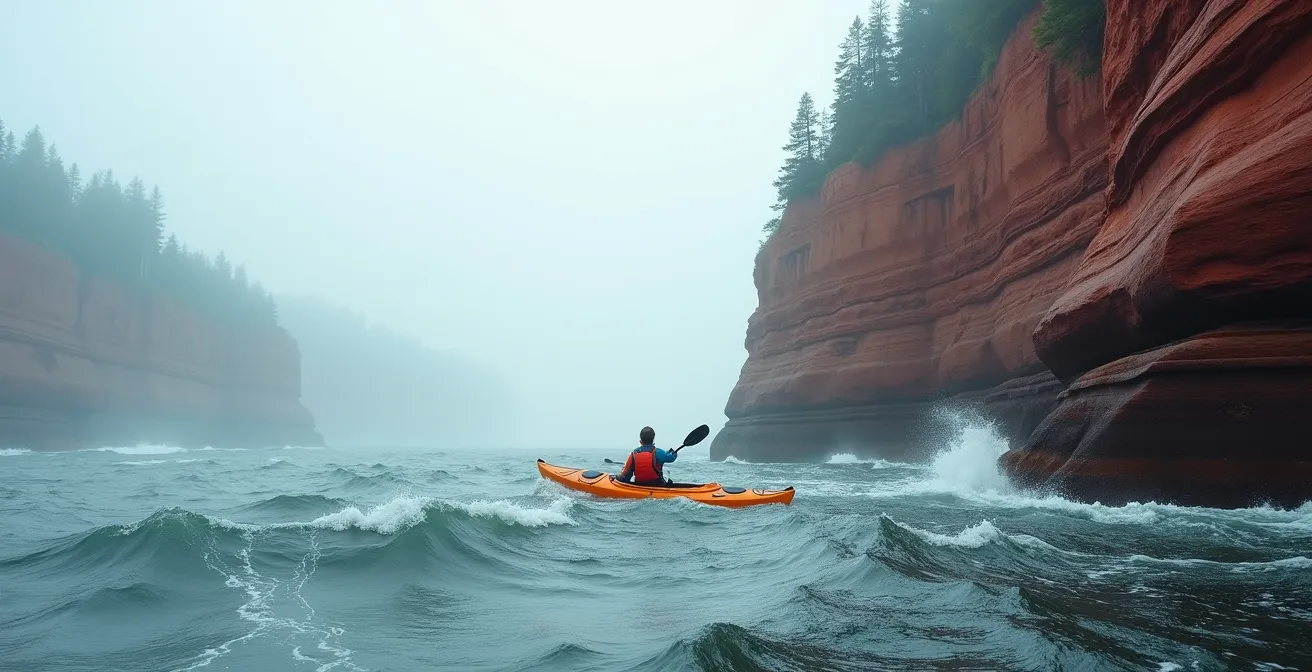
Contrary to what many intermediate paddlers believe, lake kayaking experience is not just insufficient for the Bay of Fundy—it’s a liability. Legal minimums do not equal safety here.
- The Bay of Fundy’s currents can exceed 10 knots, easily overpowering even the strongest paddler’s 2-3 knot speed.
- A proper sea kayak with sealed bulkheads and a spray skirt is required, and you must prove you can escape it if you capsize (a “wet exit”).
Recommendation: Do not attempt to paddle the Bay of Fundy without a guided tour or a valid Paddle Canada Level 2 (or equivalent) certification that proves your skills in self-rescue, navigation, and understanding tides.
For an intermediate paddler accustomed to the predictable calm of a lake, the allure of coastal exploration is a powerful next step. The dramatic cliffs and sea caves of Canada’s Bay of Fundy seem like the ultimate proving ground. You have a solid brace, a strong forward stroke, and you’ve handled choppy water before. This leads to a critical question: if you’re already a competent paddler, do you really need a formal certification just to rent a kayak for a day on the coast? The short answer is a strict and unwavering yes. The longer answer is that the question itself reveals a dangerous misunderstanding of the environment.
Many assume that ocean kayaking is simply lake kayaking on a larger scale. This assumption is the single greatest risk you will face. The Bay of Fundy is not a bigger lake; it is a complex and overwhelmingly powerful tidal engine governed by non-negotiable physics. Your strength and stamina, the very things that give you confidence on a lake, are rendered almost meaningless against its forces. Reputable outfitters on the bay don’t ask for certification to be difficult; they do it because they have a duty of care, and they know that without specific training, a confident intermediate paddler is often in more danger than a cautious novice on a guided tour.
This guide is not about basic paddling tips. It is a direct, safety-focused breakdown from an instructor’s perspective on why the skills that make you proficient on a lake are the very things that can put you in peril in the Bay of Fundy. We will dissect the forces at play, the mandatory equipment differences, the essential rescue skills, and the planning mindset required to survive, let alone enjoy, this magnificent but unforgiving environment.
To navigate this topic with the seriousness it deserves, this article breaks down the critical safety pillars. The following sections detail the exact reasons why uncertified paddling in the Bay of Fundy is not a risk worth taking, moving from the physics of the water to the specific skills you must possess.
Summary: Why Your Lake Skills Don’t Translate to the Bay of Fundy
- Why can a kayak be swept out to sea against the paddler’s strength?
- Why must you prove you can escape a capsized skirt before renting a closed-cockpit kayak?
- Stability or speed: which vessel is safer for coastal exploration?
- The navigation mistake of paddling without a compass in maritime fog
- How to plan your paddle so the wind helps you home rather than fighting it?
- How to operate a rental boat legally without a Pleasure Craft Operator Card?
- How to explore the St. Martins sea caves before the tide turns?
- How to hike the West Coast Trail without underestimating the mud and tides?
Why can a kayak be swept out to sea against the paddler’s strength?
The fundamental misunderstanding for lake paddlers is one of energy differential. On a lake, your primary opposition is wind. While challenging, it’s a force you can often overcome with strength and technique. The Bay of Fundy operates on a completely different scale. The danger isn’t the height of the tide, but the speed of the water moving to create that height. A fit paddler might sustain a speed of 2-3 knots. The Bay of Fundy, however, can produce a staggering 10+ knots peak current speed during its tidal exchange.
Imagine trying to run up a downward-moving escalator that is moving four times faster than you can run. Your maximum effort results in you moving backward. This is the reality of paddling against a dominant tide. It’s not a test of your endurance; it’s a battle of non-negotiable physics you will lose every time. Getting caught in an outgoing tide while trying to return to shore isn’t a matter of paddling harder; it can quickly become an impossible situation where you are helplessly carried out into the open bay.
This immense power also creates dangerous secondary effects unheard of on inland waters. Tide rips form where fast currents flow over shallow areas, creating chaotic, steep waves even on calm days. Eddy lines, the visible shear line between the main current and slower water behind a headland, can grab a kayak and spin it unexpectedly. Understanding these features isn’t academic; it’s a core survival skill.
Without the training to recognize, predict, and strategically use these currents—for instance, by paddling during slack tide or using eddies to rest—a paddler’s strength becomes a non-factor. This is the first and most important reason why uncertified paddling is forbidden by responsible operators.
Why must you prove you can escape a capsized skirt before renting a closed-cockpit kayak?
If the force of the current is the primary external hazard, the risk of capsize and cold-water immersion is the primary internal one. Sea kayaks require a spray skirt to prevent waves from swamping the cockpit. This skirt seals you into the boat. While essential for seaworthiness, it introduces a critical risk: if you capsize, you are trapped upside down underwater unless you can calmly and efficiently perform a “wet exit.”
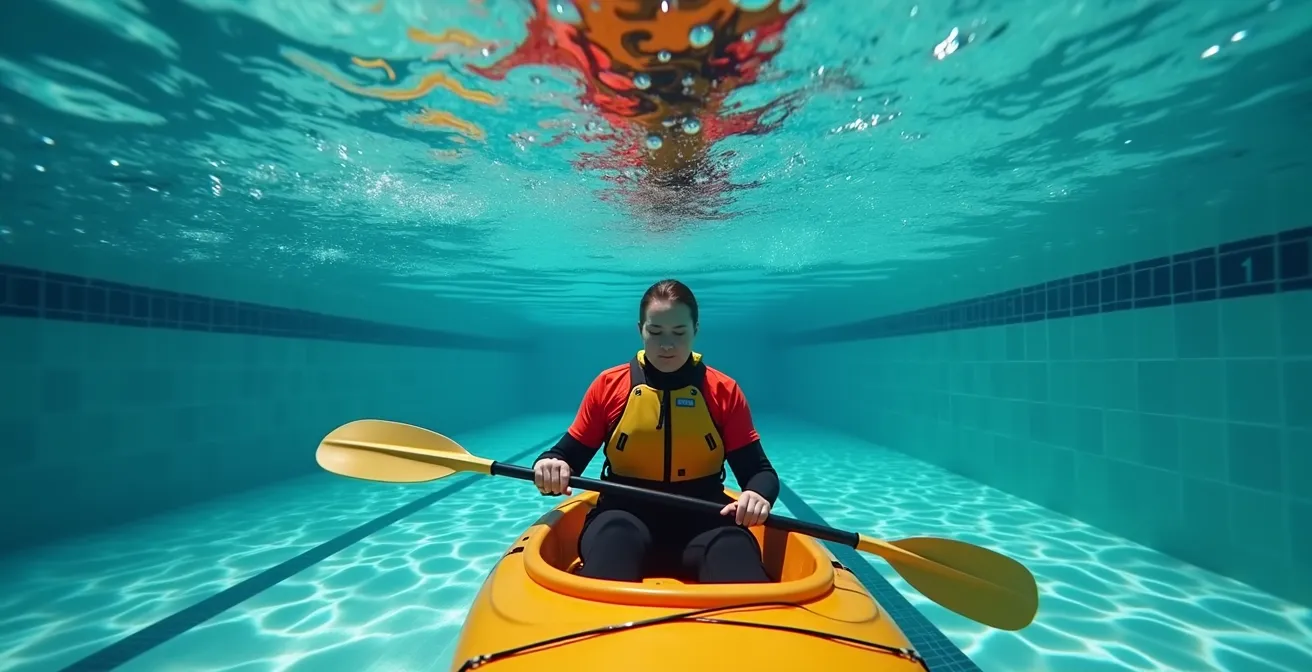
This isn’t a skill you can figure out on the fly. Panic is a natural response to being inverted in cold, dark water. A practiced wet exit is a muscle memory drill that overrides panic. You must know, without thinking, how to find the grab loop of your skirt, pull it forward and off, and push yourself out of the cockpit. Outfitters require a demonstration of this skill because the alternative is drowning. The water in the Bay of Fundy is cold year-round, with as little as 15 minutes of estimated survival time for an unprepared person. You do not have time to experiment.
As Baymount Outdoor Adventures notes in their safety policy, the risks are real and cannot be ignored. They state that while they “go to great lengths to manage the hazards inherent to sea kayaking on the Bay of Fundy, however, these risks cannot be completely eliminated.” This sober assessment from a top outfitter underscores the importance of a paddler’s own self-rescue capabilities. Proving you can perform a wet exit is the absolute minimum requirement of that capability. It is a non-negotiable prerequisite for being entrusted with the equipment in this environment.
Without this proven skill, you are a liability not only to yourself but to any potential rescuers. It is the single most important hands-on test of a paddler’s readiness for coastal waters.
Stability or speed: which vessel is safer for coastal exploration?
Paddlers transitioning from lakes often equate a “stable” feeling boat with a “safe” boat. In the context of sea kayaking, this is a dangerous misconception. The wide, flat-bottomed recreational kayaks popular on lakes have high primary stability; they feel solid and are hard to tip over on flat water. However, they have very low secondary stability, meaning once they are tilted past a certain point by a wave, they capsize abruptly and without warning.
A proper sea kayak is the opposite. It is longer (14-18 feet), narrower, and may feel “tippy” to a novice. This is because it has lower primary stability but extremely high secondary stability. This design allows a skilled paddler to lean the kayak onto its edge to carve turns and, more importantly, to remain stable and in control as waves pass underneath it. Furthermore, speed itself is a safety feature. The ability to make headway against wind or a moderate current can be the difference between reaching a safe harbour and being swept into a dangerous area. The length of a sea kayak is crucial for this efficiency.
The table below, based on an analysis of outfitter fleet choices, highlights the critical differences in vessel design that directly impact safety in a maritime environment.
| Feature | Lake/Recreational Kayak | Sea Kayak | Safety Impact |
|---|---|---|---|
| Length | 9-12 feet | 14-18 feet | Longer = better tracking, faster speed |
| Primary Stability | High (feels stable) | Lower | Deceptive comfort vs actual seaworthiness |
| Secondary Stability | Low | High | Critical for handling waves and lean turns |
| Bulkheads | Often none | 2-3 sealed compartments | Essential flotation if capsized |
| Deck Lines | Minimal | Full perimeter | Required for rescues |
| Rudder/Skeg | Rarely | Standard | Maintains course in wind/current |
One of the most critical and often overlooked features are sealed bulkheads. These are internal walls that create watertight compartments in the bow and stern. If you capsize and exit your kayak, a boat without bulkheads will fill completely with water, becoming almost impossible to get back into. A sea kayak with bulkheads will trap only a small amount of water in the cockpit, remaining afloat and enabling self-rescue or assisted rescue. Using a recreational kayak without bulkheads in the Bay of Fundy is an unacceptable risk.
Guides at FreshAir Adventure report that while paddlers new to sea kayaks initially feel unstable, they quickly appreciate the superior performance and control once trained. Their choice of 17-foot touring kayaks is a direct response to the demands of the Bay of Fundy, where speed can be a critical safety tool when crossing channels against strong currents.
The navigation mistake of paddling without a compass in maritime fog
The Bay of Fundy is famous for its propensity to generate thick maritime fog, often with little to no warning. For a paddler, being enveloped in fog is a profoundly disorienting experience. All landmarks vanish. The sound of waves breaking can echo in confusing ways. Without a reliable navigation tool, it is incredibly easy to paddle in circles or, worse, to paddle directly away from shore into the open bay.
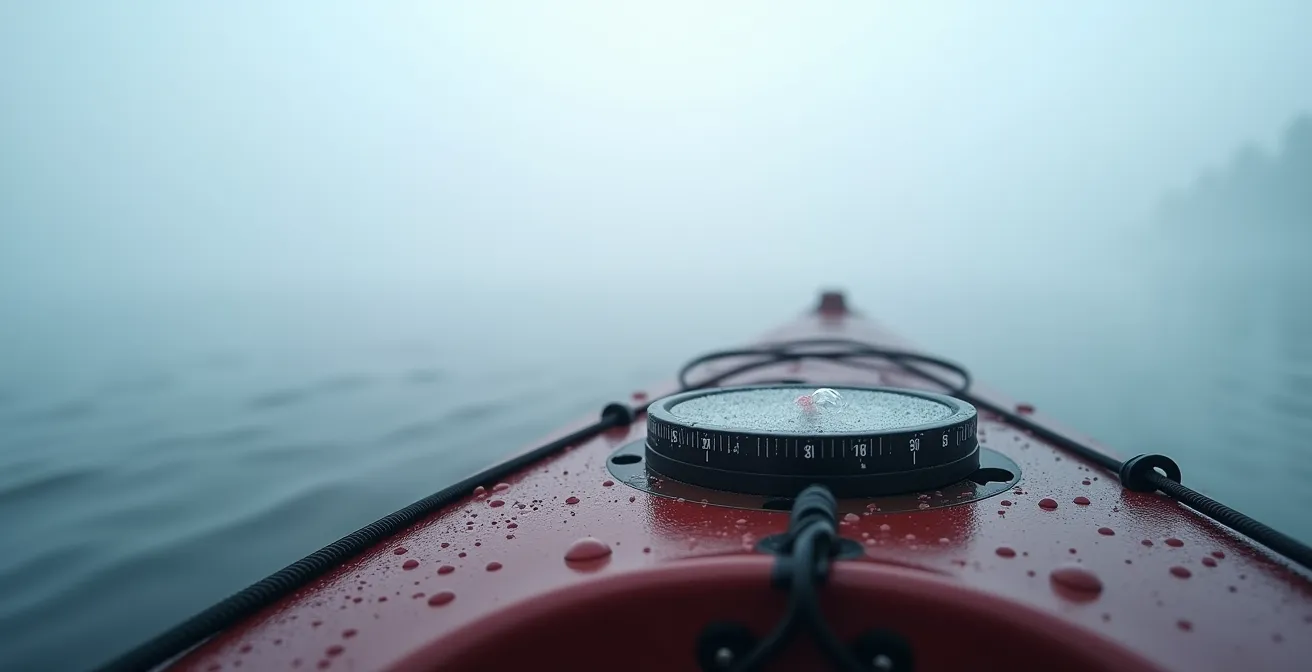
Relying on a GPS or a phone is a common but flawed strategy for intermediate paddlers. Batteries die, electronics fail in wet environments, and touch screens are useless with wet hands. The non-negotiable, primary navigation tool for a sea kayaker is a deck-mounted compass. It is hands-free, requires no power, and is unerringly reliable. It is not an accessory; it is a core piece of life-saving equipment.
Using it effectively, however, is a skill. You must know how to take a bearing to a landmark *before* the fog rolls in. You must understand how to account for lateral drift from the tide, which will push you sideways even as you paddle straight. A paddler who simply points their kayak at a compass heading without compensating for the current will miss their destination by a significant margin. This skill, known as “dead reckoning,” is a fundamental part of any sea kayaking certification.
Your Fog Navigation Action Plan: Key Points to Verify
- Points of contact: Before launching, take bearings to your destination and at least two “bail-out” points on shore. Note these on your chart.
- Collecte: Ensure your primary tool (deck compass) is mounted and functional, and you have a backup (waterproofed paper chart from the Canadian Hydrographic Service).
- Cohérence: Compare your intended course with the tide and current predictions. Will the current push you left or right? Add a correction angle (e.g., 10 degrees) to your bearing to compensate.
- Mémorabilité/émotion: Practice a sound signaling protocol. A loud whistle or horn blast every two minutes is the standard to alert other vessels to your position.
- Plan d’intégration: If fog sets in, trust your compass, not your instincts. Stick to the pre-planned bearing and do not deviate.
Ignoring this aspect of preparation is one of the most common and dangerous mistakes a lake paddler can make when transitioning to the coast. In the Bay of Fundy, what you can’t see can absolutely hurt you.
How to plan your paddle so the wind helps you home rather than fighting it?
On a lake, a paddler might start their journey by paddling with the wind at their back for an easy start, accepting they’ll have to fight it on the way home. In a sea kayaking context, this is a recipe for disaster. A tired paddler battling a headwind at the end of the day is in a vulnerable position. The core principle of safe sea kayak trip planning is to paddle out against the dominant force and return with it at your back.
This means checking the marine forecast not just for wind speed, but for wind direction. If a westerly wind is predicted for the afternoon, you plan a route that takes you west in the morning. The return trip becomes easier and safer as the wind helps push you home when you are most fatigued. Paddle Canada certification standards indicate that even 22-35 km/h moderate wind effects (12-19 knots) can make paddling extremely difficult and generate significant waves. You do not want to be fighting this on your return leg.
The situation becomes even more complex and dangerous in “wind-over-tide” conditions, where the wind blows in the opposite direction of the tidal current. This conflict creates unusually steep, choppy, and unpredictable waves that can easily capsize an unprepared paddler. A key planning skill is to time your paddle to avoid this. For example, if the tide is flowing east and a westerly wind is blowing, you are in a high-risk scenario. A certified paddler knows to wait for slack tide or for the tide to turn and run with the wind.
Case Study: Strategic Planning at Cape Chignecto
Tour guides at Nova Shores Adventures provide a perfect example of this principle in action. They consistently plan their trips to paddle out against the prevailing winds during a rising tide. This ensures the return journey, when their clients are most tired, is assisted by both the falling tide and a tailwind, making the paddle significantly easier and safer. Their guides explicitly note that wind opposing the tide creates hazardous conditions, especially around headlands, a risk they mitigate entirely through careful, proactive planning.
This strategic thinking—using environmental forces to your advantage—is a massive leap from the brute-force approach that might work on a lake. It is a mindset shift that is fundamental to safety.
How to operate a rental boat legally without a Pleasure Craft Operator Card?
There is often confusion regarding the legal requirements for paddling in Canada. The most commonly known license is the Pleasure Craft Operator Card (PCOC). It is crucial to understand that, under Transport Canada regulations, the PCOC is only required for operating a *motorized* pleasure craft. Human-powered vessels, including kayaks, canoes, and stand-up paddleboards, are exempt from this specific requirement.
This legal fact leads many intermediate paddlers to a dangerous conclusion: “If I don’t legally need a license, then I must be qualified to go.” This is the “legal vs. safe” fallacy. While you don’t need a PCOC, you are still legally required to have specific safety equipment on board. For most kayaks, this includes an approved PFD, a sound-signaling device (like a whistle), and a bailing device.
However, reputable outfitters in high-risk environments like the Bay of Fundy operate on a standard that goes far beyond the legal minimum. Their insurance providers and their duty of care demand it. They have the right and the responsibility to require proof of skill, which usually takes the form of a Paddle Canada certification or a skills demonstration. This is not to create a barrier; it is to ensure you have the skills to handle local hazards that Transport Canada’s generic rules don’t account for.
This philosophy is perfectly articulated by Jeremy Cline of OutdoorsNB, a respected local outfitter, who emphasizes their goal is to ensure you are both competent and confident. As he states on their website:
We want to ensure you are both competent and confident in that kayak. That’s why we are trained by professionals and are experienced in the Bay of Fundy
– Jeremy Cline, OutdoorsNB
In essence, the absence of a legal requirement for a PCOC does not grant you the right to rent a kayak in any condition. It simply means the government’s baseline is low. The outfitter’s baseline, grounded in local knowledge and experience, is what truly matters for your safety.
How to explore the St. Martins sea caves before the tide turns?
The St. Martins sea caves in New Brunswick are one of the Bay of Fundy’s most iconic paddling destinations. They offer a spectacular reward but also represent a significant hazard that encapsulates all the principles discussed so far. At high tide, the caves are completely flooded. Access is only possible by kayak during a brief window at low tide. Miscalculating this window is not an inconvenience; it can be fatal. The incoming tide floods the caves with incredible speed, and a paddler who lingers too long can be trapped inside with no escape.
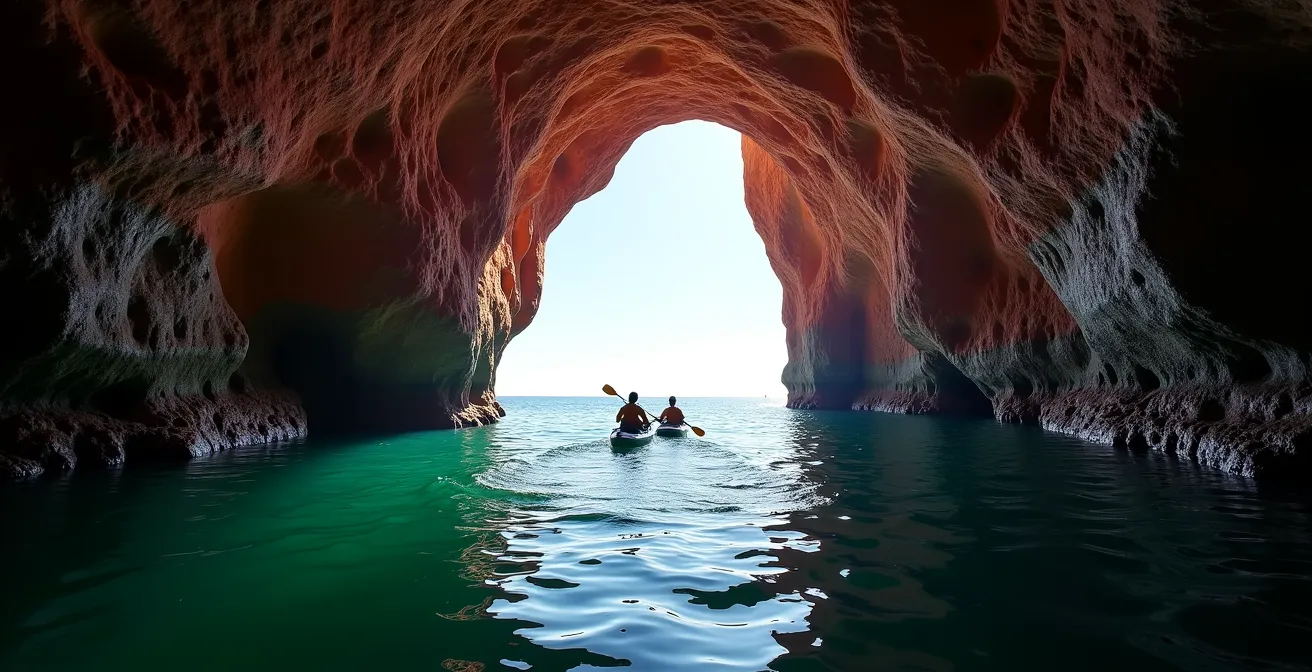
The only way to explore these caves safely is with a strict adherence to a timetable dictated by the official tide charts from Fisheries and Oceans Canada. Experienced guides recommend a narrow window of roughly 3 hours before and after low tide for safe exploration. A certified paddler knows how to read the tide table for St. Martins, identify the exact time of low tide, and then plan their entire paddle around that single point in time.
This means starting your paddle out well before low tide to arrive as the water is at its lowest, and more importantly, setting a hard “turnaround time.” You must be heading out of the main cave complex no later than two hours after low tide to ensure you have a safe margin to exit the area before the rising water blocks your way. You must also watch for environmental cues, such as the water beginning to lap higher on the cave walls or a noticeable increase in the speed of the current flowing into the caves. These are signs that your window is closing.
Exploring the sea caves is a tangible goal for many, but it must be approached with the discipline and knowledge of a certified paddler, not the casual curiosity of a tourist. It’s a final exam in environmental literacy where the consequences of failure are absolute.
Key Takeaways
- Your physical strength is irrelevant against the Bay of Fundy’s 10+ knot currents; only tidal planning ensures safety.
- A demonstrated wet exit is non-negotiable. If you can’t prove you can escape a capsized boat, you shouldn’t be in one.
- “Stable” recreational kayaks are dangerous in coastal waves. A long, narrow sea kayak with sealed bulkheads is the only safe option.
How to hike the West Coast Trail without underestimating the mud and tides?
To truly cement the concept of respecting tides, it is useful to look outside of kayaking at another iconic Canadian adventure: hiking the West Coast Trail (WCT) on Vancouver Island. Though a different activity in a different ocean, the gravest danger to hikers is identical to the one facing paddlers in the Bay of Fundy: a profound underestimation of the power and inevitability of the tides. The WCT has sections of beach that are only passable at low tide. Each year, numerous hikers require emergency evacuation because they misread tide tables or ignored their schedule and became trapped against impassable headlands by the rising water.
The root cause of these incidents is the same skill liability seen in paddlers. An experienced mountain hiker who is strong and fit may assume they can simply “hike faster” to beat the tide. They fail to understand that the tide is not a challenge to be overcome; it is a non-negotiable environmental schedule that dictates their movement. Their mountain skills are not directly transferable.
This parallel is powerful. Whether you are on foot on the Pacific coast or in a kayak on the Atlantic coast, mastery of Canadian tide tables is the paramount skill. It requires planning your entire day—every stop, every channel crossing, every cave exploration—around the precise schedule of high and low water. As the official Bay of Fundy Tourism advisory warns, “Kayaking Fundy’s waters should always be taken seriously and ideally be paddled with a guide. A blowing fog or an onshore wind on a falling tide can produce precarious conditions quickly.”
Ultimately, the certification required by Bay of Fundy outfitters is not about kayaking. It is about proving you have developed this fundamental respect and the literacy to read and abide by the rules of the ocean. Get certified, get a guide, or choose a calmer coast. But do not challenge the Bay of Fundy unprepared.
Frequently Asked Questions About Kayak Rentals in Canada
Do I need a Pleasure Craft Operator Card for a kayak?
No, the PCOC is only required for motorized vessels. Human-powered craft like kayaks, canoes, and SUPs are exempt from this federal requirement in Canada.
What safety equipment is legally required?
Transport Canada mandates that for most kayaks, you must have: an approved PFD for each person, a sound signaling device (like a whistle), and either a bailer or a manual water pump. For kayaks over 6 meters in length, a 15m buoyant heaving line is also required.
Can outfitters require certifications beyond legal minimums?
Yes, absolutely. Reputable outfitters, especially in hazardous areas like the Bay of Fundy, have a duty of care and insurance requirements that lead them to mandate higher standards. They will often require a Paddle Canada certification or an equivalent skills demonstration to ensure you can handle local conditions safely, a standard which far exceeds Transport Canada’s basic equipment rules.