
Contrary to popular belief, a beginner can safely experience Class IV rapids on the Ottawa River, but the key is understanding how it’s made safe, not just focusing on the thrill.
- Class IV rapids involve powerful hydraulics like “keepers,” but their physics are predictable and navigable with expert guide techniques.
- The Ottawa River’s uniquely warm summer water and deep channels significantly reduce the risks (like cold shock) associated with falling out compared to other Canadian rivers.
Recommendation: Instead of choosing based on a number, choose based on the experience you want: an active, high-participation ride in a smaller sport raft (often in Class III) or a big-wave, high-stability adventure in a larger raft through Class IV.
The question hangs in the air at every rafting outpost in the Ottawa Valley: “Should we do the ‘gentle’ trip or the ‘extreme’ one?” For a first-time rafter, the line between Class III and Class IV rapids feels like a chasm. On one side is the promise of excitement; on the other, a genuine fear of the raw power of whitewater. You want the visceral thrill you’ve seen in videos, but the thought of being thrown into a churning, angry river is terrifying. Most guides will give you the standard definitions of the international scale of river difficulty, talking about wave size and maneuverability. They’ll tell you to “listen to your guide” and “paddle hard.”
But this advice misses the core of your question. It doesn’t calm the fear of the unknown. As a guide, I can tell you the real secret to choosing the right trip isn’t about your bravery; it’s about understanding. The key to replacing fear with confidence lies in appreciating the physics of the river and the engineered system of safety—from raft design to guide training—that allows us to navigate it. The difference between Class III and IV isn’t just “bigger waves”; it’s a difference in water dynamics, paddling technique, and the type of experience you’ll have.
This guide will take you inside the mind of a river guide. We’ll break down the forces at play, explain the safety protocols for when things go wrong, and demystify the intimidating features of the river. By the end, you won’t just be choosing a number; you’ll be making an informed decision about the kind of adventure that truly fits you, armed with respect for the river, not fear of it.
Summary: Your Guide to Ottawa River Rapids
- Why Does the Raft Get Stuck in a “Keeper” and How Do Guides Get It Out?
- Active Paddling or Holding On: Which Experience Is More Visceral?
- Warm Deep Water or Glacial Freeze: Which River Offers a Better Summer Experience?
- The Panic Mistake to Avoid if You Fall Out of the Raft in a Rapid
- When to Book to Experience the Highest Water Levels of the Year?
- The Swimming Error That Leads to Cold Water Shock in July
- Stability or Speed: Which Vessel Is Safer for Coastal Exploration?
- Do You Need a Certification to Rent a Sea Kayak in the Bay of Fundy?
Why Does the Raft Get Stuck in a “Keeper” and How Do Guides Get It Out?
The term “keeper hydraulic” is whispered with a mix of fear and awe. It’s one of the defining features of a Class IV rapid and a primary source of anxiety for new rafters. So, what is it? A keeper isn’t a monster; it’s a feature of fluid dynamics. It forms when water flows over a submerged object (like a rock ledge), creating a powerful, recirculating current that flows back on itself. This backwash can be strong enough to hold a person or even a raft. Understanding this is the first step to respecting, not fearing, it.
The image below shows a cross-section of this phenomenon. You can see how the surface water is actually flowing upstream, back toward the feature that created it. This is the “keeper” effect. It feels unnatural, and that’s what makes it dangerous if you don’t know what you’re dealing with. A guide’s job is to read the river’s surface and identify these features from a distance, choosing a line that avoids the most powerful part of the hydraulic or uses its energy to help pivot the raft.

So how do we get a raft out if it gets stuck? It’s not about brute force; it’s about technique. The primary method is to get weight to the downstream edge of the raft, sinking it just enough to catch the outbound current flowing underneath the surface hydraulic. This is why you’ll hear guides yelling “Get down!” or moving paddlers around the boat. Other techniques involve using “throw bags” (ropes) from shore or another raft to pull the boat free. Every guide has trained extensively in these extraction scenarios. The keeper is a powerful feature, but it’s a known quantity with established rescue protocols.
Active Paddling or Holding On: Which Experience Is More Visceral?
The type of rapid you’re in often dictates the type of rafter you become: an active participant or a passenger holding on for the ride. This choice is at the heart of the Class III vs. Class IV experience. Class III rapids, often found on the Ottawa’s Middle Channel, are typically more technical. They require precise maneuvering through a maze of rocks and waves. In this environment, active, synchronized paddling is crucial. You are part of the engine, following your guide’s commands to power through cross-currents and pivot around obstacles. The thrill is one of teamwork and finesse.
Class IV, found on the Main Channel, is about navigating massive waves and powerful features. Here, there are moments of intense, all-out paddling followed by commands to “Hold on!” or “Get down!” as the raft plows into a wall of water. The experience is less about technical precision and more about power and survival. As one operator notes, some companies use smaller rafts to amplify this feeling. An analysis of rafting on the Ottawa points out that sporty, six-person rafts guarantee a wet and wild ride, making every wave feel enormous and turning even smaller rapids into a rodeo. This choice of a smaller boat forces a more visceral, hands-on experience.
Ultimately, neither is “better,” they are just different kinds of thrill. The visceral feeling of being a critical team member, digging your paddle in to miss a rock by inches, is a different sensation from the heart-pounding moment of bracing as a wave the size of a car crashes over the bow. The commands a guide gives reflect this:
- Active paddling: You’ll constantly follow your guide’s synchronized paddle commands to navigate through waves and currents.
- “Bump” command: You’ll lean in and place your paddle’s T-grip on the floor for stability when the raft is about to intentionally hit a rock.
- “Hold on!” moments: You’ll grip the outside safety line with all your might during major drops or when surfing a wave.
- Recovery position: You’ll be expected to get back into your seat immediately after a big hit, ready for the next paddle command.
Warm Deep Water or Glacial Freeze: Which River Offers a Better Summer Experience?
For a beginner, one of the biggest sources of fear is the water itself. Specifically, the cold. Many of Canada’s most famous whitewater rivers are fed by glacial melt, making an unexpected swim a genuinely shocking and potentially dangerous experience. This is where the Ottawa River stands in a class of its own. Thanks to a series of dams upstream that create large, sun-drenched lakes, the Ottawa is one of the warmest whitewater rivers in the country. In mid-summer, the water is not a threat; it’s a treat.
A swim in the Ottawa in July or August is refreshing, not terrifying. This single factor dramatically changes the beginner experience. The fear of falling in is lessened when the consequence is a pleasant dip rather than a gasp-inducing shock. As monitoring data shows, the swimming season in Ottawa lasts from July to August, with water temperatures staying comfortably above 20°C. This makes a huge difference in confidence.
This warmth is a stark contrast to other iconic Canadian rafting destinations. A quick comparison highlights just how unique the Ottawa is for a summer trip:
| River | Summer Temperature | Gear Required |
|---|---|---|
| Ottawa River | 22°C (71°F) | Splash top/thin wetsuit |
| Kicking Horse River (BC) | 4°C (39°F) | Full drysuit mandatory |
| Jacques-Cartier River (QC) | 10°C (50°F) | Thick wetsuit required |
Furthermore, the Ottawa’s deep channels provide another confidence boost. Unlike “bony” rivers with many shallow, rocky sections, the Ottawa is generally deep. This means that if you do go for a swim, you are far less likely to come into contact with the riverbed. This combination of warm and deep water makes the Ottawa River an ideal playground for learning to handle whitewater.
The Panic Mistake to Avoid if You Fall Out of the Raft in a Rapid
Despite all the training and skill, swimmers happen. It’s a part of rafting. Knowing what to do in this situation is the single most important piece of safety information you will learn. The instinct, when your feet touch the bottom in a moving current, is to try and stand up. This is the absolute biggest mistake you can make, and it can have severe consequences.
River guides are unequivocal about this rule. As one set of professional guidelines states clearly:
NEVER stand up in moving current. Most guides never walk in water over their shins. This prevents a situation called ‘Foot Entrapment’ which is where you put your size 9 foot in a size 8 hole or crack in the bottom of the river.
– Raft Masters Safety Guidelines, 10 Whitewater Rafting Safety Tips
Once your foot is trapped, the force of the current against your body can push you face-down into the water, making it impossible to get back up. This is why the first thing you learn is to fight that instinct and adopt the “Whitewater Swimmer’s Position,” also known as the “Floating Position.” This defensive posture is your primary tool for self-rescue.
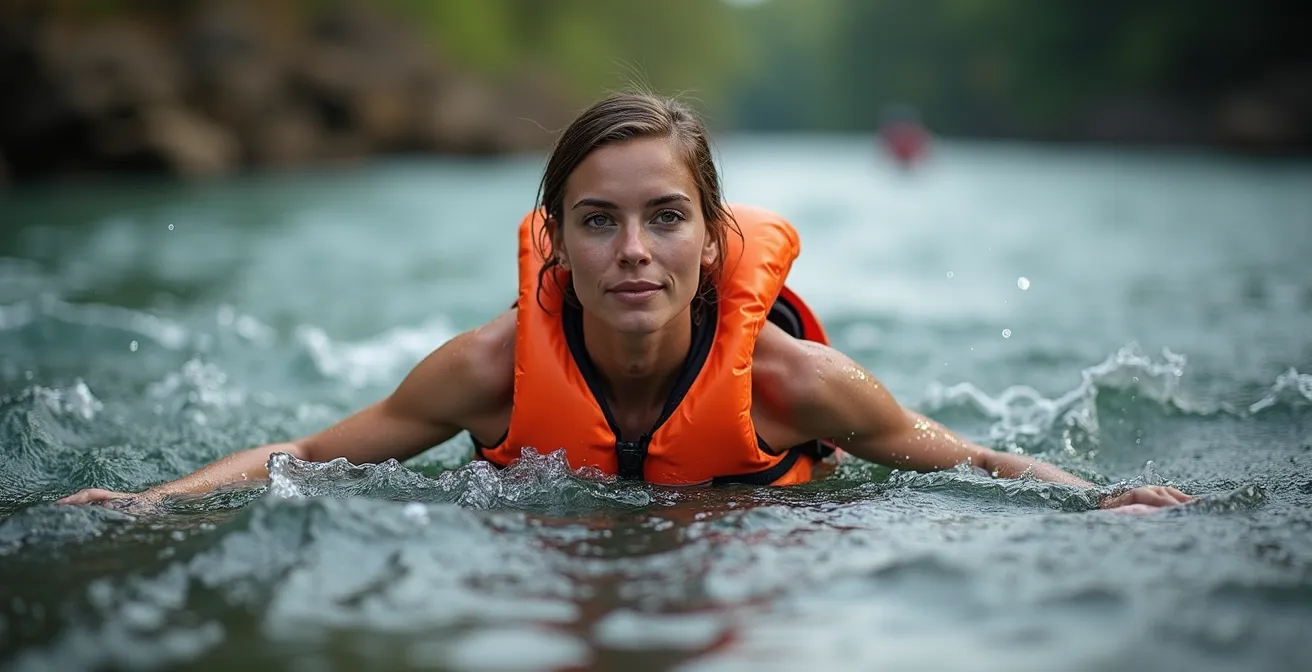
As the image demonstrates, this position turns you into a human buoy. Your life jacket (PFD) does the work of keeping you afloat, while your body position protects you from the two biggest dangers: foot entrapment and head injuries. It allows you to breathe, see where you’re going, and use your feet to fend off rocks. Mastering this position in your head before you even get on the water is a powerful way to build confidence.
Your Action Plan: The Whitewater Swimmer’s Position
- Float on your back with your arms outstretched for balance and your feet up at the surface, pointing downstream.
- Keep your face and toes out of the water, creating a “toes to nose” line of sight.
- Use this position to get oriented, take a breath, and push off any obstacles with your feet.
- Once you have your bearings and are in calmer water, transition to an active swimming position (on your front) and swim towards the raft or shore.
When to Book to Experience the Highest Water Levels of the Year?
The character of the Ottawa River changes dramatically throughout the season, and this is almost entirely due to one factor: water volume. The same rapid can feel like two completely different beasts in May versus August. The volume of water is measured in cubic meters per second (CMS), and understanding this metric is key to choosing your thrill level. If you are seeking the biggest, most powerful waves, you need to come during the spring freshet.
From May to mid-June, the melting snowpack from Algonquin Park and the surrounding watershed floods into the river system. This is when the river is at its peak, transforming the rapids into enormous, churning wave trains. It’s not uncommon for spring flows to reach in excess of 4,500 CMS. At these levels, some of the rockier, more technical rapids of the summer completely disappear under the volume, replaced by “bus-sized” hydraulics that can swallow a raft whole. This is a powerful, big-water experience that attracts thrill-seekers from around the world. It is the absolute peak of Class IV and even touches on Class V intensity.
In contrast, the summer season offers a completely different, though no less exciting, experience. From late June through September, water levels drop to a more consistent and manageable flow. Summer levels are often around 250 CMS. At this volume, the river reveals its technical side. More rocks are exposed, creating more complex and challenging lines for guides to navigate. The waves are smaller but steeper, and the pace is often faster and more continuous. For a beginner, summer levels are generally more reassuring, as the sheer power of the river is less overwhelming, and the warm water makes for pleasant swimming.
The Swimming Error That Leads to Cold Water Shock in July
The term “cold water shock” is a serious one in the world of watersports. It refers to the body’s involuntary gasp reflex upon sudden immersion in cold water, which can lead to inhaling water. It’s a valid concern on many of Canada’s rivers, but it’s a fear that is largely misplaced on the Ottawa River during peak summer. As we’ve established, the Ottawa in July and August is exceptionally warm for a whitewater river. Data confirms that during July, the Ottawa River maintains temperatures above 21°C+ (70°F+), a level generally considered outside the danger zone for a sudden, severe cold shock reflex for a healthy adult.
So, if the water isn’t dangerously cold, what is the real swimming error to avoid? It’s panic. Panic is the catalyst that turns a simple swim into a dangerous situation. When you fall into a rapid, the experience is disorienting. The noise, the current, and the surprise can trigger a fight-or-flight response. This is when you forget your training. You might try to stand up (the cardinal sin), flail wildly instead of getting into the swimmer’s position, or try to swim against the current, exhausting yourself.
The most important thing to do is to take one second to get your bearings. Your PFD is doing its job; you are buoyant. The goal is to override the panic with a trained response: get on your back, get your feet up, locate the raft, and listen for your guide’s instructions. A calm swimmer is a safe swimmer who can be easily rescued. A panicking swimmer is a liability to themselves and their rescuers. On the warm Ottawa in July, the greatest danger isn’t the temperature; it’s your own state of mind. Acknowledging this and preparing mentally is a massive step towards a safe and enjoyable trip.
Stability or Speed: Which Vessel Is Safer for Coastal Exploration?
While the title mentions coastal exploration, the principle of vessel choice is central to your Ottawa River experience. The type of raft you are in is a critical piece of safety equipment that directly influences stability and the intensity of your ride. On the Ottawa, you will generally find two main options: large, high-volume rafts (often holding 12 people) and smaller, sportier rafts (holding 6-8 people). The choice between them is a trade-off between stability and agility.
The 12-person “big rafts” are the battleships of the river. Their size and volume make them incredibly stable. They are much less likely to flip and can punch through massive waves and hydraulics on the Class IV Main Channel, like the infamous “Bus Eater” or “White Faced Monster.” For a first-timer who is apprehensive about the power of big water, a seat in a big raft offers a huge sense of security. You are part of a larger, more stable craft, which can feel very reassuring when navigating the river’s biggest features.
On the other hand, the 6-person “sport rafts” are the sports cars of the river. They are more agile, quicker to maneuver, but also far more “flippable.” They are often used on the more technical Class III rapids where precision is key, but some outfitters run them on the Main Channel for a guaranteed high-intensity ride. In a sport raft, you feel every wave and current. The ride is wetter, wilder, and demands more from each paddler. A flip in a sport raft is a more common and almost expected part of the adventure.
This table breaks down the key differences based on raft size:
| Raft Type | Capacity | Stability Factor | Best For |
|---|---|---|---|
| 12-person big raft | Up to 13 people | High stability, less likely to flip | Class IV Main Channel |
| 6-person sport raft | 6-8 people | More agile but flippable | Class III technical rapids |
Key Takeaways
- Your biggest safety asset in a rapid is the Whitewater Swimmer’s Position: on your back, feet up, and pointing downstream. Never try to stand up in moving water.
- The Ottawa River’s warm summer water (22°C/71°F) and deep channels make it uniquely forgiving for beginners compared to cold, rocky Canadian rivers.
- The choice between Class III and Class IV is also a choice of experience: active, technical paddling in a smaller raft (often Class III) versus big-wave power and stability in a larger raft (often Class IV).
Do You Need a Certification to Rent a Sea Kayak in the Bay of Fundy?
The question of certification is often on people’s minds, but for a commercial rafting trip, the focus isn’t on you—it’s on your guide. You don’t need any certification to be a passenger in a raft. However, the person at the helm holding your life in their hands is subject to incredibly stringent training and certification standards. Understanding the level of expertise required to be an Ottawa River guide is perhaps the most reassuring fact of all.
Being a commercial river guide in Ontario and Quebec is a highly professionalized career. Guides are not just weekend hobbyists; they are trained and certified rescue professionals. The cornerstone of this training is swiftwater rescue. As noted by industry experts, the Rescue 3 International Swiftwater Rescue Technician Level 1 Certification is considered the legal standard of care in Canada. This intensive, multi-day course involves hands-on training in river dynamics, rope systems, and complex rescue scenarios.
But that’s just the beginning. The list of required qualifications is extensive, ensuring that your guide is prepared for any situation the river might present. They are trained first responders with an intimate, first-hand knowledge of every current and eddy on their stretch of the river.
- Rescue 3 International Swiftwater Rescue Technician (SRT-1): The global standard for professional river rescue.
- Wilderness Advanced First Aid (WAFA): A minimum of 40 hours of training focused on medical emergencies in remote settings.
- License from the Ministry of Natural Resources (Ontario): A legal requirement to guide commercially in the province.
- Professional River Outfitters Association (PROA) Certification: An industry body that upholds standards of safety and professionalism.
- Company-Specific Training: Every guide undergoes weeks of training on the specific rapids of the Ottawa River with their outfitter before ever taking a commercial client.
Ultimately, the choice between Class III and Class IV is a personal one, but it should be an informed one. By understanding the forces at play, the forgiving nature of the Ottawa’s warm water, and the immense training of your guide, you can move past the fear of the unknown. The next step is to have an honest conversation with a rafting outfitter. Tell them about your comfort level and the experience you’re seeking—they will help you find the perfect trip that delivers the thrill you want with the safety you need.
Frequently Asked Questions About Ottawa River Rafting
When is the Ottawa River warm enough for comfortable swimming?
The swimming season in Ottawa lasts from July to August. During those months, the Ottawa River water temperature does not drop below 20°C (68°F) and is therefore suitable for comfortable swimming without extensive gear.
Why is the Ottawa River warmer than other Canadian whitewater rivers?
The Ottawa River is significantly warmer than glacier-fed rivers like those in the Rockies because its flow is regulated by a series of dams upstream. These dams create large, relatively shallow lakes where the water is held and warmed by the sun before being released, ensuring consistent and warm flows throughout the summer.
How does the Ottawa River’s depth affect the swimming experience?
The Ottawa’s deep channels are a major advantage for beginners. Unlike “bony” rivers with many hidden rocks in shallow sections, the Ottawa’s depth means a person who falls out of the raft is much less likely to make contact with the riverbed, reducing the risk of injury and increasing swimmer confidence.