
In summary:
- Treat Nuit Blanche as an endurance event, not a completist’s checklist; quality of experience trumps quantity of sights.
- Commit to one or two adjacent art zones. Crossing the city is the most common and draining strategic error.
- Plan your logistics—transportation, refuelling, and rest stops—as rigorously as you plan your art route.
- Your exit is as important as your entrance. Decide on your 3 AM departure plan before you even leave home.
The pre-dawn chill, the sprawling queues, the faint sense of panic as 3 AM approaches—this is the quintessential Nuit Blanche Toronto experience for the unprepared. Every year, art lovers descend upon the city with ambitious checklists, determined to absorb a year’s worth of culture in a single twelve-hour marathon. The common advice is predictable: wear comfortable shoes, check the weather, and stay hydrated. While sensible, this counsel misses the fundamental truth of the event. To truly conquer Nuit Blanche is not to see everything, but to experience the right things deeply.
The secret is to shift your mindset from that of a tourist to that of a strategist. This isn’t an art crawl; it’s an exercise in artistic endurance. Success is measured by the quality of your engagement and the energy you have left for that final, breathtaking installation, not by a frantic box-ticking race across Toronto. The greatest mistake is believing you can do it all. The greatest victory is achieving a state of flow through ruthless curation and logistical precision.
This guide abandons the futile “must-see” lists. Instead, it provides a strategic framework for your night. We will explore how to choose art that matches your interaction style, leverage public transit like a seasoned local, make the critical decision of which urban vibe to anchor your night around, and, most importantly, how to build a route that respects the ultimate constraint: the 3 AM finish line. It’s time to stop chasing art and start choreographing your experience.
To navigate this sprawling cultural marathon, we’ve structured this guide to help you build a master plan, from choosing your art style to orchestrating your final exit. Explore the key strategies below to make your Nuit Blanche a triumph of curation, not exhaustion.
Summary: A Curated Path Through Nuit Blanche Toronto
- Why are Nuit Blanche exhibits designed to be touched or walked through?
- How to use the extended subway hours safely during the art festival?
- Classic collection or contemporary edge: which gallery anchors your art trip?
- The error of trying to cross the whole city instead of focusing on one zone
- Where to find 24-hour cafes to refuel during the all-nighter?
- Serigraph or cedar: which investment holds its value better?
- Gritty multiculturalism or historic structure: which tour vibe do you prefer?
- Montreal, Toronto, or Vancouver: which city suits your travel style best?
Why are Nuit Blanche exhibits designed to be touched or walked through?
The immersive nature of Nuit Blanche installations is not a gimmick; it’s a philosophical choice to dissolve the barrier between the art and its audience. Unlike a traditional gallery where art is revered from a distance, these pieces demand your presence as a final, activating ingredient. They are conceived as temporary, living ecosystems rather than static objects. This interactivity invites a more profound, multi-sensory engagement, but it also requires you to be a more discerning viewer. The first act of curatorial ruthlessness is not deciding what to see, but what *kind* of experience you are seeking.
Are you a quiet observer, a hands-on participant, or a documentarian hunting for the perfect shot? Answering this question is the first step to building a satisfying route. Choosing an installation that aligns with your personal interaction style prevents a common Nuit Blanche pitfall: waiting in a long line for an experience you’re not emotionally or physically prepared to enjoy. Answering this question honestly allows you to filter the official program through the lens of your own desired journey, transforming a generic map into a personal itinerary.
To help define your approach, consider these archetypes:
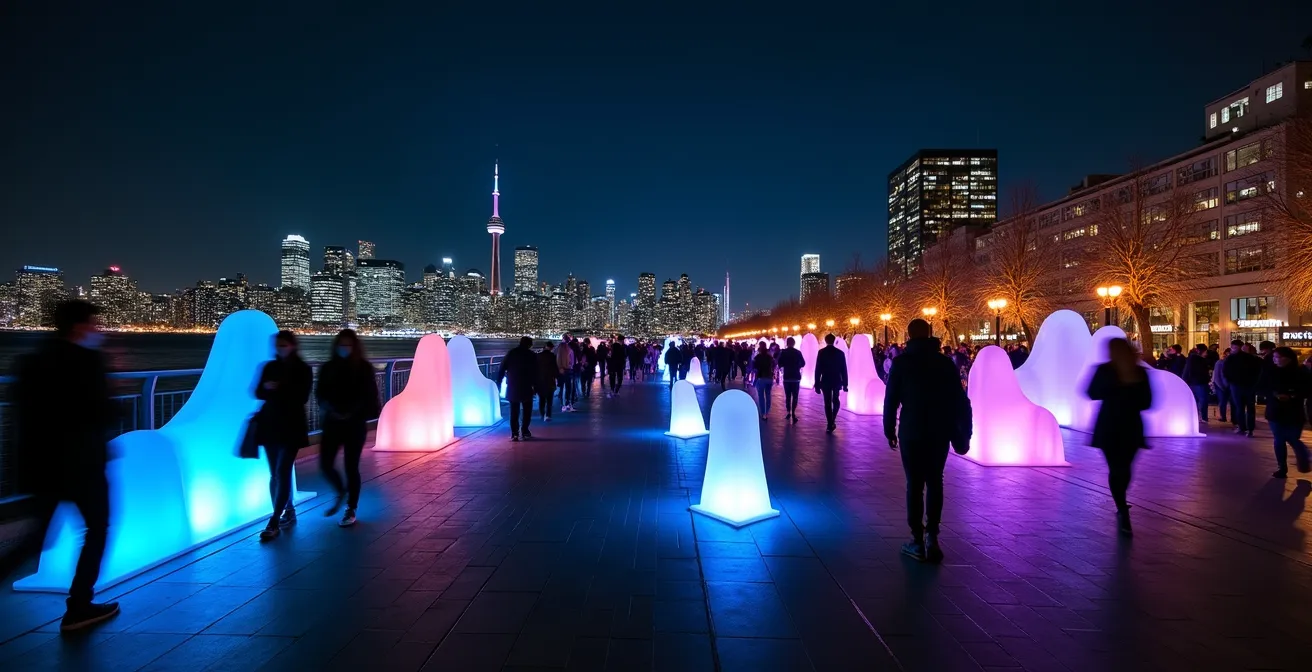
- The Spectator: You prefer to absorb the scale and atmosphere without direct physical contact. Focus on large-scale projections or waterfront installations like Shannon Garden-Smith’s past sand patterns, which can be appreciated from multiple angles without queuing. Your comfort with crowds is moderate.
- The Participant: You thrive on being part of the art. Your energy is high, and you seek pieces that require physical engagement or collaborative action. These often have the longest lines but offer the highest reward for your style.
- The Documenter: Your goal is to capture the beauty of the night. You should prioritize visually striking, photogenic installations. Floating sculptures or pieces with dramatic lighting are your primary targets, but be prepared for crowds of like-minded individuals.
- The Contemplative: You seek intimacy and a direct connection with the artist’s concept, away from the blockbuster crowds. Your best strategy is to focus on the smaller, independent projects, often tucked away from the main hubs, where you might even have a chance to speak with the artists.
By identifying your style, you begin to craft a night that plays to your strengths, ensuring your energy is spent on genuine connection rather than frustrating friction.
How to use the extended subway hours safely during the art festival?
The TTC’s all-night service during Nuit Blanche is both a blessing and a curse. While it makes the city accessible, it also creates massive bottlenecks at key stations, particularly as the 3 AM finish line approaches. Viewing the transit system as mere transportation is a rookie mistake. For the Nuit Blanche strategist, it is an essential tool for logistical choreography, requiring a plan for both entry and, more crucially, exit. A well-timed subway ride can save you an hour of walking, but a poorly-timed one can trap you in a crush of tired revelers, erasing any energy you’ve carefully preserved.
Official sources confirm that the TTC extends its service hours specifically for Nuit Blanche, with subways, streetcars, and GO trains running overnight. The key is to use this service intelligently. The cardinal rule is to avoid the busiest hubs during peak exit times. Stations like Union, Dundas, and St. George become impassable between 2:45 AM and 3:30 AM. A strategic 10-minute walk to a slightly less central station like King, Queen, or Museum can be the difference between a swift journey home and a long, frustrating wait.
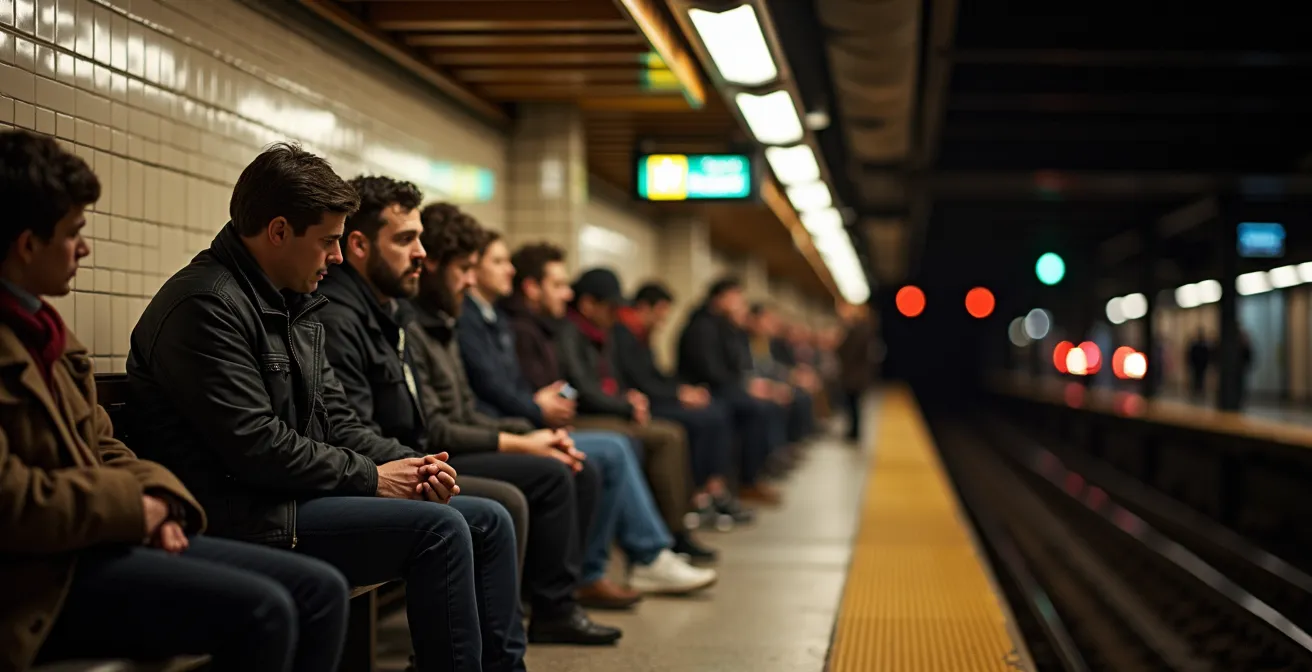
The scene above is a common sight. While artistically lit, the reality of late-night platforms is one of crowds and fatigue. Your strategy should be to bypass these chokepoints. For those exploring the Scarborough exhibits, for instance, a simple tactic is to use the less-congested north entrance at Kennedy Station. Most importantly, your exit strategy should be set before you even begin your night. Set an alarm for 2:30 AM; this is your signal to start moving toward your chosen departure point, beating the mass exodus that inevitably follows the final moments of the festival.
Finally, technology is your ally. Download the TTC service alerts app before 7 PM to get real-time updates on delays or disruptions, allowing you to pivot your logistical choreography on the fly.
Classic collection or contemporary edge: which gallery anchors your art trip?
Every successful Nuit Blanche route needs an anchor—a central zone or institution that serves as the gravitational heart of your evening. This choice is the most significant strategic decision you will make, as it dictates your geography, your energy expenditure, and the very character of your experience. The fundamental question is whether to gravitate towards a “Blockbuster Hub” or a “Hidden Gem” zone. The former offers a high density of spectacular, large-scale works, while the latter promises intimacy and discovery. There is no right answer, only the one that is right for *you*.
To make this decision, you must weigh the trade-offs with brutal honesty. A blockbuster zone, like the waterfront, promises iconic photo opportunities and a palpable social energy. The trade-off is significant: massive crowds and potential wait times of 30-60 minutes for a single popular installation. Conversely, focusing on independent projects in less-trafficked areas offers a more contemplative experience, walk-through access, and even the possibility of direct conversations with artists. This is a choice between grand spectacle and personal discovery.
This comparative analysis, drawn from an overview of the festival’s layout, can help you decide:
| Aspect | Blockbuster Hub (Waterfront) | Hidden Gem (Independent Projects) |
|---|---|---|
| Crowd Density | 80+ projects with massive queues | Smaller audiences, intimate settings |
| Wait Times | 30-60 minutes for popular installations | Walk-through access, minimal waiting |
| Photo Opportunities | Iconic shots with Lake Ontario backdrop | Unique, less-photographed perspectives |
| Artist Interaction | Limited due to crowds | Direct conversations possible |
| Experience Type | Grand spectacle, social energy | Personal discovery, contemplative |
Case Study: The Contemporary Edge of Performance
For those leaning towards a contemporary edge, consider an anchor like the Toronto Dance Theatre. A piece like Italian choreographer Michele Rizzo’s 12-hour performance offers a unique form of artistic endurance. Inspired by “pedestrian movements”—the everyday actions of rushing for a bus or walking home—it transforms the mundane into a captivating spectacle. Anchoring your night here means committing to a durational, evolving experience, a stark contrast to the quick-hit nature of many installations.
Ultimately, selecting your anchor is an act of self-knowledge. Do you draw energy from a crowd, or does it drain you? Is your goal to see the famous works, or to discover the unknown? Be honest, and choose the path that will fuel, not deplete, your spirit.
The error of trying to cross the whole city instead of focusing on one zone
The single greatest strategic failure at Nuit Blanche is ambition unchecked by reality. The map, with its glittering constellations of art spread from Etobicoke to Scarborough, is a seductive liar. It whispers the possibility of seeing it all, a promise that inevitably leads to exhaustion, frustration, and a night spent largely in transit. The seasoned Nuit Blanche attendee knows the truth: the event is not a city-wide buffet, but a series of distinct, prix-fixe menus. Your task is to choose one menu and savour it.
Committing to a single zone, or at most two adjacent ones, is the cornerstone of a successful night. This “zone focus” strategy transforms your experience from a frantic race into a deliberate exploration. It maximizes your experience density, replacing travel time with engagement time. You’ll walk less and see more, with energy to spare for that final, stunning piece before 3 AM. It allows for spontaneity within a defined area—discovering a smaller work on a side street, or taking an unplanned break—without jeopardizing your entire schedule.
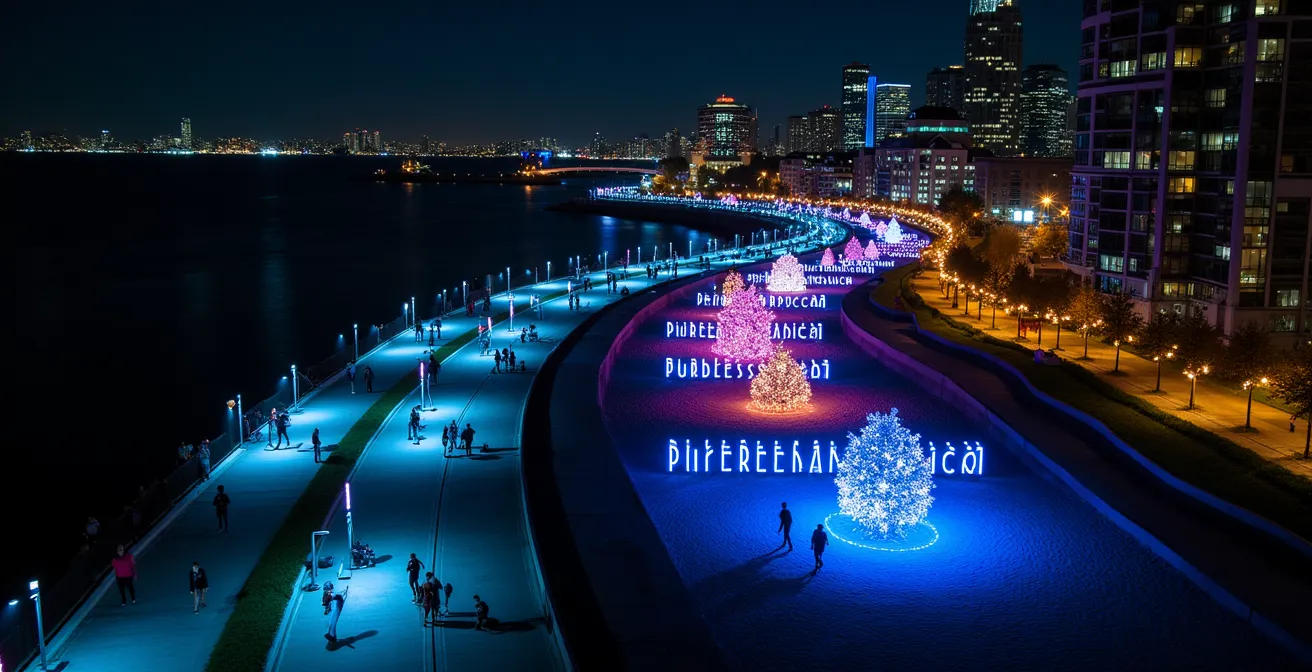
The illuminated map above tempts you to connect the dots across vast distances. Resist. Instead, view it as a collection of separate worlds. Your goal is to choose one world and inhabit it fully for the night. This requires planning. Before 7 PM, when cellular networks become congested, you must have a clear, offline plan. This is not just a list of artworks; it is a battle plan for your artistic endurance marathon.
Action Plan: How to 3-AM-Proof Your Nuit Blanche Zone
- Select your primary zone based on its unique character and TTC accessibility (e.g., Downtown for subways, Scarborough for Blue Night buses).
- Pin a maximum of four ‘must-see’ installations on an offline map, all within a 20-minute walking radius of each other.
- Add three backup installations nearby. These are your pivots in case of unexpected closures or overwhelming queues at your primary targets.
- Identify and mark a designated rest station with washrooms. For the Queen West zone, for example, Theatre Passe Muraille offers a wheelchair-accessible, low-sensory environment.
- Screenshot your custom map with all pins and notes before 7 PM to ensure you have a reliable guide when mobile data fails.
By defining your territory, you reclaim control over the night. You are no longer a victim of the map’s vastness, but the master of your own curated, high-quality art experience.
Where to find 24-hour cafes to refuel during the all-nighter?
In the marathon of Nuit Blanche, a strategic pause is not a sign of weakness; it’s a critical component of artistic endurance. By 1 AM, your energy will wane, your feet will ache, and your critical faculties will dull. A well-timed stop at a 24-hour café is the secret weapon that allows you to reset, recharge, and re-engage with the art for the final push to 3 AM. Toronto’s culinary landscape is your ally in this, offering numerous independent, all-night dining options that are far more soulful than fast-food chains.
The key is to integrate these “refuel stations” into your zone plan from the outset. Don’t wait until you’re depleted to search for a spot. Know in advance where you can find a hot drink, a proper meal, and a place to sit for 30 minutes. The city’s 24/7 diners and cafes are legendary and often become informal hubs for fellow Nuit Blanche participants, adding another layer to the communal experience. Having these locations pinned on your map provides a psychological safety net, freeing you to immerse yourself in the art, knowing that respite is just a short walk away.
Here are some strategically located 24-hour refuel stations to build into your route:
- Downtown Zone: 7 West Cafe (Charles & Yonge) is a classic choice. This multi-level institution serves pasta and all-day breakfast, just a 10-minute walk from the main Yonge-Dundas installations.
- West End: The Lakeview Diner (Dundas West & Ossington) is a retro haven near the Trinity-Bellwoods and Queen West art scenes, perfect for milkshakes and hearty sandwiches.
- Financial District / Waterfront: Fran’s Restaurant is a reliable standby with a full menu all night, conveniently located for those exploring the installations near the lake.
- Scarborough: For those in the east end, Perfect Chinese Restaurant offers a different kind of late-night energy with congee and dumplings, close to the Scarborough art clusters.
- Quick Grab-and-Go: Kettleman’s Bagel Co. has multiple 24-hour locations, offering a fast and efficient option if you don’t want a full sit-down break.
Case Study: 7 West Cafe, an Unofficial Nuit Blanche HQ
For over three decades, 7 West has served as a sanctuary for Toronto’s night owls. As detailed in a review of the city’s best 24-hour spots, it’s a cozy, three-level Victorian house where you can find everything from brunch to burgers. During Nuit Blanche, its 24/7 first floor and rooftop patio become a buzzing hub of conversation and recovery. A late-night poutine here, with its thick-cut fries and rich gravy, is more than just food; it’s a rite of passage and a strategic refuelling for the hours ahead.
By treating your food and rest breaks with the same strategic importance as your art viewing, you ensure you’ll have the stamina to appreciate the night’s final, and often most magical, hours.
Serigraph or cedar: which investment holds its value better?
This question, typically posed in the hushed halls of a commercial gallery, seems out of place amidst the ephemeral chaos of Nuit Blanche. Yet, it offers a crucial lens through which to appreciate the very soul of the event. The art you encounter on this night is, for the most part, not created as a durable commodity. You are not witnessing the creation of a serigraph or a cedar sculpture destined for an auction block. You are participating in temporary, site-specific experiences whose value is not in their potential resale price, but in their immediate, unrepeatable impact.
Understanding this distinction is key to enjoying Nuit Blanche. The festival’s economy is one of memory, not materials. A massive, interactive light installation that will be dismantled at sunrise holds a different kind of value than a painting. Its worth is measured in the collective gasp of the crowd, the shared moment of wonder, the photograph that captures a fleeting alignment of light and shadow. It is an investment in your personal history, a story you will tell, not an asset you will liquidate. Many installations, particularly large-scale public works, are designed to be priceless but not valueless.
The artists are playing with a different currency: engagement, dialogue, and public space transformation. While a serigraph’s value is tied to rarity and the artist’s market, the value of a Nuit Blanche piece is tied to its accessibility and its power to create a shared moment. To ask which holds its value better is to compare two different languages. One speaks of markets and permanence; the other speaks of moments and impermanence. On this one night, the language of the moment is the only one that matters.
So, as you walk the streets, let go of the collector’s mindset. Your reward is not a tangible object, but the richness of the experience itself. This is the unique return on investment that Nuit Blanche offers.
Gritty multiculturalism or historic structure: which tour vibe do you prefer?
Your choice of zone is more than a geographical decision; it’s a curatorial statement about the kind of urban narrative you want to experience. Nuit Blanche doesn’t happen in a sterile “white cube” gallery. It unfolds within the living, breathing fabric of Toronto, and the city itself becomes an unspoken collaborator in every piece. The character of a neighbourhood profoundly shapes how you perceive the art within it. Therefore, a crucial part of your strategy is to ask: what is my preferred vibe? Do I want my art set against a backdrop of raw, contemporary urban life, or framed by the elegant bones of history?
Choosing a “gritty multiculturalism” vibe means heading to zones like Queen West, Parkdale, or parts of Scarborough. Here, art is juxtaposed with the vibrant, chaotic energy of the everyday. An installation in a laneway might be flanked by colourful graffiti and the scent of a dozen different cuisines. This experience is about the dynamic friction between art and life. The city is not a polite backdrop; it’s an active participant, sometimes messy and always authentic. This is the choice for those who find beauty in the unexpected and energy in diversity.
Alternatively, opting for a “historic structure” vibe will lead you to areas like the Distillery District or the Financial District. Here, contemporary art is placed in dialogue with heritage architecture. A light projection might dance across the face of a 19th-century Victorian industrial building, or a soundscape might echo through the soaring atrium of a modern bank tower. This experience is about resonance and contrast. It’s a more controlled, often more awe-inspiring environment where the dialogue between past and present is made explicit. This is the path for those who appreciate curated atmosphere and grand architectural statements.
Neither vibe is superior; they simply offer different narratives. By consciously choosing the story you want to be a part of, you add another layer of personal meaning to your Nuit Blanche journey.
Key takeaways
- Adopt the Mindset of a Marathoner: Treat Nuit Blanche as an endurance event where energy management and strategic pauses are paramount, not a frantic race to see everything.
- Embrace Curatorial Ruthlessness: The key to a great night is not what you see, but what you consciously decide to miss. Choose one zone and explore it deeply.
- Master Your Logistics in Advance: Your transit plan, exit strategy, and refuelling stops are as crucial as your art itinerary. Plan them before 7 PM to avoid network congestion.
Montreal, Toronto, or Vancouver: which city suits your travel style best?
Pitting Canada’s great cultural capitals against each other might seem like a parlour game, but the question reveals a truth about Nuit Blanche Toronto. The city you choose for a cultural pilgrimage reflects the kind of experience you seek. Montreal, with its concentrated Quartier des Spectacles, offers a dense, walkable, and highly curated festival experience. Vancouver’s events are often set against a stunning natural backdrop, blending art with the sublime beauty of mountains and ocean. Toronto’s offering is something else entirely.
Nuit Blanche Toronto is the ultimate expression of the city’s sprawling, decentralized, and multicultural character. It does not offer the cozy convenience of Montreal or the breathtaking vistas of Vancouver. Its unique proposition is one of scale, diversity, and logistical challenge. To “do” Nuit Blanche in Toronto is to embrace the vastness of the GTA, to navigate its distinct neighbourhood identities, and to engage in the very act of artistic endurance this guide has detailed. It is, perhaps, the most demanding of the major Canadian all-night art festivals, but also potentially the most rewarding for the prepared strategist.
The choice is not about which city is “better,” but which experience aligns with your cultural travel style. Do you prefer a curated campus of art, an aesthetic dialogue with nature, or a gritty, city-spanning marathon? If the idea of logistical choreography, zone-based strategy, and artistic endurance excites you, then Toronto’s unique, challenging, and exhilarating brand of Nuit Blanche is unequivocally the event for you. It’s a festival that asks you to be more than a spectator; it demands you become a participant in the very rhythm of the city itself.
Now that you have the strategic framework, the next step is to open the official Nuit Blanche map, not as a daunting list of tasks, but as a field of possibilities from which you will confidently curate your own perfect, unforgettable night.